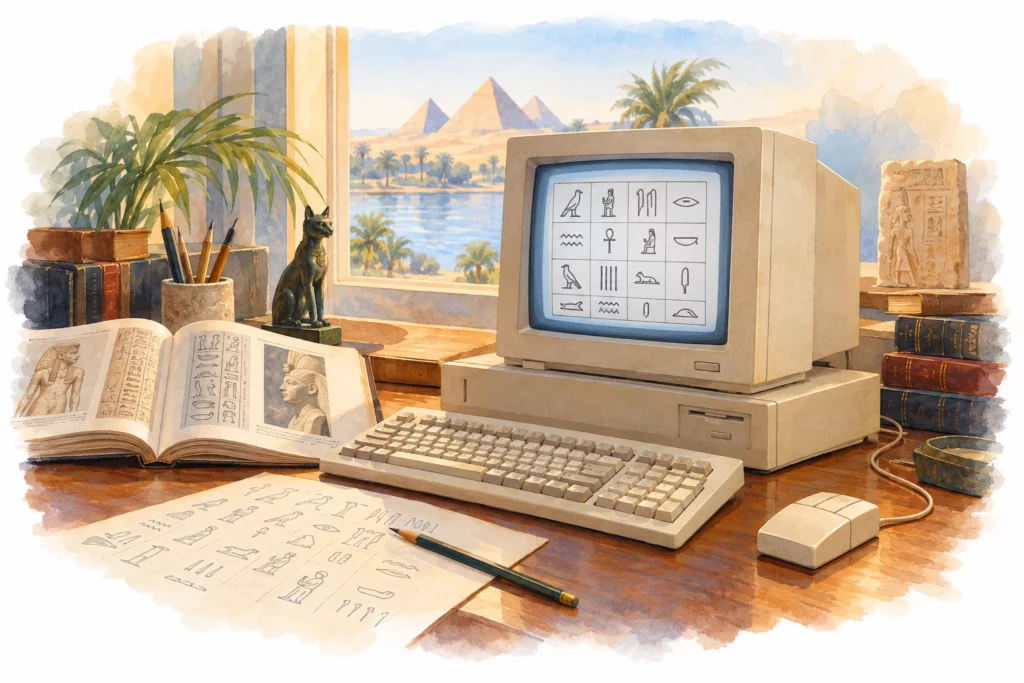
Egyptian inscriptions and words were first reproduced in plates, editions and handwritten slips. From the 1980s onwards, entering them into computers made other searches and comparisons possible. Digital images also give access to details that ordinary photography renders poorly. The different tools need to be told apart to understand what they bring to reading.
| Date | Milestone |
|---|---|
| 1988 | Publication of the Manuel de codage for hieroglyphic texts |
| 2004 | The Thesaurus Linguae Aegyptiae goes online |
| 2009 | Unicode 5.2 includes 1,071 hieroglyphs |
| 2019 | Unicode adds layout characters for composing quadrats |
| 2024 | Unicode 16.0 adds 3,995 signs, many of them Ptolemaic |
Encoding hieroglyphs
Before texts could be searched on a computer, a way had to be found to write them there. The Manuel de codage, published in 1988 by Jan Buurman, Nicolas Grimal, Michael Hainsworth, Jochen Hallof and Dirk van der Plas, offers a shared convention. A sign is identified by its code or by a transliteration value; characters indicate its position in relation to the others.
The asterisk is used to place signs side by side and the colon to stack them. A spelling of the name of Ptah can thus be entered as p*t:H, with the stool and the loaf placed above the flax wick. The code therefore contains information about the signs and about their arrangement.
Software turns this input into hieroglyphs laid out on the page. JSesh, free software developed by Serge Rosmorduc, is widely used in Egyptological publications. On screen, it carries on the care given to the visual arrangement of writing.
Unicode took in 1,071 hieroglyphs in 2009, then composition characters in 2019. In September 2024, version 16.0 added 3,995 signs, notably from the late repertoire. These historical additions bring the total to more than 5,000 encoded signs. They give these forms a place in a common system for exchange and display; knowing their code is no substitute for knowing how to read them.
Documents cited: The builders of Egyptology · How hieroglyphs work · Ptolemaic hieroglyphs
Online corpora
The Thesaurus Linguae Aegyptiae continues the Berlin dictionary. It makes it possible to examine the attestations of a word in texts that are transliterated, translated and organised for research. The old slips thus find new readers and can be set alongside new data.
| Resource | Institution | Content |
|---|---|---|
| Thesaurus Linguae Aegyptiae (TLA) | Berlin-Brandenburg Academy of Sciences and Humanities and Saxon Academy of Sciences in Leipzig | Egyptian texts transliterated, translated and lemmatised; digitised slips of the Berlin dictionary |
| Ramses Project | University of Liège | large annotated corpus of Late Egyptian texts |
| Trismegistos | KU Leuven | directory of texts, papyri and places of Graeco-Roman Egypt |
| Digital Giza | Harvard University | archives of the Giza excavations, photographs, plans and 3D models |
| Karnak database | CNRS and the Egyptian Ministry of Antiquities (CFEETK) | inscriptions and decoration of the temples of Karnak |
The Ramses Project, in Liège, deals with annotated Late Egyptian texts. Trismegistos gathers information on the documents and places of Graeco-Roman Egypt. Digital Giza, at Harvard, brings together excavation archives, photographs, plans and models of the Giza plateau. The Karnak database gives access to the inscriptions and decoration of the site. These resources answer different questions: you have to choose the one that actually documents what you are looking for.
Seeing what the eye can no longer see
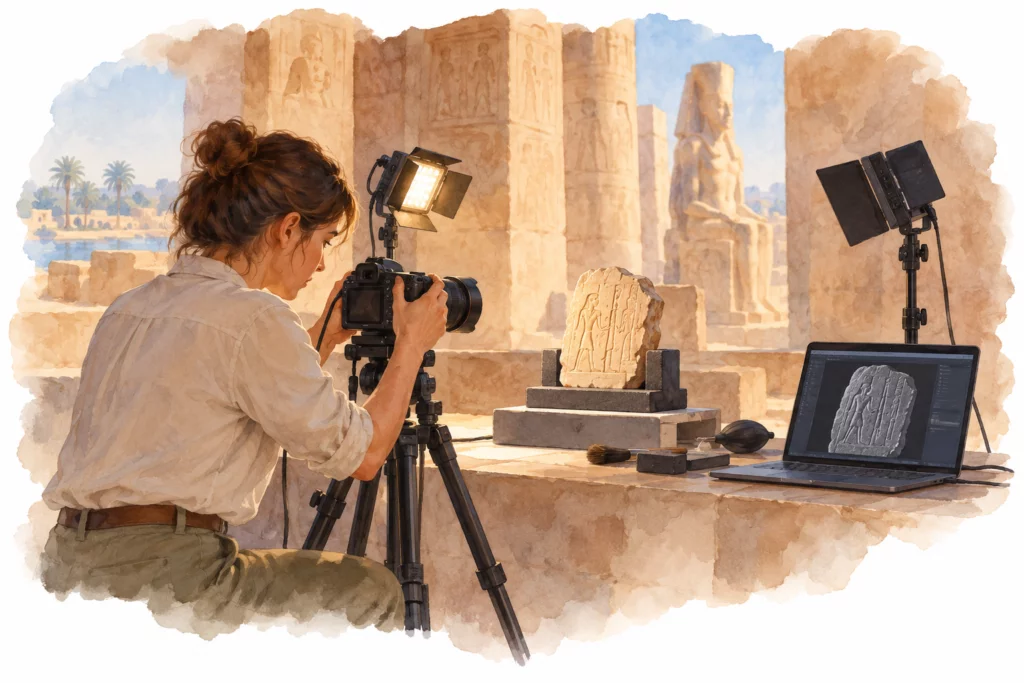
Digital imaging can also improve observation. With RTI, a surface is photographed under many different lights. On screen, the light can be moved to examine a very faint stroke or a worn incision. What escaped a single photograph sometimes becomes more legible.
Photogrammetry uses many shots to build a three-dimensional model of an object or a wall. Its surface can be examined from several angles and a documented state of the monument preserved. The quality of the model depends on the images, how they are processed and the checks made on the measurements.
Multispectral techniques and luminescence can distinguish traces of ink or pigment that are hard to see in ordinary light. Egyptian blue, for example, has a characteristic infrared luminescence. These methods work on what the surface still preserves; they do not bring back material that has been entirely lost.
The facsimile of the tomb of Tutankhamun, installed in 2014 near Howard Carter’s house, also uses these documentation methods to present the walls. The reproduction gives access to a recorded state of the monument. It does not replace all the observations that can be made on the materials of the original.
What digital tools change
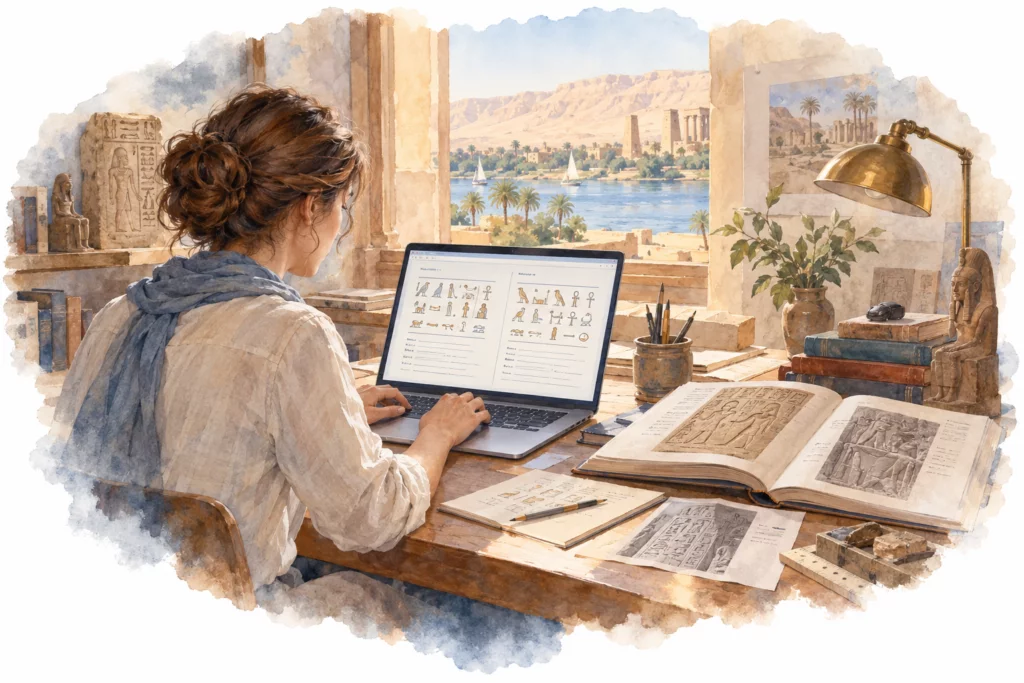
A lexical search can now quickly bring together attestations kept in several collections. The study of spellings also benefits from the images and records available. The result then calls for an interpretation based on the language and the context of the documents.
These resources make archives accessible outside specialist libraries. The reader can examine an image, consult a transcription and find the reference of a translation. Their value lies in allowing this return to the documents, even when we cannot yet read them ourselves.
Towards artificial intelligence
Annotated images and encoded texts also serve as examples for machine learning programs. The next article examines the tasks already studied, the results obtained and the difficulties that remain, particularly for cursive scripts.
Documents cited: Artificial intelligence
Sources
- Jan Buurman, Nicolas-Christophe Grimal, Michael Hainsworth, Jochen Hallof and Dirk van der Plas, Inventaire des signes hiéroglyphiques en vue de leur saisie informatique. Manuel de codage des textes hiéroglyphiques en vue de leur saisie sur ordinateur, Paris, De Boccard, Mémoires de l’Académie des inscriptions et belles-lettres, n. s. 8, 1988 (in French).
- Unicode Consortium, announcement of Unicode 16.0, 10 September 2024.
- Thesaurus Linguae Aegyptiae, Berlin-Brandenburg Academy of Sciences and Humanities.
- Ramses Project, University of Liège.
- Digital Giza, Harvard University.
- Serge Rosmorduc, JSesh, hieroglyphic editor.