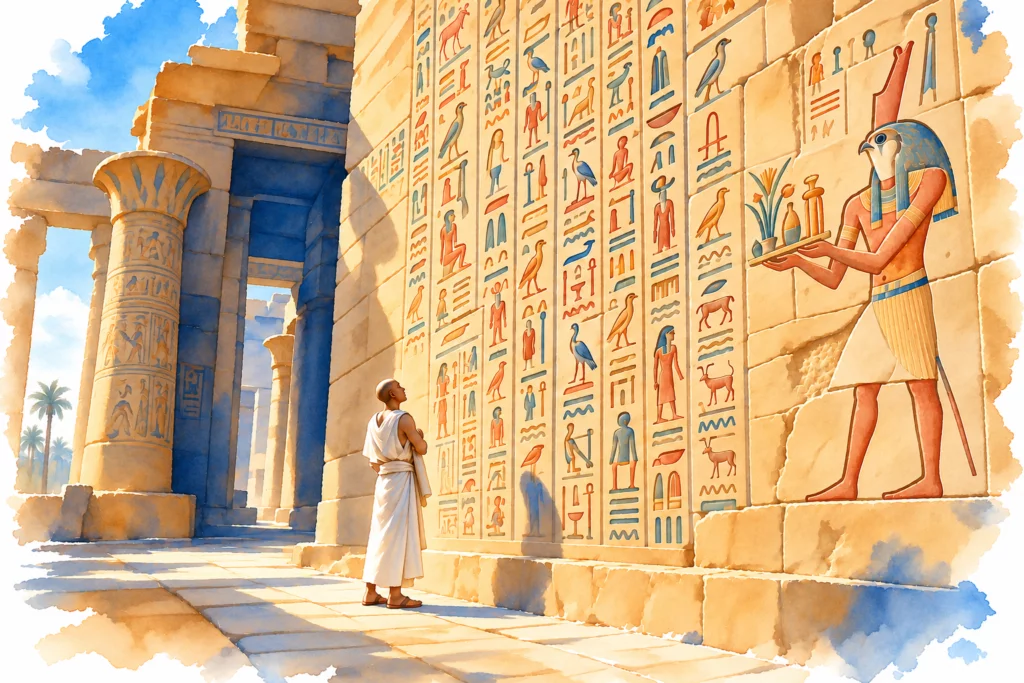
The temples of Edfu, Dendera and Esna preserve particularly abundant inscriptions. They belong to a period when the administration wrote mostly in Greek and Demotic. Hieroglyphs continued to be practised in the learned circles of the temples, which multiplied their forms and values. The quantity of visible texts should therefore not be confused with the number of people able to read them. This learned tradition continued under the Roman emperors, notably at Esna.
| Milestone | Date |
|---|---|
| Alexander the Great in Egypt | 332 BC |
| Foundation of the temple of Edfu | 237 BC (Ptolemy III) |
| Memphis decree (Rosetta Stone) | 196 BC |
| Start of the temple of Hathor at Dendera | 54 BC (Ptolemy XII) |
| Cryptographic hymns of Esna | end of the 1st century AD |
| Last texts at Esna | c. AD 250 (Emperor Decius) |
| Last dated hieroglyphic inscription, Philae | 24 August AD 394 |
Greek kings, Egyptian temples
After Alexander, who arrived in Egypt in 332 BC, the Ptolemies governed the country; Rome succeeded them in 30 BC. Greek and Demotic were used by the administration. The foreign rulers nevertheless presented themselves as pharaohs on the monuments and funded the great sanctuaries.
Edfu, Dendera, Kom Ombo, Esna and Philae preserve the traces of these buildings and their decoration. The temple of Horus at Edfu, built from 237 to 57 BC, offers a particularly well-preserved whole. Its inscriptions describe the festivals, rituals, sacred geography and foundation stories. They even tell us about the temple’s books. Maxence de Rochemonteix, then Émile Chassinat, undertook their publication for the IFAO from 1892.
Documents cited: Everyday scripts
The Rosetta Stone: three contemporary scripts
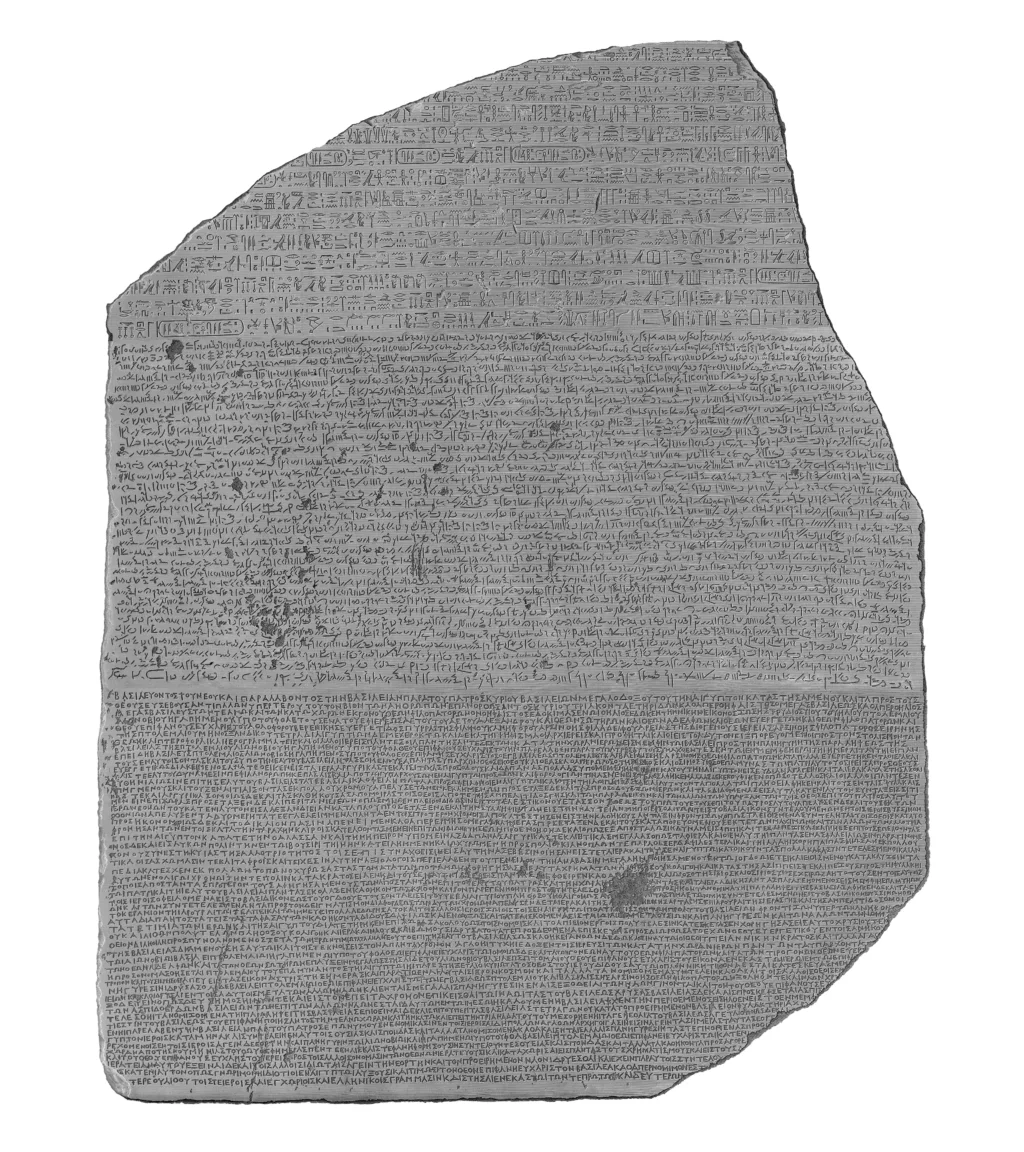
Issued in 196 BC under Ptolemy V, the Memphis decree is reproduced on the Rosetta Stone in two languages and three scripts. Egyptian appears in hieroglyphs in the upper register and in Demotic in the middle; Ancient Greek occupies the bottom of the stone. These three contemporary versions show the coexistence of scripts in Ptolemaic Egypt. The document belongs to a system that was already old, more than three millennia after its first evidence.
How the repertoire exploded
The priests went on using phonograms, logograms and determinatives. They multiplied the possibilities, however: signs were modified or combined, an animal was given a crown, a divine figure an attribute. Inventories reach several thousand signs; the figures of 6,000 to 7,000 often quoted depend on what is counted as a distinct form.
An old sign could also receive a new value. With acrophony, the first consonant of the word depicted becomes the phonetic value of the sign. The same consonant can then be written in many ways. Choosing among these spellings gave the scholar the opportunity to bring into the inscription a reference to the forms and attributes of the god.
The language of the inscriptions takes up the classical Egyptian of the Middle Kingdom, whereas everyday usage had changed. Scholars learnt this traditional Egyptian and the spellings that went with it. The sound value of the signs was sometimes accompanied by references to the attributes of a god.
Documents cited: How hieroglyphs work
Esna: hymns written with a single animal
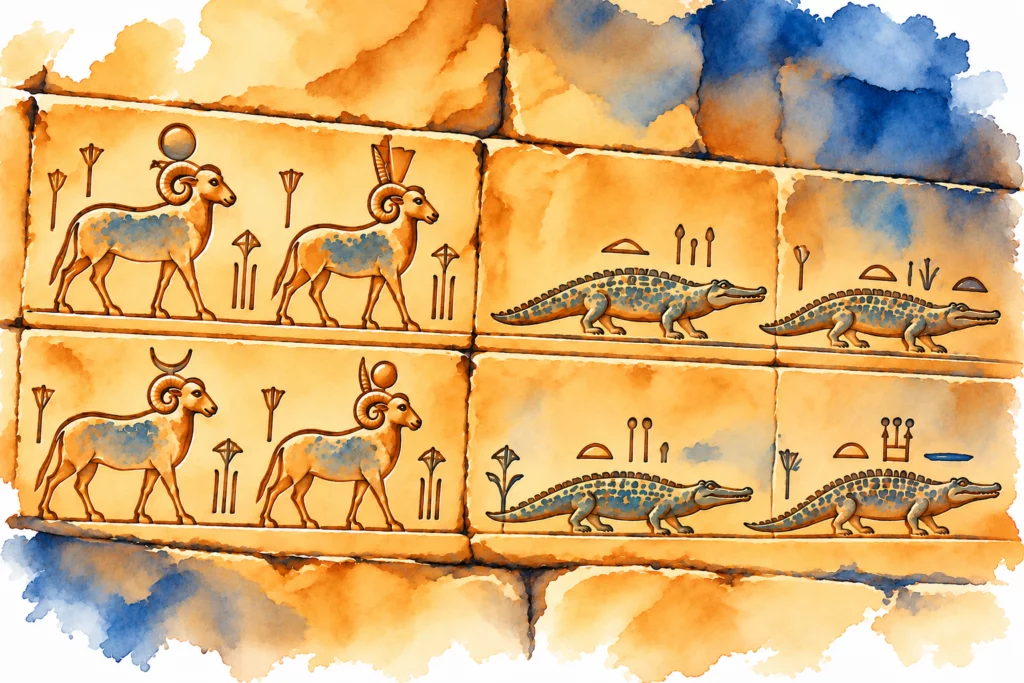
In the pronaos of the temple of Khnum at Esna, two hymns attract particular attention. One is composed almost entirely of rams, the other of crocodiles. They date from the time of Domitian, at the end of the 1st century AD.
The posture, headdress and attributes of the ram or the crocodile change its value in the text. The reader finds the words of a hymn in this succession of animals. The choice of visible forms contributes at the same time to the praise of the god.
Serge Sauneron began publishing the texts of Esna in 1959 and studied these writing devices. The hymn to the rams is now satisfactorily translated. The one to the crocodiles, more difficult and damaged, still has passages whose reading remains uncertain.
Why so much complexity?
Late inscriptions bring together a considerable body of religious knowledge. In a country governed by foreign rulers, the temples were places where an Egyptian tradition was preserved and reworked. Graphic choices made it possible to develop this tradition in the very substance of writing.
Mastery of these spellings set the temple scholars apart and required long training. Their compositions met several religious and social concerns. It would not be enough to explain their complexity solely by a wish to keep other readers out.
This specialisation, however, made transmission dependent on the institutions that carried it. When the temples lost their resources and their priests, it became harder to train those who would still be able to read, compose and carve these texts.
Reading Ptolemaic writing today
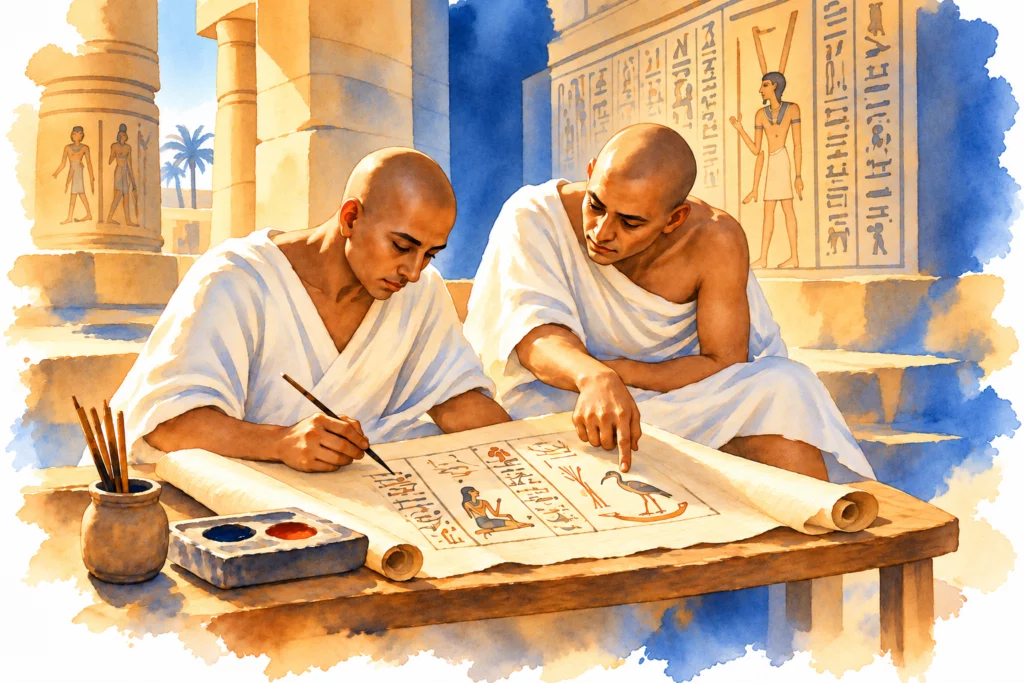
Long judged decadent, these texts have regained their place in research thanks to patient editorial work. Chassinat at Edfu, Chassinat, François Daumas and Sylvie Cauville at Dendera, and Sauneron at Esna contributed greatly to their study. Dieter Kurth produced a reference grammar of Ptolemaic Egyptian and led the Edfu project.
The records of these texts have also been used to identify the late signs now available in computer tools. In 2024, Unicode added nearly 4,000 more of them. The codes make it possible to type and display them; their interpretation still rests on the texts and the studies that document them.
Documents cited: The digital age
Towards the disappearance
The sanctuaries maintained the conditions needed for this training. Under Rome, their decline gradually reduced the number of scholars able to compose and read the inscriptions. The last known dated hieroglyphic inscription is at Philae, where the next article takes us.
See: The disappearance
Sources
- Serge Sauneron, Esna, Cairo, IFAO, 1959–2009, especially L’écriture figurative dans les textes d’Esna (Esna VIII, 1982) (in French).
- Émile Chassinat, Le temple d’Edfou, Cairo, IFAO, MMAF, 1892–1934 (in French).
- Dieter Kurth, Einführung ins Ptolemäische. Eine Grammatik mit Zeichenliste und Übungsstücken, Hützel, Backe-Verlag, 2007–2008.
- Sylvie Cauville, L’offrande aux dieux dans le temple égyptien, Leuven, Peeters, 2011 (in French).
- Andréas Stauder, chapter on Egyptian cryptography, in John Bodel and Stephen Houston (eds), The Hidden Language of Graphic Signs. Cryptic Writing and Meaningful Marks, Cambridge University Press, 2021.
- British Museum, entry for the Rosetta Stone, EA24, decree of 196 BC; Description de l’Égypte, Antiquités, volume V, pls 52–54, for the assembled historical records.
- Description de l’Égypte, Antiquités, volume V, plates 52 to 54, early 19th century.