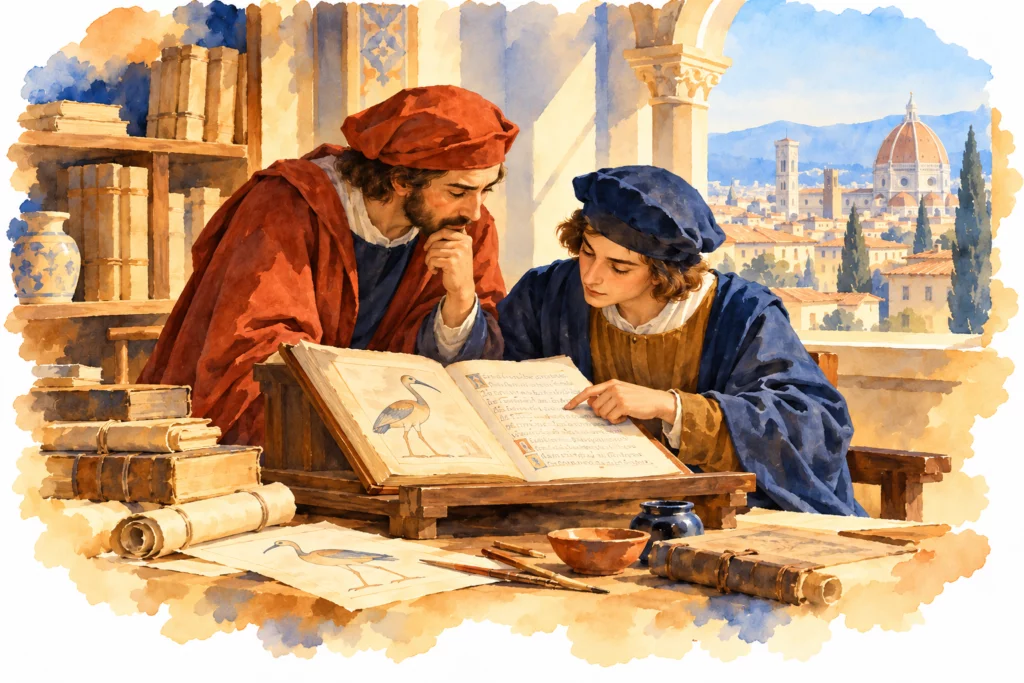
Writers who could no longer read hieroglyphs still recognised their figures: a bird, a sun, a plant. They looked for ideas and symbols in these images. This interpretation shaped attempts at reading for a long time, because it seemed to give the drawings a meaning. It left aside their use to record the sounds of the Egyptian language.
| Date | Milestone |
|---|---|
| 5th century BC – 4th century AD | Greek and Roman writers describe Egypt without reading its scripts |
| 5th century | Hieroglyphica of Horapollo |
| 10th century | Ibn Wahshiyya and the interest of Arab scholars |
| 1419–1422 | A manuscript of Horapollo travels from Andros to Florence |
| 1505 | First printed edition of Horapollo, in Venice |
| 1556 | Hieroglyphica of Pierio Valeriano |
| 1586 | The Vatican obelisk is re-erected in St Peter’s Square |
| 1652–1654 | Oedipus Aegyptiacus of Athanasius Kircher |
| 1761 | The Abbé Barthélemy suggests that cartouches contain names |
| 1797 | Georg Zoëga takes up the hypothesis |
Before the forgetting: the Greek and Roman view
Greek and Roman writers wrote a great deal about Egypt. Their accounts remain precious, but they do not all give us access to a direct reading of the inscriptions. Travellers depended on guides, priests and interpreters; they also questioned the country from the standpoint of their own concerns.
Herodotus, in the 5th century BC, distinguishes a sacred script and a popular script. He reports traditions, including that of Cheops the tyrant, without having deciphered the walls himself. Diodorus Siculus and Strabo in turn pass on information they gathered or compiled. When Diodorus describes signs that are supposed to express the figurative meaning of objects rather than syllables, he contributes to the symbolic view that would later prevail.
Manetho holds a different place: an Egyptian priest under the first Ptolemies, he wrote in Greek a history based on the traditions and archives of the temples. His division into dynasties is still a tool of our chronology. His work, however, reaches us through late summaries whose differences prevent us from recovering his original wording everywhere.
Plato makes Theuth and Thamus the characters of a reflection on memory; Plutarch, around AD 100, offers a continuous account of Isis and Osiris, which he interprets as a philosopher. Their texts shed as much light on their authors’ own questions as on the Egyptian traditions they discuss.
Chaeremon, an Egyptian priest and Stoic philosopher of the 1st century, then Plotinus in the 3rd century, contributed to the idea that the figures could express meanings directly. Thoth was likened to Hermes Trismegistus; the Greek mystical writings associated with him would be taken in the Renaissance for a wisdom going back to the pharaohs.
Some accurate indications nevertheless survive. Clement of Alexandria distinguishes three scripts and mentions a use of signs that has been compared to phoneticism. In the 4th century, Ammianus Marcellinus preserves a Greek translation of inscriptions on an obelisk, attributed to Hermapion and largely correct. These elements are not yet enough to reconstruct the system.
In Rome, the obelisks brought over from the time of Augustus and the cults of Isis made Egypt very present. Under Domitian, new hieroglyphic inscriptions were even composed there, such as those on the obelisk now in Piazza Navona. We should also remember that Egyptian priests themselves practised learned graphic games. Outside writers may have taken a particular use of the script for the way it worked in general.
Documents cited: Ptolemaic hieroglyphs
Horapollo, the finished form of the error
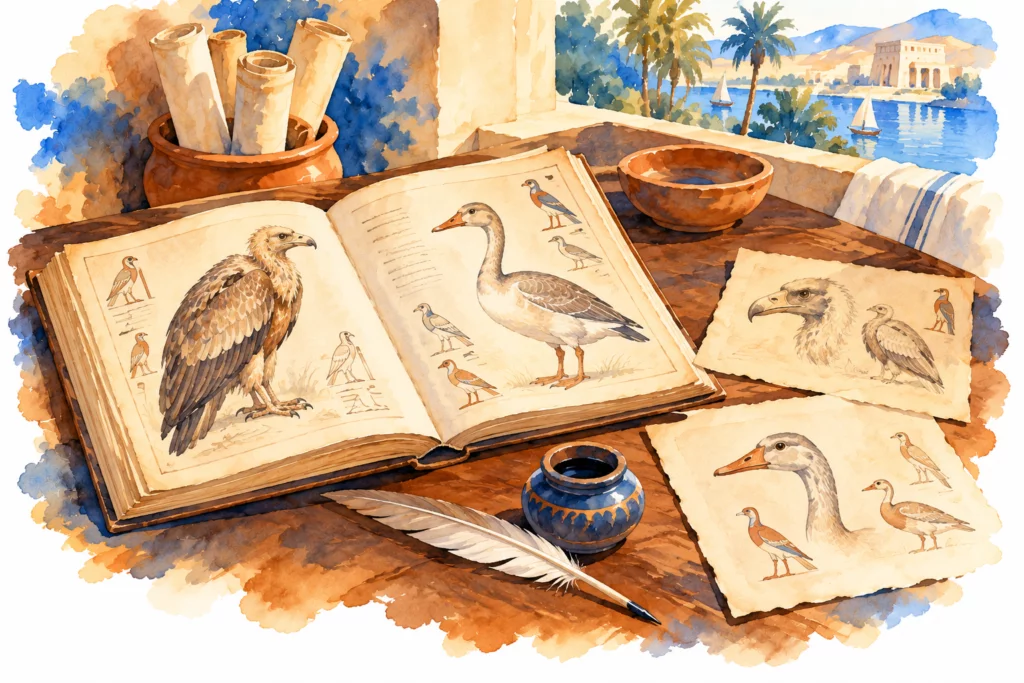
In the 5th century, the Hieroglyphica of Horapollo explain nearly two hundred signs by symbolic meanings. The vulture would stand for the mother because all vultures were believed to be female; the goose would stand for the son because of its attachment to its young. Some values correspond to real uses, but their explanations and the absence of a phonetic reading prevent the language from being recovered.
The treatise thus offers for each image an explanation that the reader can remember. A few values are correct, but the stories that justify them do not explain how the script works. Horapollo’s influence would prolong this search for symbolic meanings long after the disappearance of the script’s last ancient readers.
The Arab scholars
The monuments continued to interest scholars in the Muslim world. In the 10th century, Ibn Wahshiyya proposed values for ancient signs. Okasha El Daly has argued that some hieroglyphic readings were phonetic and correct. This interpretation remains debated: the insights identified are not agreed to amount to a method for reading continuous texts.
This Arab research belongs to the history of attempts at reading, even when it did not lead to a method for translating the texts. It documents an interest in Egyptian scripts well before their rediscovery by European humanists.
The Renaissance of symbols
In 1419, on the island of Andros, Cristoforo Buondelmonti found a manuscript of Horapollo, which reached Florence in 1422. In it the humanists met the Egypt they had hoped for: the keeper of an ancient wisdom expressed in figures. The edition by Aldus Manutius, in Venice in 1505, helped to spread the treatise.
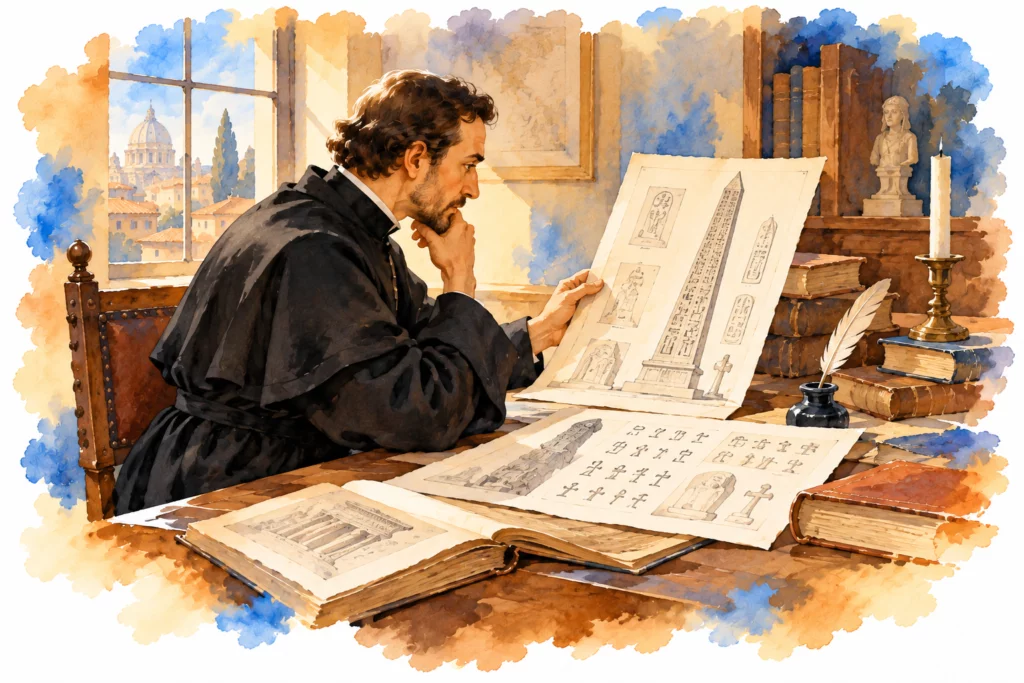
Artists and authors of emblem books drew on it. The Hieroglyphica of Pierio Valeriano, published in 1556, developed a vast repertoire of symbols. In Rome, Sixtus V had the obelisks raised again; the Vatican obelisk was set up in St Peter’s Square in 1586. The inscriptions regained a spectacular place in the city without yet regaining their readers.
Athanasius Kircher, error and insight
In the 17th century, Athanasius Kircher offered long interpretations of the inscriptions in his Oedipus Aegyptiacus. In his hands, a royal name could become a meditation on the divine powers. His ‘translations’ do not render the Egyptian text.
Kircher’s Coptic works, the Prodromus coptus of 1636 and the Lingua aegyptiaca restituta of 1643, nevertheless defend a fruitful connection: Coptic descends from the language of the pharaohs. His interpretations of hieroglyphs are wrong, but this linguistic work prepared a way of recovering the words. Champollion would follow that path.
The 18th century, a return to reason
Between 1737 and 1741, William Warburton considered the practical uses of a human script rather than a language reserved for mystery. In 1761, the Abbé Jean-Jacques Barthélemy suggested that the groups enclosed in an oval frame contained the names of kings or gods. Georg Zoëga took up the question in his 1797 treatise on obelisks and considered phonetic values.
These scholars began to examine repetitions, the frames around certain groups and possible correspondences with names. Their proposals did not yet give a continuous reading. They provided hypotheses that new documents could put to the test.
Towards the Rosetta Stone
The stela discovered at Rosetta in July 1799 bears a decree in hieroglyphs, Demotic and Greek. The Greek text at last made it possible to compare the two Egyptian scripts with a readable version. It would take twenty-three years of research to achieve decipherment.
Documents cited: The Rosetta Stone and the race to decipherment
Sources
- Erik Iversen, The Myth of Egypt and its Hieroglyphs in European Tradition, Copenhagen, 1961 (reissued Princeton University Press, 1993).
- Jurgis Baltrušaitis, La quête d’Isis. Essai sur la légende d’un mythe, Paris, Flammarion, 1985 (in French).
- Okasha El Daly, Egyptology: The Missing Millennium. Ancient Egypt in Medieval Arabic Writings, London, UCL Press, 2005.
- Daniel Stolzenberg, Egyptian Oedipus. Athanasius Kircher and the Secrets of Antiquity, University of Chicago Press, 2013.
- Visite Égypte portraits ‘Witnesses of Antiquity’: Herodotus, Plato, Manetho, Diodorus Siculus, Strabo, Plutarch (in French).