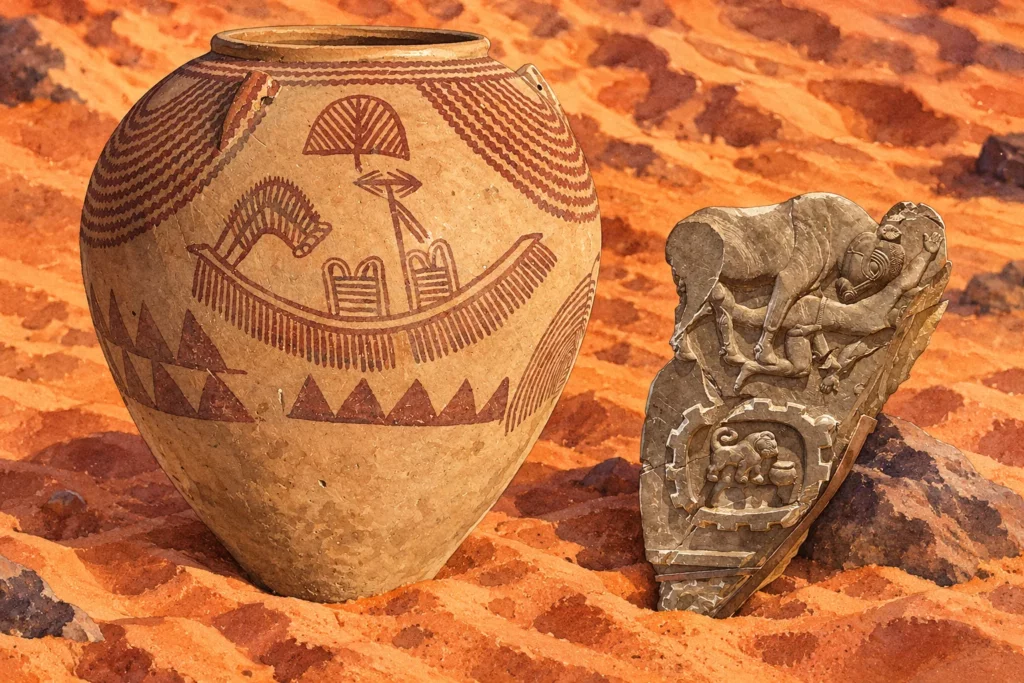
Boats are painted on the vases of Naqada. Their hulls, their oars and the emblems raised above the cabins recur from one object to the next, among animals and figures with raised arms. The first inscriptions will appear later. For the moment, the potters use a repertoire of images, some of whose conventions will last a long time, but whose meaning partly escapes us.
Landmarks: the Naqada culture
Naqada is first of all a site in Upper Egypt. In 1894–1895 Flinders Petrie and James Quibell excavated tombs there whose pottery would make it possible to organise the chronology. Petrie classified the shapes, observed how they changed and built up his ‘sequence dates’. Werner Kaiser, in 1957, then Stan Hendrickx refined this classification into three main phases, Naqada I, II and III.
The dates given remain benchmarks. The radiocarbon work published by Michael Dee and his team in 2013 places the transition from Naqada II to Naqada III between 3377 and 3238 BC. It invites us to tighten a chronology that textbooks readily began around 4000 BC. The formation of the state took place over a few centuries, with transformations that the objects allow us to follow unevenly.
| Phase | Approximate dates | What is painted |
|---|---|---|
| Naqada I | c. 3900–3600 BC | Red pottery with white decoration: geometric patterns, animals, rare human figures |
| Naqada II | c. 3600–3300 BC | Light-coloured pottery with reddish-brown decoration: boats, emblems, figures with raised arms; painted tomb at Hierakonpolis |
| Naqada III | c. 3300–3100 BC | First signs of writing (article 3) |
Naqada I: white on red
Naqada I vases are made of Nile clay, burnished and then painted in white on their red surface. This is known as ‘white cross-lined’ ware. Networks of lines and chevrons at first cover the walls. The repertoire also includes plant motifs, hippopotamuses, crocodiles, gazelles and a few human figures.
Some figures lead dogs; others raise their arms and are shown larger than those around them. The difference in size gives the latter a particular importance. It recalls a well-known device of pharaonic art. This does not allow us to give them the identities or functions of later figures: we can follow a convention without yet knowing whom it refers to.
Naqada II: boats, emblems and raised arms
With Naqada II, the potters used a light calcareous clay, marl, against which the decoration stands out in reddish-brown. The boat becomes one of the most frequent motifs. Its hull is long, its oars numerous, its cabins clearly visible. Ostriches, plants, lines of water and triangles, perhaps mountains, are set around it. On some vases, women with raised arms are shown larger than the men.
A pole raised above the cabin sometimes carries an emblem: a Z-shaped sign, an elephant, hills, horns or a harpoon. Jar EA 36328 in the British Museum shows two boats with different emblems. These small details could make it possible to recognise an affiliation, a place or a protection. Their repetition shows that they are not mere interchangeable ornaments.
Some emblems resemble the standards of the provinces and gods of the pharaonic period. Their continuity has to be examined case by case. The vase does not give us the name of what is meant, and a resemblance is not enough to restore it.
Hierakonpolis: the first painted wall
Around 3500 BC, an important person was buried at Hierakonpolis, ancient Nekhen, in a mud-brick tomb with one plastered and painted wall. Frederick Green uncovered it in 1898–1899. ‘Tomb 100’ preserves the record of the oldest known wall painting in Egypt. We know it mainly from the copy published with Quibell in 1902.
Boats are still present, but other scenes catch the eye. A man raises his mace over three figures; elsewhere, a figure masters two great wild animals rearing on either side. Fights, animals and traps fill the wall. The smiting gesture will be found again on the Narmer Palette, then on pharaonic temples. The ‘master of animals’ recalls the one on the handle of the Gebel el-Arak knife, in the Louvre.
These gestures come before the royal names that we shall be able to read in inscriptions. Power is already depicted in forms that will be taken up again. That does not make the wall a text in which each image could be translated into words.
Marks, palettes, seals: towards repeated signs
On Naqada II vases, marks incised before or after firing stand apart from the decoration: strokes, crosses, schematic animals. Their purpose may have concerned origin, contents or recipient. The repetition and isolation of these marks bring them close to labels, even when we do not know what they refer to.
Cosmetic palettes underwent another transformation. Cut from siltstone to grind malachite and galena in particular, they took on the outlines of animals, then received reliefs. At the end of the period, some became ceremonial objects in which royal power was put on display.
Cylinder seals brought from Mesopotamia or imitated in Egypt bear witness to contacts with peoples who marked goods by impressing an image. They join the vases and palettes in documenting the uses of signs. Yet these objects have their own functions; comparing them does not mean placing them in the obligatory stages of an invention.
An image is not yet writing
A drawing of a boat can be understood without knowing the language of the person who drew it. Reading a word requires something else: recognising that the signs record a language, and in particular its sounds. The rebus principle makes this step possible. In English, a bee followed by a leaf can suggest ‘belief’, although neither drawing represents a conviction.
For Naqada I and II, we cannot demonstrate such a phonetic use. The figures make up scenes; they do not yet give us a sequence of words to read. Even the horizontal registers that will organise so many Egyptian images and texts only become established at the end of the period.
The stable forms and emblems of Naqada therefore already make it possible to recognise and identify. We cannot yet show that they record the words of a language. This limit matters more than the familiarity of some of the drawings.
Towards the first signs
The bone and ivory labels found in tomb U-j at Abydos offer other clues. Signs are combined on them, some with numbers, and phonetic readings have been proposed. ‘The birth of writing’ returns to these small pieces attached to the goods placed in the tomb.
See: The birth of writing
Sources
- Béatrix Midant-Reynes, Aux origines de l’Égypte. Du Néolithique à l’émergence de l’État, Paris, Fayard, 2003 (in French).
- Gwenola Graff, Les peintures sur vases de Nagada I – Nagada II. Nouvelle approche sémiologique de l’iconographie prédynastique, Egyptian Prehistory Monographs 6, Leuven, 2009 (in French).
- Stan Hendrickx, ‘Predynastic – Early Dynastic Chronology’, in E. Hornung, R. Krauss and D. Warburton (eds), Ancient Egyptian Chronology, Leiden, Brill, 2006.
- Michael Dee et al., ‘An absolute chronology for early Egypt using radiocarbon dating and Bayesian statistical modelling’, Proceedings of the Royal Society A 469, 2013.
- David Wengrow, The Archaeology of Early Egypt, Cambridge University Press, 2006.
- James E. Quibell and Frederick W. Green, Hierakonpolis II, London, 1902.