The sky in human form
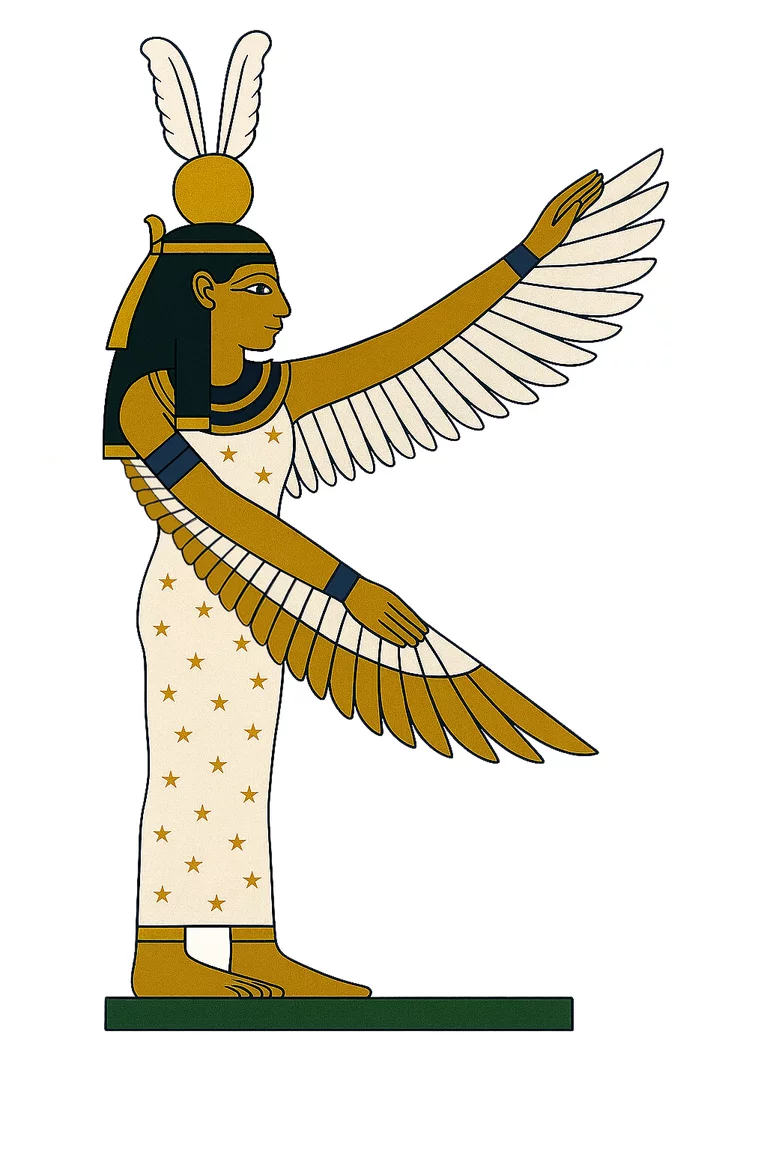
Nut is the goddess of the sky. In a famous image her arched body stretches above the earth, while her hands and feet touch the limits of the world depicted. Stars can be scattered over her silhouette. This representation does not turn the sky into a character in the sense of an individual portrait: it gives a body to the expanse that envelops the living. The British Museum recalls the link between Nut, the vault of heaven and the rhythm of the sun.
In the genealogy of Heliopolis, Nut is linked to Geb, the earth, and her children include Osiris, Isis, Seth and Nephthys. This divine family links sky, earth and the generations that organise the world. In scenes of the separation of sky and earth, Shu, associated with the air, stands between Nut and Geb: his gesture makes visible the space in which life can unfold.
The journey of the sun
Some stories say that Nut swallows the sun in the evening and gives birth to it every morning. This cycle gives the sun’s disappearance at night a temporary meaning. Light passes through a hidden phase before it reappears. This is not a scientific description of astronomy, but an image-rich and ritual language for expressing the regularity of the day. The goddess holds together the starry night and the promise of dawn, two inseparable aspects of her celestial role.
The link between Nut and Ra helps explain how often images of the sky appear in tombs. The deceased hopes, like the sun, to pass through the night and know a new morning. This analogy does not imply that every tomb illustrates exactly the same text. Ceilings, coffins and papyri offer different compositions. The goddess can be an immense sky, a welcoming mother or a winged protector. Each medium stresses a particular relationship with the dead.
A presence beside the deceased
The Metropolitan Museum describes a coffin on which the wings of Nut accompany an invocation asking the goddess to cover the face of the dead woman. The work shows the importance of an image placed very close to the body. The sky is no longer only above the landscape; it goes with the person into the tomb. The written word, the colour and the position of the figure together contribute to the protection hoped for. A material detail of the coffin thus becomes essential to its religious meaning.
Nut appears in several forms depending on the function of the image: a starry vault above the earth, a winged figure on a coffin or a mother welcoming the deceased. These representations link the wrapping of the body to the hope of rebirth. The sky goddess thus has a place in individual destiny: the renewal of the sun offers a model for the life hoped for after death.
The coffin cited by the museum is a reminder that celestial images were sometimes a few centimetres from the face of the dead. This material closeness changes how the scene is read. The immense vault becomes an intimate wrapping. To understand a figure of Nut, then, we must ask not only what it represents, but also where it was placed and who could see it.
Sources and references
Reference works
- Richard H. Wilkinson, The Complete Gods and Goddesses of Ancient Egypt, London, Thames & Hudson, 2003, entry Nut
- Christian Leitz (ed.), Lexikon der ägyptischen Götter und Götterbezeichnungen, 8 vols, Leuven, Peeters, 2002–2003 (Orientalia Lovaniensia Analecta 110–116 and 129)