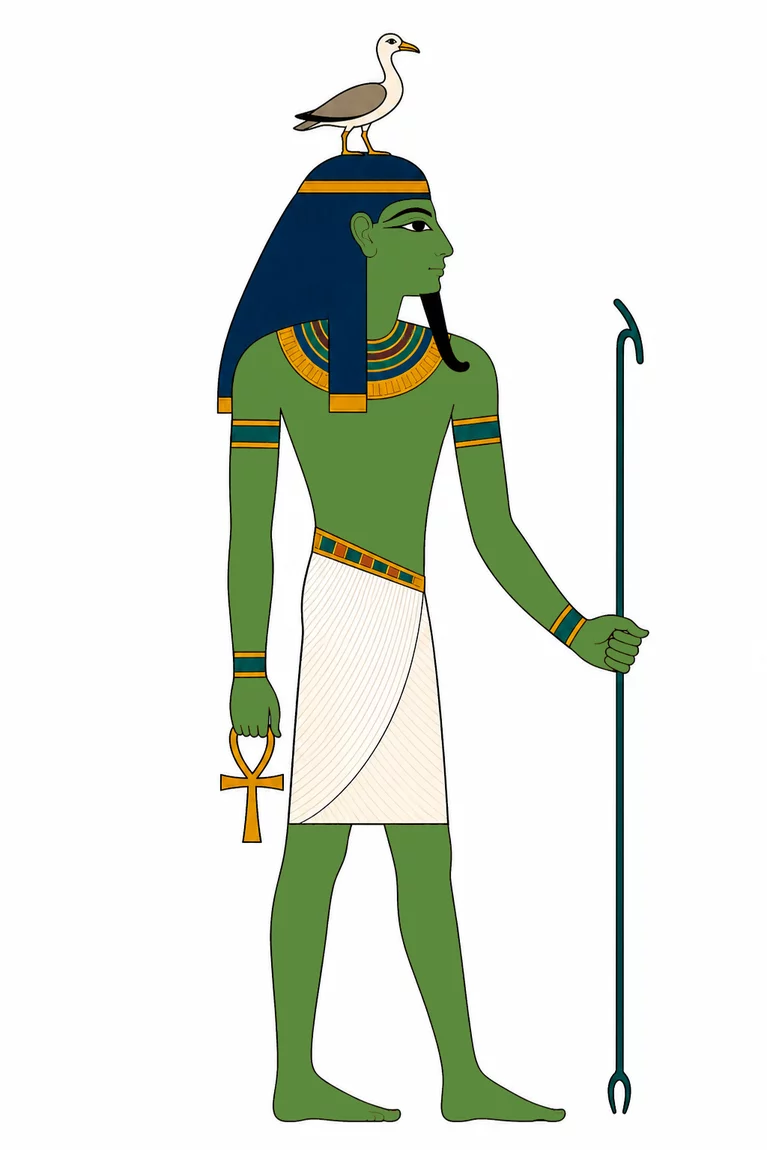
Geb personifies the earth in several religious traditions of ancient Egypt. Son of Shu and Tefnut, he belongs to the great divine family of Heliopolis. His consort is Nut, the sky. When Egyptian art shows them together, Geb can lie stretched out beneath the vault formed by her body. This image gives human form to the space where people live, plants grow and the dead rest.
The earth beneath the sky
The separation of Geb and Nut by their father Shu is a central motif of the Heliopolitan creation stories. The air opens a space between earth and sky, the condition for a habitable world. Geb is therefore not just the ground underfoot: he is part of the very architecture of the cosmos. An ancient scene can show him lying down, raising his head and one arm towards Nut. Other images show him standing, sometimes crowned with a goose, a sign that helps to identify his name.
The green colour found in some representations refers to vegetation and fertility. Plants come out of the earth, minerals are found in it and snakes live there. The Global Egyptian Museum nonetheless stresses a more ambivalent side of Geb: the earth also receives the dead. In funerary texts, entering the ground can arouse the fear of decay as much as the hope of a new existence. The same god combines fertility and confinement.
A line of gods
In the genealogy of Heliopolis, Geb and Nut are the parents of Osiris, Isis, Nephthys and Seth. This descent places the earth at the origin of the great stories of kingship, death and rebirth. The family tie should not make us forget the variety of local versions: not every Egyptian tradition arranges the gods in a single, stable tree.
Geb also appears in the stories of the conflict between Seth and Horus. Some versions present him as the arbiter of the division of the land. The account preserved on the Shabaka Stone mentions a first division, then the handing over of the whole land to Horus. Earthly kingship could thus be thought of as an inheritance from Geb. The expression ‘heir of Geb’ applied to the ruler does not mean that this god was seen as a historical king; it places power within a mythical order.
Reading the images and texts
Our drawing shows him standing, with green skin and the goose that can serve as his emblem. It complements, without replacing, the well-known ancient image of the god lying beneath Nut. Egyptian visual conventions do not fix a single portrait for each deity. They choose signs suited to a medium and a purpose. A cosmological scene, a royal inscription and a funerary vignette do not tell exactly the same story.
Geb is readily associated with the stability of the material world, but the documents show a figure less peaceful than he appears. The god of the earth feeds the living, receives the dead and can settle a quarrel between heirs. His functions link the physical landscape to the memory of the generations. This is why his name appears in very different religious contexts.
Looking at the Nile valley, one can understand the importance of this symbol: the black earth fertilised by the flood, the desert, the burial grounds and the cultivated land belong to the same tangible world. Geb personifies this concrete base without being reduced to a mere backdrop beneath the other gods.
Sources and references
Reference works
- Richard H. Wilkinson, The Complete Gods and Goddesses of Ancient Egypt, London, Thames & Hudson, 2003, entry Geb
- Christian Leitz (ed.), Lexikon der ägyptischen Götter und Götterbezeichnungen, 8 vols, Leuven, Peeters, 2002–2003 (Orientalia Lovaniensia Analecta 110–116 and 129)