The moisture of the first world
Tefnut holds an ancient place in the great divine family of Heliopolis. The British Museum presents her as a power of moisture, daughter of Atum and partner of Shu. In this story of origins, their couple precedes Geb, the earth, and Nut, the sky, who are their children. Moisture should not be imagined as mere rain described in a weather forecast. It represents a condition of the living world in a way of thinking where elements and deities answer one another. The air of Shu and the moisture of Tefnut make it possible to tell how a habitable space came into being.
With Shu, Tefnut forms the first couple born of Atum in the genealogy of Heliopolis. Their children, Geb and Nut, then give birth to the following generations of the Ennead. Moisture and air thus come before earth and sky in this account of how the world was ordered. Other religious centres, such as Memphis or Hermopolis, developed their own traditions of origins.
A solar lioness
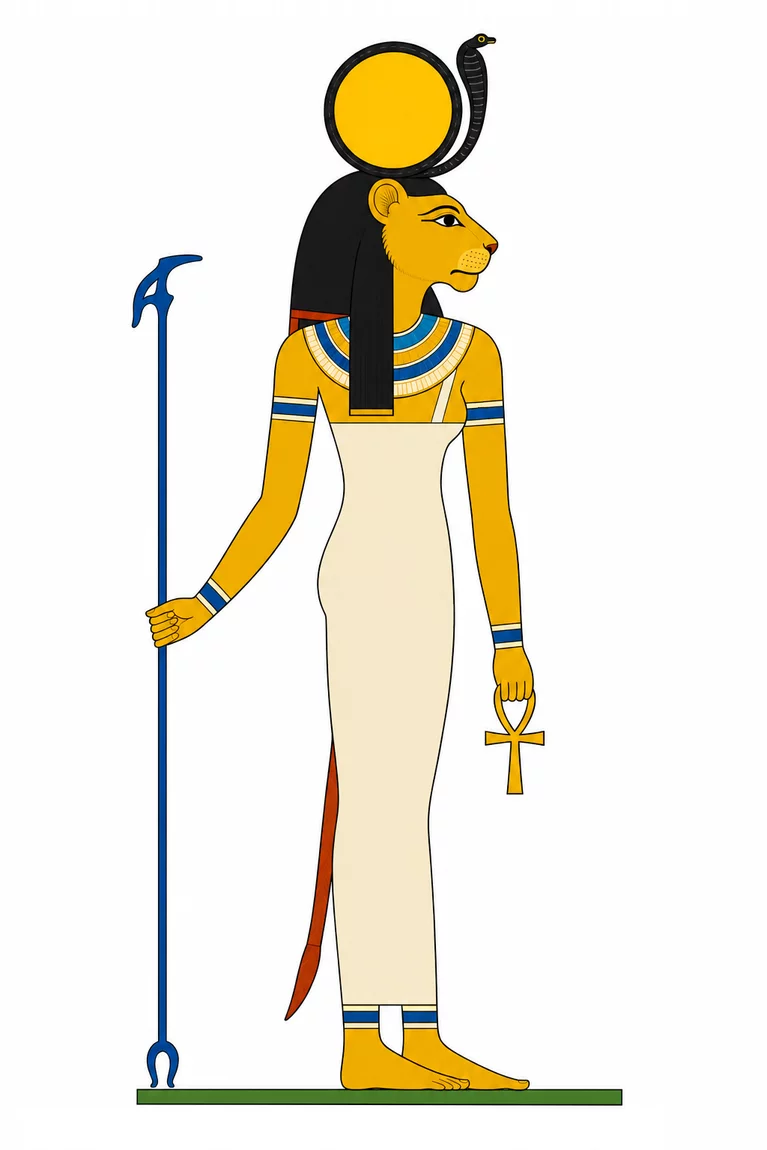
Tefnut can be shown as a lioness or as a woman with a lioness’s head, crowned with the sun disc and the uraeus. These attributes express her solar character and her protective power. They are also found with other goddesses, notably Sekhmet. To tell these figures apart on an ancient object, the image must be compared with its inscription, its provenance and the deities that accompany it.
The strength of the lioness qualifies the idea of a goddess who would be nothing but gentle moisture. Egyptian deities do not always allow themselves to be reduced to a single word. In some stories of a Distant Goddess, a dangerous lioness leaves Egypt and then returns after being calmed. Late versions attach different names to this figure; we should therefore avoid telling all these stories as a single episode of Tefnut. Thoth sometimes appears in the stories of the return, which links skilful speech to the calming of a fearsome power.
Reading the sources and images
A papyrus in the Metropolitan Museum shows Tefnut with Shu and other gods in a solar barque. Her presence in this group shows the goddess beyond an abstract family tree. Religious images bring powers together to act in a precise context, here a scene linked to the course of the sun. The association with Ra on an object does not mean that all lioness goddesses become indistinguishable. Each figure keeps a name, a place and a function that can be read in the composition.
The genealogy of Heliopolis, the stories of the Distant Goddess and the scenes of the solar barque shed light on complementary aspects of Tefnut. A power of the origins, she also takes part in the maintenance and renewal of the world. Her lioness form is a reminder that the moisture life needs and the fearsome energy of the sun can belong to the same deity.
Sources and references
- British Museum, Tefnut
- British Museum, gods and goddesses of Egypt
- Metropolitan Museum, Tefnut and Shu in a barque
Reference works
- Richard H. Wilkinson, The Complete Gods and Goddesses of Ancient Egypt, London, Thames & Hudson, 2003, entry Tefnut
- Christian Leitz (ed.), Lexikon der ägyptischen Götter und Götterbezeichnungen, 8 vols, Leuven, Peeters, 2002–2003 (Orientalia Lovaniensia Analecta 110–116 and 129)