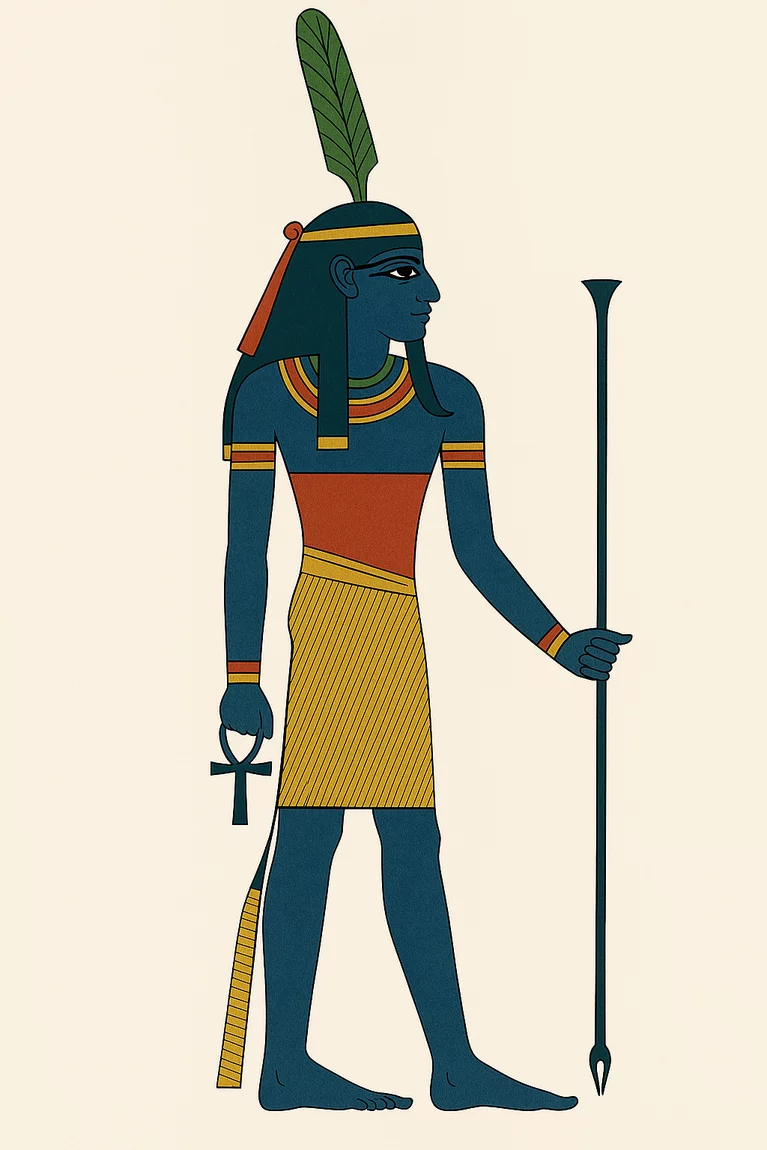
The air between sky and earth
Shu is associated with the air and with the space that separates the sky from the earth. In a tradition of Heliopolis, he comes forth from Atum together with Tefnut. Their children are Geb and Nut. The Metropolitan Museum explains that Shu lifts up the sky, allowing life to take place between the two expanses. This gesture gives a visible form to an abstract idea: a habitable world requires distance, light and breath.
The British Museum shows this separation in images where Nut arches over Geb while Shu stands between them. A composition of this kind does not tell of a datable event; it expresses a structure of the cosmos. Sky, earth and air become divine persons whose positions explain their relationships. The body of Shu literally fills the space that allows the world to unfold. His place in the image is therefore as important as his attributes.
The image of a gesture
On a small amulet in the Metropolitan Museum, Shu kneels with his arms raised and supports a disc above him. The museum sees in this posture the gesture of separating sky and earth. The size of the object shows that a cosmic idea could be represented in a portable figure. It was not reserved for the great ceilings of temples. The gesture is enough to recall a function that longer texts set out in other ways.
Shu can be shown standing, wearing a feather on his head, or kneeling with his arms raised to support the sky. These postures express different ways of making his function visible. To recognise him in an ancient scene, the presence of Geb and Nut, the gesture performed and the inscribed name are complementary clues.
Breath and generation
In the genealogy of Heliopolis, the relationship of Shu with Tefnut joins air and moisture. Modern words help us approach their domains, but they do not replace the ritual texts. Divine kinship describes an order of generation and an organisation of the world; it does not resemble an everyday family story. Shu is at once a member of this line and the spatial condition that makes it possible to distinguish his descendants, sky and earth.
This page invites us to see the empty space between the figures as an active element. In Egyptian art, space is not necessarily a mere blank background. Between Nut and Geb, Shu makes perceptible the air we do not see directly. The god gives form to an elementary human experience, breathing, and to an immense cosmological question, how the world took on its structure. This double scale is his strength.
The role of Shu appears with particular force when he is shown with Nut and Geb. Alone, he may seem a god of air who is hard to represent; placed between them, his action becomes instantly legible. The visual composition works almost like an explanation. Our isolated portrait therefore invites a return to the complete scenes and the dated objects. That is where divine relationships stop being a list of names and become an image of the world.
Sources and references
- Metropolitan Museum, amulet of Shu
- British Museum, creation and feminine power
- British Museum, gods and goddesses
Reference works
- Richard H. Wilkinson, The Complete Gods and Goddesses of Ancient Egypt, London, Thames & Hudson, 2003, entry Shu
- Christian Leitz (ed.), Lexikon der ägyptischen Götter und Götterbezeichnungen, 8 vols, Leuven, Peeters, 2002–2003 (Orientalia Lovaniensia Analecta 110–116 and 129)