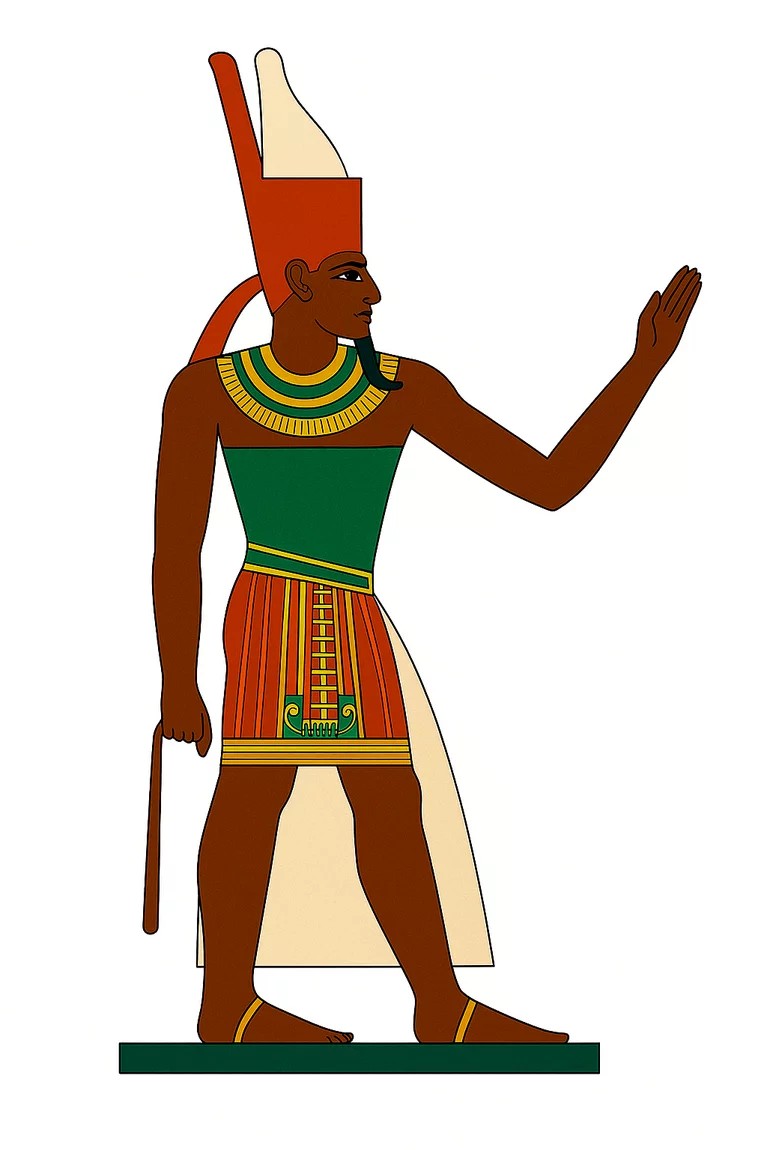
Atum holds a central place in the creation traditions of Heliopolis. He appears at the beginning, when the ordered world does not yet exist, and then gives birth to the first divine powers. His name is associated with the idea of completion, which also suits his place in the solar cycle: he can represent the evening sun. Creator and figure of the daily decline are not two incompatible characters. The Egyptians readily thought of origin and return, the first morning and the end of the day, as one continuity.
The beginning at Heliopolis
Heliopolis, Iunu in Egyptian, was a great centre of the solar cult. In its theology, Atum rises from the primordial waters, personified by Nun. He appears on a first rise of land, often called the primeval mound. The site of Heliopolis also associated the benben stone with this beginning and with the first light. This story is not a geological description of the landscape: it gives an intelligible form to the passage from an undifferentiated state to an organised world.
Egyptian creation stories cannot be reduced to a single version. Those of Memphis, Hermopolis or Thebes stress other gods and other images. Atum dominates the theological construction of Heliopolis without erasing these parallel traditions. They coexist in the texts and could even be brought together by the priests.
The first children and the Ennead
Atum brings forth Shu and Tefnut, the first divine couple of the great Ennead of Heliopolis. The sources tell of this act in several ways, sometimes with direct bodily images. It is better to read them as different expressions of the god’s creative capacity than to look for a single mechanism. Shu and Tefnut in turn beget Geb and Nut, the earth and the sky. The genealogy then unfolds further with other major figures.
The term ‘Ennead’ refers to a group of nine gods, but the groups actually named can vary. The divine family serves above all to organise the relationships between the parts of the world. It tells how an initial principle gives way to a habitable space, to an earth, a sky and the cycles of life.
Atum in the course of the sun
Atum can be linked with Ra. The Pyramid Texts already know the form Ra-Atum. Later, solar theologies often associate Khepri with the sun coming into being in the morning, Ra with the light at its full power and Atum with the evening sun. This reading helps to understand his name linked to completion, but it does not oblige us to believe that the three gods were merely interchangeable names. Each form keeps its own contexts and images.
The sun disappears in the west without being destroyed; it crosses the night before a new rising. In this movement, Atum can express the end of a day that prepares a new beginning. Some funerary compositions extend this idea further, to the ultimate return of the world to its primordial state. There the end answers the origin.
Recognising and understanding him
Atum is often shown in human form, notably with the crowns of kingship. The illustration on this page shows him standing, wearing a double crown and raising his hand. It does not reproduce a particular monument. The inscription, the scene and the findspot remain indispensable for identifying an ancient Atum with certainty: the royal crowns do not belong to him alone.
The links of Atum with Shu, Tefnut and the sun bring together two aspects of his power. At Heliopolis he gives birth to a divine line; in the solar cycle he represents the completion of the day. The creation of the world and daily renewal thus answer one another in the traditions devoted to him.
Sources and references
Reference works
- Richard H. Wilkinson, The Complete Gods and Goddesses of Ancient Egypt, London, Thames & Hudson, 2003, entry Atum
- Christian Leitz (ed.), Lexikon der ägyptischen Götter und Götterbezeichnungen, 8 vols, Leuven, Peeters, 2002–2003 (Orientalia Lovaniensia Analecta 110–116 and 129)