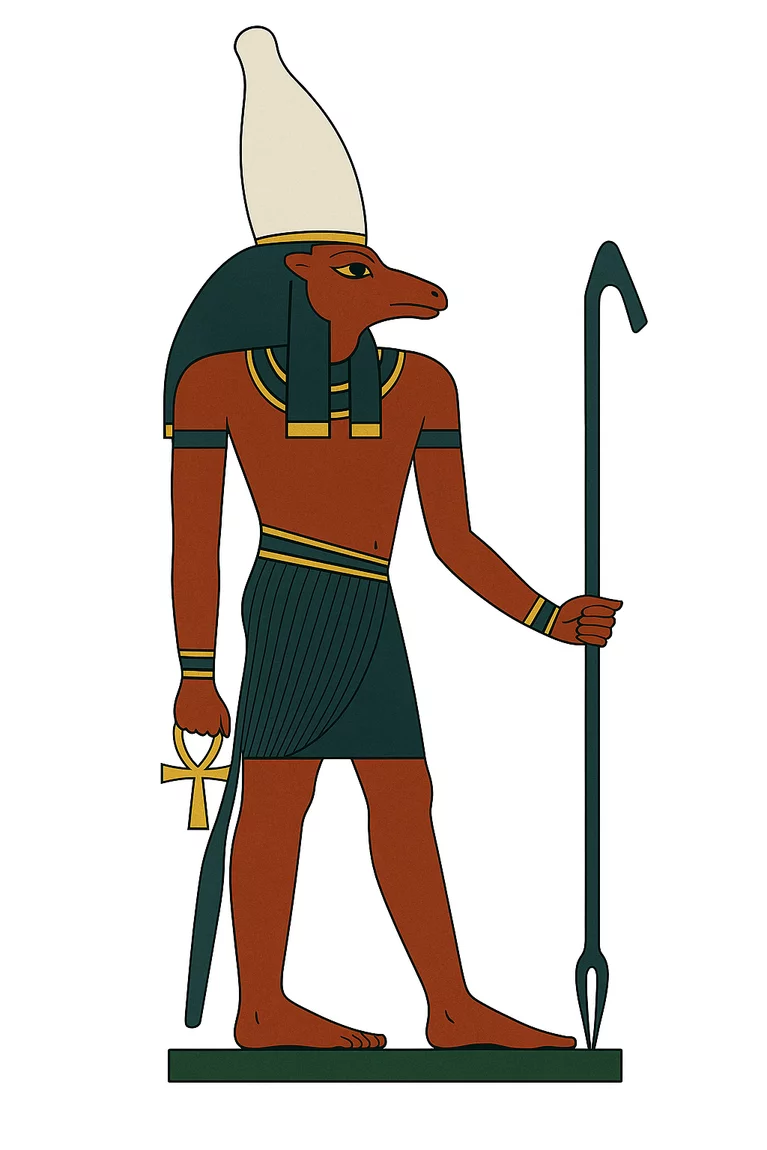
A power hard to pin down
Seth is associated with storms, the desert and the forces of disorder. The British Museum recalls his role as brother and murderer of Osiris in one great mythological tradition. That reputation does not exhaust the god, though. He can also defend Ra against dangerous powers during the solar journey. The same figure therefore appears as an adversary in one story and as a protector in another. Trying simply to file him among the ‘good’ or the ‘wicked’ would lose this tension.
In the story of Osiris, the clash with his brother causes a rupture. Isis protects the dead god’s inheritance and Horus fights for the kingship. The episodes were handed down in various forms; no short version should be taken for a single text valid in every place and every period. Temple images, narratives and royal names stress different aspects. Understanding Seth means holding these contexts together without confusing them.
The Seth animal
Seth often has the head of an animal with upright ears and a long snout, known as the ‘Seth animal’. The British Museum notes that it recalls several species without allowing itself to be firmly identified with any one of them. This silhouette is a sign that belongs to the god alone. In ancient representations, the inscribed name, the attributes and the place in the scene make it possible to pin down his identity and his role.
Provenance and inscription remain essential for recognising an ancient object. An unusual head is sometimes enough to guide the eye, but the whole scene explains the function chosen for Seth. Is he placed beside the king, in a conflict with Horus or near the solar barque? The meaning changes with the answer. Egyptian iconography does not hand each god a single moral identity. It shows relationships and actions.
Desert, kingship and protection
Rulers such as Seti I bore a name formed on that of Seth. This fact is a reminder that his cult was not uniformly rejected. The Metropolitan Museum also documents his association with Baal, the storm god from the Near East. Such an association can be explained by affinities of function in a particular historical context; it does not allow us to treat the two figures as identical from the start.
The strength of Seth can threaten an established order, but it can also be used to defend it. His role in the barque of Ra makes this paradox especially visible. There is no question of inventing a modern rehabilitation for him: the ancient sources themselves give him several places. By setting them side by side, we better understand a religion that did not work like a catalogue of fixed characters, but like a body of stories and rites in motion.
Murderer of Osiris in the cycle of Osiris, rival of Horus and defender of the solar barque in other compositions, Seth combines functions that may seem contradictory. They are explained by the variety of narratives and cult practices. His strength can threaten order or be called upon to protect it; his story has to be followed through the places, reigns and texts that give him a role.
Sources and references
Reference works
- Richard H. Wilkinson, The Complete Gods and Goddesses of Ancient Egypt, London, Thames & Hudson, 2003, entry Seth
- Christian Leitz (ed.), Lexikon der ägyptischen Götter und Götterbezeichnungen, 8 vols, Leuven, Peeters, 2002–2003 (Orientalia Lovaniensia Analecta 110–116 and 129)