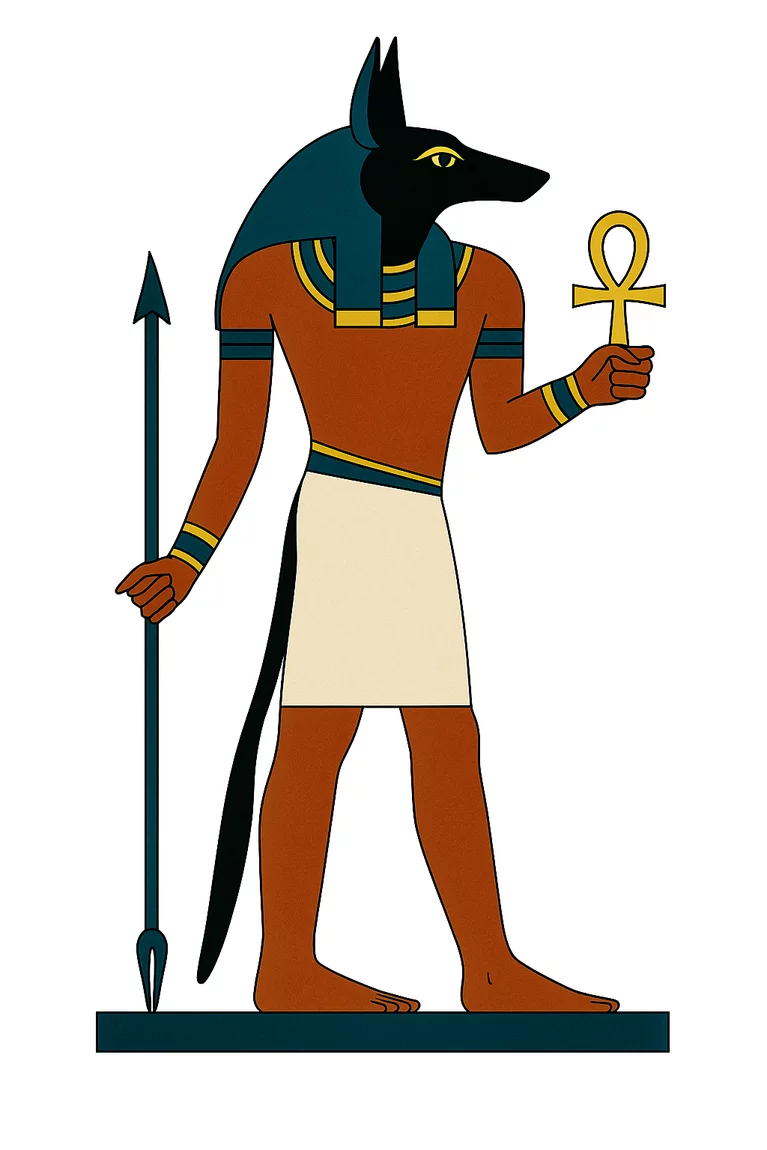
In ancient Egypt, death did not wipe out the person at a single stroke. The body had to be prepared, the name preserved, the rites performed. Anubis appears at each of these stages as a figure of vigilance. His appearance can be surprising today: a man with a canine head, or a black animal lying on a funerary chest. For the Egyptians, it said above all that a guardian stood beside the deceased.
A recognisable silhouette
Anubis is often shown with the head of a jackal, to use the name museums usually give it, or in the form of a whole canine. His black colour does not try to reproduce that of a real animal. It belongs to the language of Egyptian religious images: black can evoke both the embalmed body and the fertile earth from which life is reborn. The god thus joins the ideas of death and renewal.
A single deity could fulfil several functions depending on the period, the place and the text. It would therefore be misleading to lock Anubis into one definition. His presence nevertheless returns steadily around the tomb, mummification and the journey to the afterlife.
Preparing and protecting
Embalming was not a mere technical operation. Preserving the body allowed the dead person to keep a support for their future existence. The acts of the specialists belonged to a whole body of prayers and rites. Anubis was their divine protector; priests could wear a mask in his likeness during funerary ceremonies.
On coffins and tomb walls, the recumbent canine seems to keep watch without moving. This stillness gives the image its strength. The tomb is closed, but it is not abandoned. The god guards a threshold, and the deceased can continue on their way under his protection. The idea recurs on many objects: the presence of Anubis reassures the living as much as it accompanies the dead.
Images of the god change with the medium. On a small amulet, a few lines are enough to recognise him; in a funerary painting, he takes his place among other figures and other gestures. Anubis is therefore not read in isolation. His position, the objects around him and the function of the work help us understand what his presence promises the deceased.
At the moment of judgement
In scenes of the judgement of the dead, Anubis acts beside the balance. The heart of the deceased is weighed against the feather of Maat, the sign of order and rightness. Thoth records the result; Osiris presides over the fate of the dead. These figures are not interchangeable. Anubis prepares, leads and watches over the proper course of the passage.
The scene does not describe a hearing in the modern sense. It gives visible form to a moral question: did the deceased live in harmony with the order of the world? Images and formulas varied, and not all Egyptians had access to the same funerary objects. But the wish to pass through death without losing one’s identity runs through a large part of this tradition.
A guardian, not a monster
Cinema and fantasy tales have sometimes turned Anubis into a threatening creature. Ancient works offer a more nuanced image. His role is close to that of an attentive companion: he takes care of the body, protects the tomb and guides the deceased towards the next stage.
Seeing Anubis this way changes how we read Egyptian tombs. The painted or carved figures are not merely decorative. They express a trust: facing the unknown, the traveller does not set out alone.
Sources
- British Museum, Ancient Egyptian gods and goddesses: Anubis
- Metropolitan Museum of Art, papyrus of the judgement before Osiris
Reference works
- Richard H. Wilkinson, The Complete Gods and Goddesses of Ancient Egypt, London, Thames & Hudson, 2003, entry Anubis
- Christian Leitz (ed.), Lexikon der ägyptischen Götter und Götterbezeichnungen, 8 vols, Leuven, Peeters, 2002–2003 (Orientalia Lovaniensia Analecta 110–116 and 129)