Heka is at once the name of a power that the ancient Egyptians recognised in effective words and acts, and the name of a god who personifies it. Translating the term as ‘magic’ is convenient, but the English word can mislead if it suggests only a show or a marginal practice. Heka ran through healing, protection, temple rites and funerary preparations. It was one of the means by which humans and gods acted in the world.
A force that makes action effective
The British Museum presents heka as a powerful and natural element, central in life as in the afterlife. Spoken formulas, divine names, images and objects could take part in one and the same ritual action. An amulet is not reduced to its material; it draws its importance from its form, from the words and from the use around it. Likewise, a funerary inscription was not only meant to be read by visitors. It helped to equip the deceased for a transformed existence.
The modern distinction between religion, medicine and magic does not always correspond to Egyptian practice. Remedies, acts and words could be used together. That does not mean that the Egyptians ignored observation of the body or the effects of plants. Their way of healing combined dimensions that we now more readily separate. Heka represents the effective power of this whole, not a simple opposition to knowledge.
The god and the other deities
Heka appears as a divine figure in some texts and images. He is found beside other powers that take part in creation and in maintaining order. The goddess Isis is often celebrated for her great mastery of effective words; that does not mean she was simply a female version of Heka. Thoth is linked to knowledge and writing, while Hu personifies authoritative speech. Their domains meet without merging.
At Esna, the god takes his place in the world of Khnum. Local theologies could associate gods in particular ways and give a general power a precise place in a temple. To describe a scene, then, we must read its inscription and know its provenance. Saying that Heka is ‘the god of magic’ is a useful starting point, but the formula does not replace the study of how he was invoked.
Practices to protect life
Protection against illness, bites or threatening forces is one field in which heka can be seen at work. Some objects bear divine images and texts intended to ward off a danger. Their effectiveness was conceived as a relationship between gesture, word and divine power. Families, healers and priests could all take part, each in a different setting. These uses cannot be described as a single ceremony performed everywhere in the same way.
In the afterlife, the deceased also needed names, formulas and protections. The power of Heka makes this concern to prepare words and images before death understandable. The tomb was not only a place of material preservation: it held means of action for an uncertain future. Funerary texts show the value placed on knowing the right words, without each formula having to be attributed to the god Heka himself.
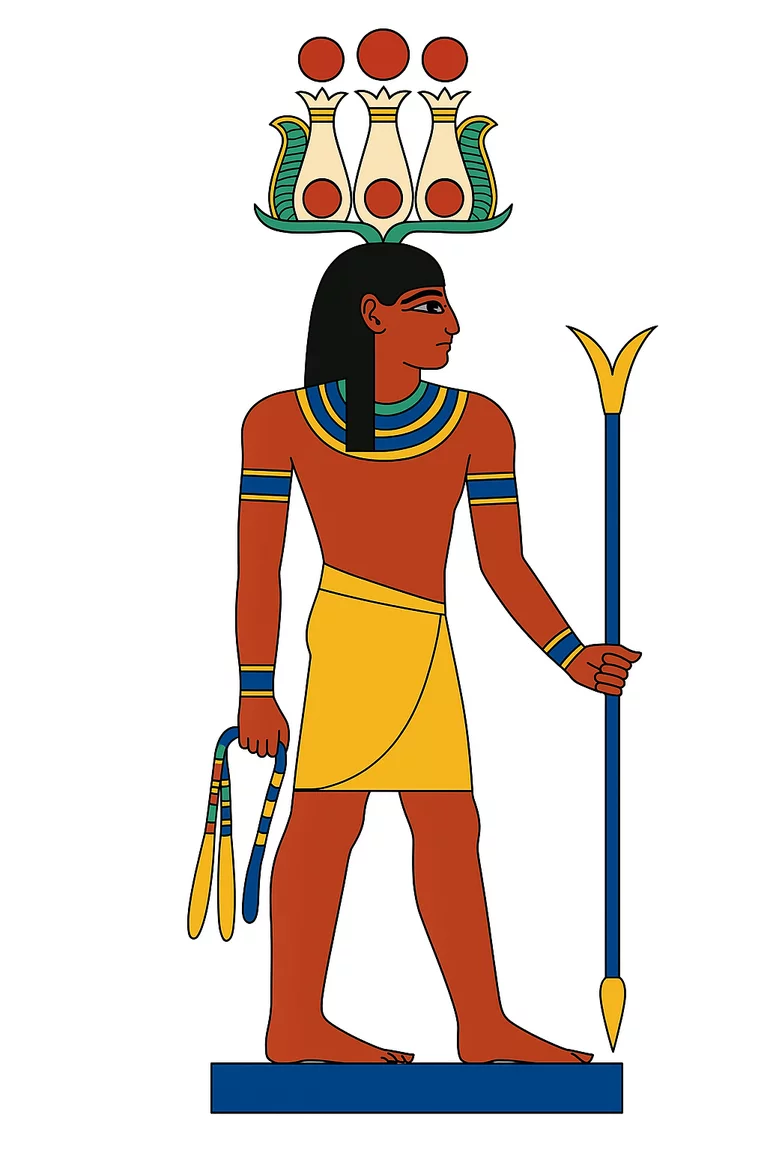
Our illustration shows Heka in human form so as to include him in the gallery. It follows the graphic language of the other portraits, with costume, collar and sceptre. This contemporary choice does not fix a single ancient portrait. What above all distinguishes Heka in the sources is his name and the power it expresses: making a word or an act produce an effect in the order of the world.
Sources and references
Reference works
- Richard H. Wilkinson, The Complete Gods and Goddesses of Ancient Egypt, London, Thames & Hudson, 2003, entry Heka
- Christian Leitz (ed.), Lexikon der ägyptischen Götter und Götterbezeichnungen, 8 vols, Leuven, Peeters, 2002–2003 (Orientalia Lovaniensia Analecta 110–116 and 129)