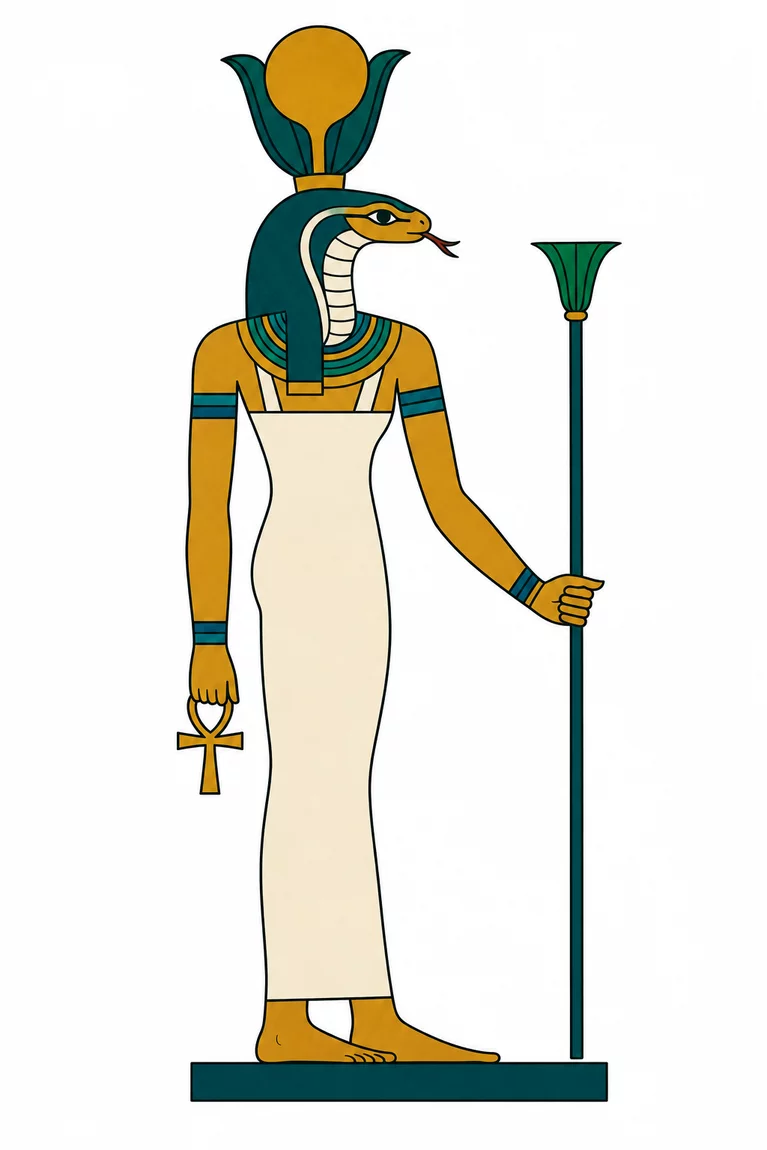
Hauhet, also called Hehet in some transliterations, belongs to the Ogdoad of Hermopolis: a group of eight divine powers gathered in four couples. She forms a pair with Heh. Their name evokes the boundless extent of the primordial state. The goddess rarely appears as the isolated heroine of a long story. Her interest lies precisely in showing how the Egyptians could give names and faces to the conditions that precede the appearance of the ordered world.
A goddess among eight powers
In the tradition of Hermopolis, Hauhet and Heh take their place beside Nun and Naunet, associated with the first waters, Kek and Kauket, linked to darkness, and Amun and Amaunet, linked to what is hidden. These terms do not form a list of material elements in the modern sense. They give religious expression to what exists before light, forms and familiar limits.
Hermopolis (ancient Khemenu) bore a name meaning ‘city of the Eight’. It recalls the place of the group in the religious memory of the city. The texts and images of the Ogdoad changed over time; the best-known developments belong mainly to the late periods. It would therefore be misleading to describe a single doctrine, entirely fixed from the beginnings of Egyptian history. Local traditions were reread and combined with those of other religious centres.
Before the appearance of the sun
According to versions of the Hermopolitan creation, the eight powers prepare the appearance of the first sun. It can be described as a child emerging from a primeval island or as a birth linked to a flower. The story does not put Hauhet alone in the foreground. The couple she forms with Heh takes part in a set of conditions prior to the visible world. The idea of boundless extent helps us imagine this ‘before’, without confusing it with an empty space described by modern physics.
Other Egyptian centres told of beginnings differently. At Heliopolis, Atum plays a major role; at Memphis, it is Ptah. These stories could coexist and engage with one another. The fact that Hermopolis had its own Ogdoad did not imply that all Egyptians rejected the other explanations of creation. Each tradition sought to place a sanctuary and its gods within the order of the cosmos.
The serpent form
In images of the Ogdoad, the female members can have a serpent’s head and the male members a frog’s head. The Global Egyptian Museum also notes entirely human representations or, in some contexts, baboon figures greeting the rising sun. Our illustration chooses a serpent’s head for Hauhet so as to make her membership of the group instantly legible. The details of the headdress and the objects held in the hands belong to the visual unity of this contemporary series.
The serpent here is no sign of wickedness. In Egyptian religion this animal can be protective, dangerous, royal or primordial depending on the context. A serpent-headed goddess is therefore not automatically Meretseger or Renenutet. The inscribed name and the presence of the other members of the Ogdoad remain essential for identifying Hauhet.
Her page invites us to look at the gods in groups and relationships. Hauhet tells us less about an individual adventure than about a primordial horizon shared with seven other figures. In this way of thinking, even an extent without edge receives a name, a partner and a place in the images of the beginning.
Sources and references
- Global Egyptian Museum, Ogdoad
- Global Egyptian Museum, Hermopolis
- Global Egyptian Museum, serpents in iconography
Reference works
- Richard H. Wilkinson, The Complete Gods and Goddesses of Ancient Egypt, London, Thames & Hudson, 2003, entry Ogdoad
- Christian Leitz (ed.), Lexikon der ägyptischen Götter und Götterbezeichnungen, 8 vols, Leuven, Peeters, 2002–2003 (Orientalia Lovaniensia Analecta 110–116 and 129)