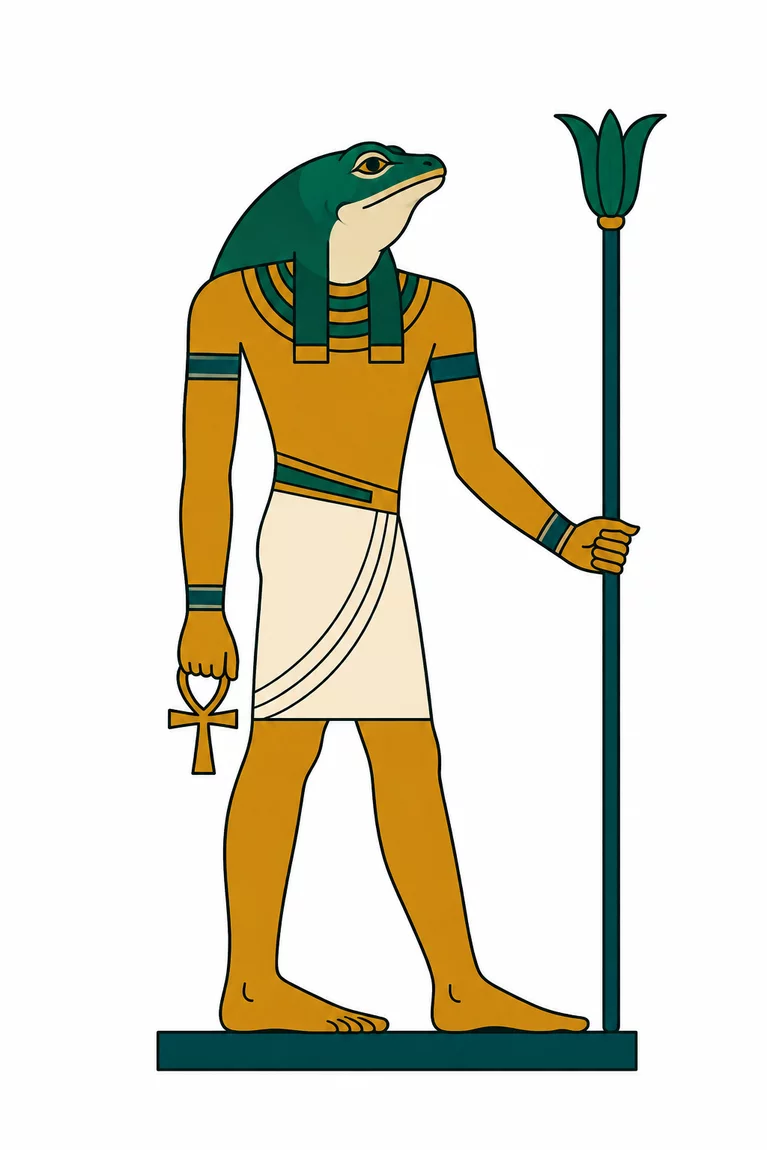
Heh, written Hehou in French, is one of the eight primordial gods of the Ogdoad of Hermopolis. His partner is Hauhet, also called Hehet. Their pair expresses the idea of a boundless extent before the world was put in order. The word associated with Heh can also evoke an immense number, ‘a million’, in some iconographic uses. These meanings cross, but we must distinguish the member of the Ogdoad, the signs of writing and the uses of the image in different contexts.
The city of the Eight
Hermopolis bore an Egyptian name meaning ‘city of the Eight’. The group brings together four couples: Nun and Naunet for the first waters, Kek and Kauket for darkness, Heh and Hauhet for extent, Amun and Amaunet for what is hidden. The names organise a reflection on the primordial state rather than a family of heroes with detailed individual biographies.
In some versions, the Ogdoad precedes or prepares the appearance of the first sun. An island rises in the midst of the waters; elsewhere the sun is born from a flower or appears as a child. These images do not form a single story that could be told word for word for every period. They developed in particular temples and texts. The Global Egyptian Museum stresses that the late forms of the tradition are especially well documented, while the name of the city and of the gods is much older.
A frog, several images
The four male gods of the Ogdoad are frequently shown with frogs’ heads; the corresponding goddesses can have serpents’ heads. Heh takes this form in the illustration on this page. The frog evokes the watery world from which life springs, but it is not enough to identify the god. Heka is not one of these frog-headed gods, and other religious figures may use this animal. The composition and the inscription are therefore needed to read an ancient representation.
The members of the Ogdoad can also appear in human form. Their representations express a function and a relationship as much as an appearance. To recognise Heh in the group, the presence of his partner and the inscribed name count for more than an isolated attribute. The forms vary with period and place, while the couple Heh and Hauhet remains associated with the boundless extent of the primordial world.
The sign of long ages
An inlay in the Metropolitan Museum of Art shows the hieroglyphic sign heh associated with ‘millions of years’. The entry links the god to immensity and to the support of the sky. This dimension makes Heh interesting beyond cosmogony: a wish for a very long duration can call on the same network of images. That does not mean that every occurrence of the sign automatically designates the primordial couple of Hermopolis. Writing, image and story can use shared elements with distinct intentions.
Heh helps us understand an Egyptian way of thinking about the infinite without treating it as an isolated abstraction. He has a place in a group, a partner, a possible animal form and links with the emergence of the sun. His power lies in this relationship between what has no apparent bound and the visible world that takes shape.
Sources and references
- Global Egyptian Museum, Ogdoad
- Global Egyptian Museum, Hermopolis
- Metropolitan Museum of Art, the heh sign of millions of years
Reference works
- Richard H. Wilkinson, The Complete Gods and Goddesses of Ancient Egypt, London, Thames & Hudson, 2003, entry Ogdoad
- Christian Leitz (ed.), Lexikon der ägyptischen Götter und Götterbezeichnungen, 8 vols, Leuven, Peeters, 2002–2003 (Orientalia Lovaniensia Analecta 110–116 and 129)