A figure of the Ogdoad
Naunet is the female partner of Nun in the Ogdoad of Hermopolis. This group of eight deities evokes qualities of the world before the appearance of the sun and the organisation of a habitable space. The names of the couples are close, but this closeness should not erase the presence of two figures. Hermopolitan theology uses male and female duality to express a primordial power that goes beyond the isolated character of a story. The group matters as much as each of its members.
The word ‘waters’ suggests an immediate image, but this is not an ordinary seascape. The primordial waters allow us to think about what precedes familiar distinctions: earth and sky, day and night, bank and current. Naunet contributes to this language of beginnings. She is not always in the foreground of a continuous story, because her function shows itself above all in the structure of the group and in her relationship with Nun. The lack of a long biography does not mean the lack of a role.
Giving form to the invisible
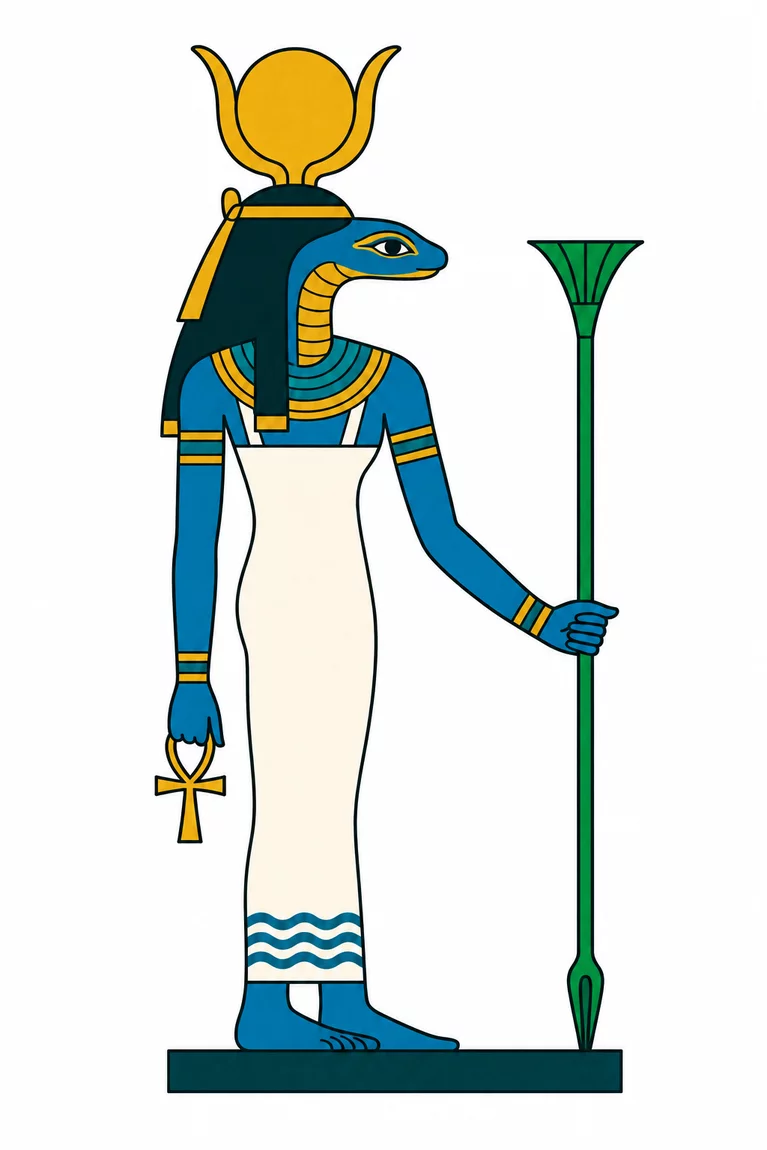
The female figures of the Ogdoad can receive a serpent’s head, while the male figures are often shown with a frog’s head. These animals are not naturalistic portraits of primordial powers. They give a form to what, by definition, lies before the visible world. The serpent’s head chosen for our illustration signals that Naunet belongs to this iconographic tradition. The standing silhouette brings her close to the other deities presented in this series.
An attribute shown in a contemporary image is never enough to reconstruct an ancient cult. To identify an ancient work, we must consider the inscription, the findspot and the other gods depicted. Several serpent goddesses exist in the pantheon. Without context, confusing them would be easy. The name Naunet becomes clearer when it appears with the members of the Ogdoad and in a scene devoted to origins. Images must be read together with the texts and the space in which they are found.
Several stories of origins
The tradition of Hermopolis does not erase that of Heliopolis. In the latter, Atum holds a central place at the moment creation begins. The sanctuaries developed different, sometimes complementary, ways of telling this threshold. The couple Nun and Naunet helps us understand this diversity. The gods of the Ogdoad are not simply names to be placed before more famous figures: they organise an explanation of their own of the primordial state and its transformation.
Naunet finally shows how the Egyptians gave relational form to the most abstract notions. Water without a shore, darkness or infinity are hard to paint. Divine couples, gestures and crowns make these ideas visible in a temple. Our drawing seeks this legibility without standing in for an archaeological document. The goddess is a reminder that the familiar world could be born from a deep state whose powers went on receiving a name and a place.
The importance of Naunet is better understood when we look at the eight figures together. The repetition of couples is not a decorative list: it organises visually a thought of the world before the world. A goddess less known today can thus hold a structuring place in a theological system. The individual drawing helps to recognise her, while the group explains her function.
Sources and references
Reference works
- Richard H. Wilkinson, The Complete Gods and Goddesses of Ancient Egypt, London, Thames & Hudson, 2003, entry Ogdoad
- Christian Leitz (ed.), Lexikon der ägyptischen Götter und Götterbezeichnungen, 8 vols, Leuven, Peeters, 2002–2003 (Orientalia Lovaniensia Analecta 110–116 and 129)