The guardian of a landscape
Meretseger is closely linked to the mountain that towers over the Theban necropolis. Her name is generally understood as ‘she who loves silence’. Silence evokes the realm of the tombs, but also the steep ground above the Valley of the Kings. The craftsmen of Deir el-Medina, who were responsible for the royal burials, lived close by. Their relationship with this goddess therefore had a local, concrete dimension: they worked beneath the gaze of the mountain and could recognise a divine presence in it.
The Metropolitan Museum holds a Ramesside ostracon bearing her image and the names of workers from Deir el-Medina. An ostracon is a flake of limestone or a potsherd used for drawing or writing. This modest document links a divine figure to identifiable people. It tells us about a precise milieu and period; it does not allow us to assume that the whole of Egypt honoured Meretseger in a uniform way. Neighbourhood cults count as much as the great theologies of the temples.
The serpent, fear and protection
Meretseger can appear as a cobra. In Egyptian iconography the serpent does not express danger alone: it can also defend a sacred place and drive back what threatens it. The goddess’s power is thus understood in two directions. She can punish a fault, but the worshipper can also seek her help. Fear and hope do not exclude each other. A guardian of the necropolis can be fearsome precisely because the protection she gives is strong.
Prayers and stelae from the region sometimes speak of suffering, the admission of a fault and an appeal to divine mercy. It would be unwise to turn this language of devotion into a medical diagnosis or a detailed historical account of each event. Rather, it shows how a person put their experience into words before the goddess. The worshipper was not addressing a distant, indifferent force: they hoped to be heard, relieved and restored to a favourable relationship with the protector of the place.
A contemporary image, ancient evidence
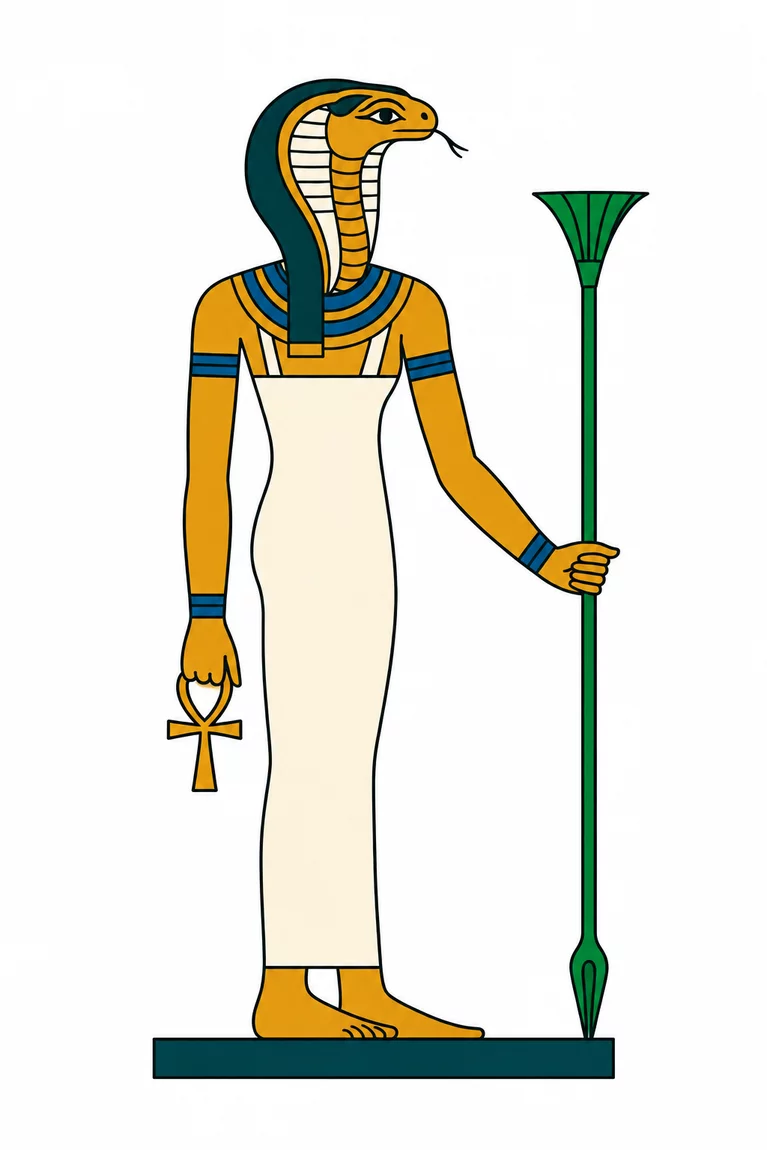
Our illustration gives her a human figure with a cobra’s head, a sceptre and an ankh. This choice gathers Egyptian-style conventions so that the reader can recognise her. It reproduces no particular relief. Ancient works may give her other forms; an inscription or the context of discovery is then surer than a single attribute for naming the figure. The museum’s ostracon is precious because its drawing and its names belong to a defined archaeological context.
Meretseger is a reminder that Egyptian religion did not take place only in the great sanctuaries. It took shape on a path, in a workshop, on a stela offered by a local inhabitant and in the landscape he saw every day. The world of the royal tombs was not separate from the lives of those who built them. The goddess links human work, the mountain and the hope of protection for the dead as for the living.
The name Meretseger also keeps a dimension of sound: to love silence is not to impose the absence of every word, since prayers were addressed to her precisely. The contrast between the silent mountain and the worshipper’s voice helps to grasp the relationship. This is evidence rooted in a place, to be read without turning each pious formula into a verifiable fact.
Sources and references
Reference works
- Richard H. Wilkinson, The Complete Gods and Goddesses of Ancient Egypt, London, Thames & Hudson, 2003, entry Meretseger
- Christian Leitz (ed.), Lexikon der ägyptischen Götter und Götterbezeichnungen, 8 vols, Leuven, Peeters, 2002–2003 (Orientalia Lovaniensia Analecta 110–116 and 129)