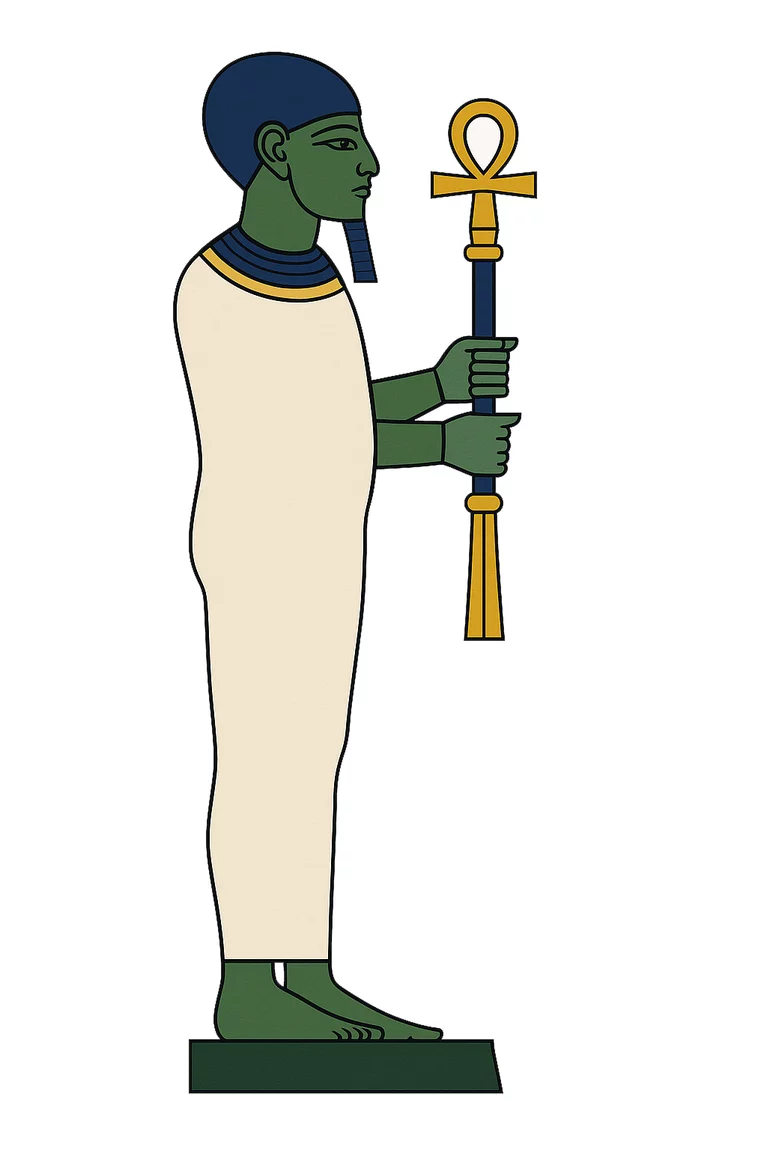
The great god of Memphis
Ptah holds a central place in the religion of Memphis. The Metropolitan Museum presents him as the great god of that ancient capital and as the master craftsman of the gods. Memphite traditions credit him with a creative act linked to thought and speech. This formula does not mean that every sanctuary in Egypt told the story of origins in the same way. It belongs to one particular way of conceiving the birth of the world and the power of a divine word.
The link between Ptah and the crafts of creation gives him a place in the world of craftsmen. Statues, tools, temples and images all call for skill. Yet saying that Ptah protects craftsmen does not make him a mere patron of a trade. Carving a sacred object is itself part of a relationship with the gods. Seen this way, making and giving form can evoke, on another scale, the creative act that the texts attribute to the god.
A recognisable silhouette
Ptah is often recognisable by a close-fitting skullcap, a straight beard and a garment worn very close to the body. The entry for a statuette in the Metropolitan Museum dwells on these details. He frequently holds a sceptre that combines signs of life, stability and authority. A particular work may, however, leave some of them out. The museum thus describes a figure who holds only a was sceptre. Iconography has to be observed object by object, not applied as a compulsory pattern.
The wrapped garment may at first glance recall certain images of Osiris. That does not make the two gods interchangeable. The headdress, the beard, the insignia and the inscription allow them to be told apart. Our portrait takes up the known features of Ptah in the shared style of the series. Its colour and drawing are contemporary choices, while the comparison with ancient statuettes rests on observable, documented elements.
Prayer and divine relationships
The Metropolitan Museum stresses that Ptah could also be regarded as a god who listened to personal requests. A statue placed in a cult setting therefore did not have only an abstract theological function. People could seek his favour and address a prayer to him. The many figures of the god dedicated over the centuries bear witness to this relationship. Their spread does not, however, allow each individual rite to be reconstructed, because the original context of the objects is sometimes incomplete.
In one Memphite tradition, Ptah forms a group with Sekhmet and the young Nefertem. This grouping shows different powers rather than a uniform family story. The vigour of the lioness goddess and the lotus of the young god answer the creative force of Ptah. Other funerary compositions associate his name with Sokar and Osiris. These combinations show how flexible divine identities were, while Ptah keeps his own silhouette and history.
Works devoted to Ptah range from small portable figures to statues intended for sanctuaries. Material and size change how they were used, without necessarily changing the god identified. Before each of them, the useful question is who commissioned it, where it stood and what acts surrounded it. This concrete attention completes the great creation narratives and lets us see how a theology took its place in religious life.
Sources and references
- Metropolitan Museum, statuette of Ptah
- Metropolitan Museum, statue of Ptah and prayers
- Metropolitan Museum, Divine Egypt
Reference works
- Richard H. Wilkinson, The Complete Gods and Goddesses of Ancient Egypt, London, Thames & Hudson, 2003, entry Ptah
- Christian Leitz (ed.), Lexikon der ägyptischen Götter und Götterbezeichnungen, 8 vols, Leuven, Peeters, 2002–2003 (Orientalia Lovaniensia Analecta 110–116 and 129)