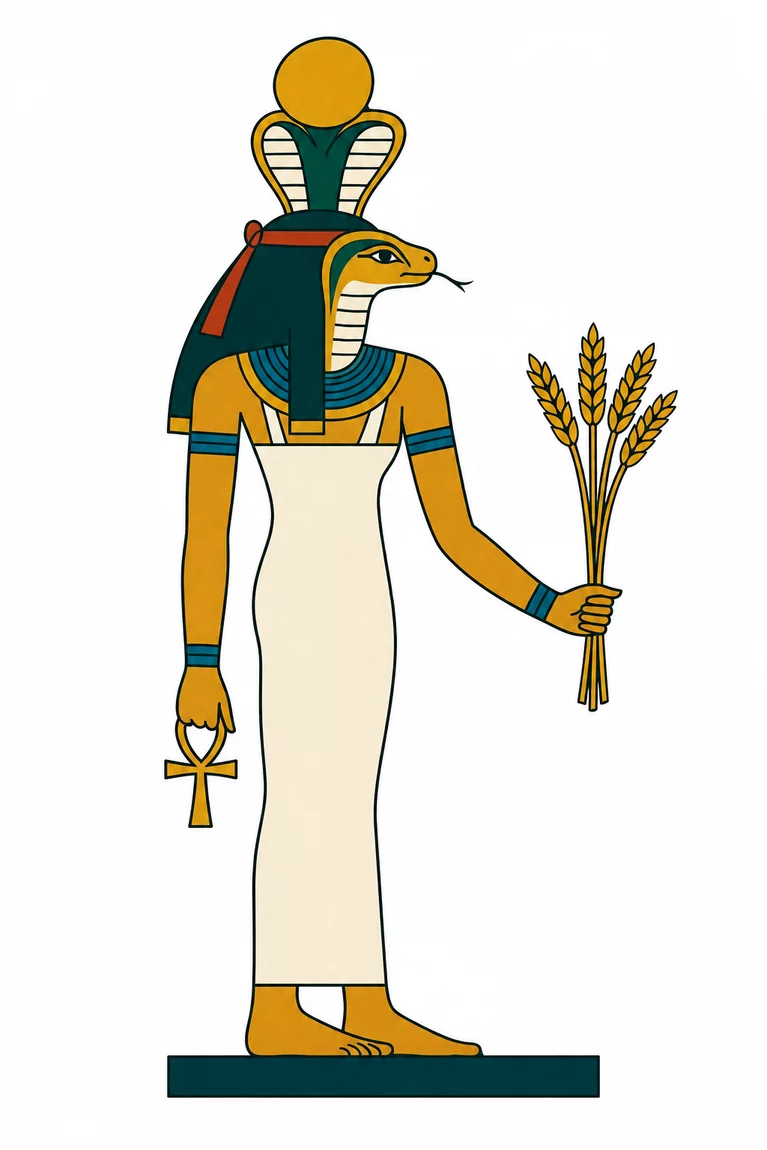
A goddess of abundance
Renenutet is associated with the prosperity of the harvest. UCL Digital Egypt presents her as a protector of the harvest, shown in serpent form. The relationship between a goddess and cereals is not a mere agricultural label. It concerns bread, stores and the security of families. In a society where production depends on the Nile and on work in the fields, protecting the harvest means defending the continuity of life. The figure of the cobra gives this protection a visible power.
A list of festivals preserved by UCL mentions a day dedicated to Renenutet and links it to the birth of Nepri, the personification of grain. A calendar festival does not allow each local ceremony to be reconstructed, but it places the goddess within the rhythm of the year. The moment of harvest turns a religious idea into a shared experience. The produce stored, the offerings and the thanksgivings could give concrete meaning to the abundance hoped for.
The protective serpent
Renenutet can be shown as a cobra, sometimes in a form mixing human and serpent features. The Egyptian cobra is not only threatening. Reared up, it protects, keeps watch and can drive back a hostile force. This ambivalence suits a goddess who watches over what has been patiently grown. Our illustration gives her a cobra’s head and ears of grain. It brings together two signs the public can understand, but does not reproduce any particular ancient work.
Several serpent deities exist in Egyptian religion. A cobra figure without its inscription is therefore not automatically Renenutet. The agricultural context, the provenance and the associated figures can help to identify her. This caution also applies to statuettes found away from their original position. The serpent motif was rich enough to serve goddesses with different functions. The name and the place count as much as the animal depicted.
A long history of images
In Egypt of the late periods, Renenutet could be brought together with Isis in the form known as Isis-Thermuthis. The British Museum holds an object associated with this compound name and with the Faiyum. This association does not mean that the two goddesses were always identical. It shows the capacity of cults to establish new correspondences between protective powers. The Graeco-Egyptian forms extend and transform older traditions.
The story of Renenutet thus links the field, the calendar and the image of the serpent. Her protection is not limited to a single act. It accompanies the hope that the grain will ripen, be harvested and feed the living. This page separates the information secured by the sources from more general interpretations of farming life. Looking at the objects with this care, the goddess appears as a power of continuity rather than a simple emblem of fertility.
The reference to the Faiyum also invites us to consider particular landscapes. A cult linked to the harvest could take on new forms in a farming region whose history changed over the centuries. The compound names of the Graeco-Roman Period bear witness to these transformations. They do not replace the older evidence; they extend it into a new setting. Renenutet thus allows us to follow, through a single goddess, the long duration and the variations of Egyptian religion.
Sources and references
- UCL Digital Egypt, Renenutet and the harvest
- UCL Digital Egypt, festival of Renenutet
- British Museum, Isis-Thermuthis and Renenutet
Reference works
- Richard H. Wilkinson, The Complete Gods and Goddesses of Ancient Egypt, London, Thames & Hudson, 2003, entry Renenutet
- Christian Leitz (ed.), Lexikon der ägyptischen Götter und Götterbezeichnungen, 8 vols, Leuven, Peeters, 2002–2003 (Orientalia Lovaniensia Analecta 110–116 and 129)