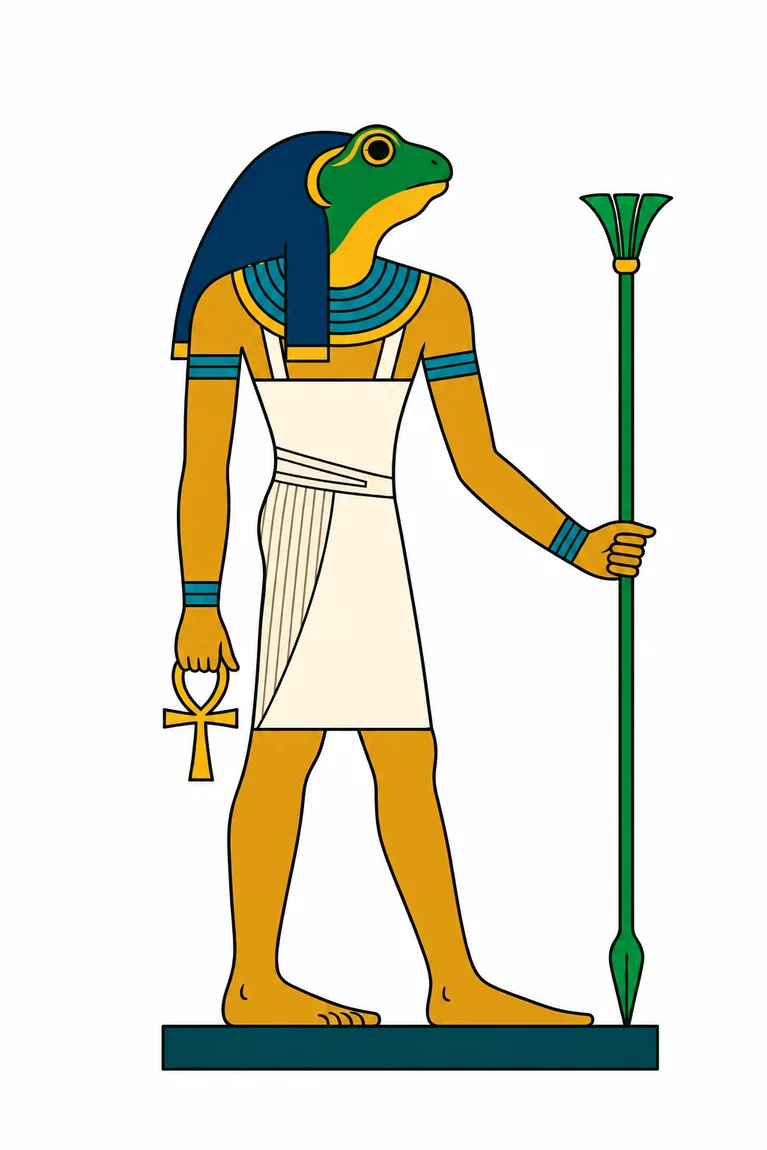
Kek, written Kekou in French, is one of the gods of the Ogdoad of Hermopolis. He forms a couple with Kauket. Together they personify the primordial darkness, before the appearance of the sun and the differentiation of the world. Their role is not that of enemies of light. They belong to the first conditions from which the Hermopolitan stories bring creation about. Understanding Kek therefore means looking at the whole group and at the religious thought of his city.
Four couples, one creation
Besides Kek and Kauket, the Ogdoad brings together Nun and Naunet, associated with the waters, Heh and Hauhet, linked to boundless extent, and Amun and Amaunet, linked to what remains hidden. The names are ways of expressing the state of the world before visible order. The city of Hermopolis bore an Egyptian name meaning ‘city of the Eight’, the mark of this local tradition.
In some versions, the first sun appears on an island born from the waters or emerges from a flower. The eight gods precede and prepare this manifestation. These images should not be turned into an over-precise chronological story: the surviving texts belong to different periods and settings. The Global Egyptian Museum indicates that the great known elaborations of the Ogdoad are mostly late, even if the group and the name of the city have an older history.
The frog’s head
Kek can be shown with a frog’s head, like the other male members of the Ogdoad. The corresponding goddesses often receive serpents’ heads. Our drawing follows this convention and adds a dark headdress to evoke darkness. It keeps the human body, the garment and the sceptre shared by the portraits in the series. This is a present-day graphic reading, not the copy of a particular statue.
The frog evokes a moist world in which life seems to spring up in abundance. Its presence in an Egyptian image is not enough, however, to name Kek. Other figures use this animal. A scene of the Ogdoad is recognised by the gathering of the eight, by inscriptions and by a context of creation. Without these clues, it is wiser to say ‘frog-headed deity’ than to assert a precise name.
A darkness that is not evil
In solar stories, a hostile serpent such as Apophis tries to hinder the rising of the sun. Kek has no such function. His relationship with darkness does not mean that he fights creation. The contrast is essential if we are to avoid projecting onto Egyptian myths a systematic opposition between a luminous good and a nocturnal evil. The first darkness is a dimension of the world before it takes shape.
This idea helps us understand why several cosmologies could coexist. At Heliopolis, Atum is a major creator; at Hermopolis, the first sun appears within a framework prepared by eight powers. Temples and texts sometimes brought these traditions together rather than choosing one against the other. Kek thus represents a way of thinking about beginnings through couples, qualities and relationships.
The god has few well-attested individual episodes, and it would be artificial to invent an adventure for him to fill out his page. His importance is collective. Through his pairing with Kauket, the ancient Egyptians gave a name and an image to what precedes the day, then placed this condition within the story of the birth of the sun.
Sources and references
Reference works
- Richard H. Wilkinson, The Complete Gods and Goddesses of Ancient Egypt, London, Thames & Hudson, 2003, entry Ogdoad
- Christian Leitz (ed.), Lexikon der ägyptischen Götter und Götterbezeichnungen, 8 vols, Leuven, Peeters, 2002–2003 (Orientalia Lovaniensia Analecta 110–116 and 129)