Before the sun lit the world, the Egyptians imagined a primordial state in which nothing had yet taken its final form. Amaunet belongs to this time of origins. With Amun, she embodies what remains hidden, invisible to human eyes. Her place in the Ogdoad of Hermopolis lets us discover a creation that does not begin with a single god, but with a set of complementary forces.
Amaunet among the eight powers of Hermopolis
The Ogdoad, ‘group of eight’, brings together four divine couples. Nun and Naunet refer to the primordial waters; Kek and Kauket to darkness; Heh and Hauhet to boundless extent; Amun and Amaunet to what is concealed. Each couple pairs a male and a female form. These names do not describe characters engaged in a single adventure: they give a divine presence to qualities of the universe before the ordered world appeared.
Hermopolis (ancient Khemenu) was the ‘city of the Eight’. This religious tradition placed the primordial powers there and told, depending on the version, of the emergence of a first land and the coming of the sun. Egyptian creation stories varied from one sanctuary and one period to another. It would therefore be misleading to turn the Ogdoad into a fixed story, recited everywhere in the same way.
The meaning of the name and the relationship with Amun
The name Amaunet, also transcribed Amunet or Amonet, is the feminine form of that of Amun. Their couple evokes the hidden character of the primordial state. ‘Hidden’ does not simply mean absent: this power exists without yet being offered to sight. In the logic of Egyptian theologies, what precedes creation can thus be thought of as a reserve of possibilities.
Amun would take on a considerable place at Thebes, where he became one of the great gods of the kingdom. This rise does not make Amaunet the principal goddess of the Theban triad. In that triad, Amun is usually associated with Mut and Khonsu. Amaunet can nevertheless appear at Thebes as his counterpart or, occasionally, as his consort. Texts and places thus preserve several ways of linking these deities, without our needing to confuse them.
How do you recognise her?
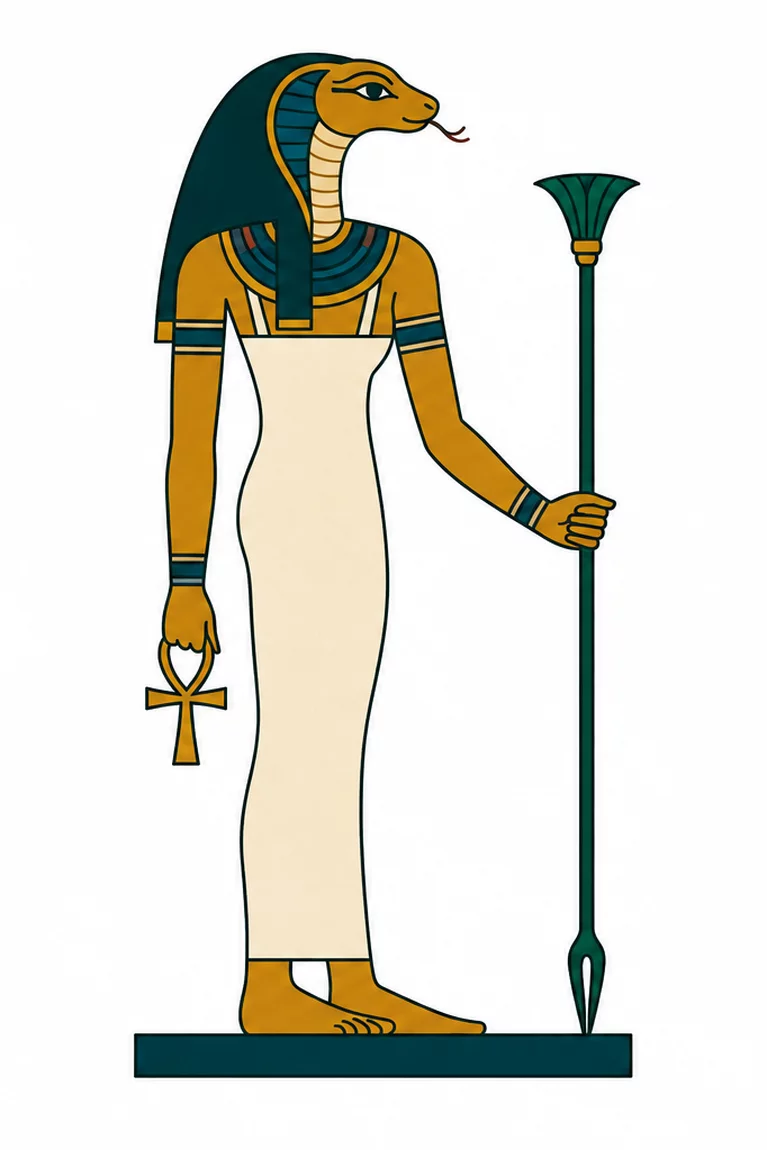
In representations of the Ogdoad, the male gods often have a frog’s head and the goddesses a serpent’s head. Amaunet can thus be shown among four serpent goddesses. There are also human representations of the members of the group. To identify an ancient figure, the context, the other deities depicted and the inscription must be taken into account. These images present Amaunet as one of the primordial powers that precede the appearance of the organised world.
From the origin of the sun to the Theban traditions
The Eight are associated with the birth of the sun: light springs from a world still undifferentiated. Some traditions describe an island or a mound emerging from the waters, others give a role to a primordial egg. These are not successive scenes of a single story, but different formulations of the same question: how could a visible, ordered world come out of the first state? Amaunet takes part in this answer by representing, with Amun, the hidden dimension of that state.
In the Ptolemaic Period, texts also credit her with the qualities of a primordial mother and associate her with the north wind. Other formulations make her the mother of the sun. These associations show that Egyptian gods did not have a function fixed for the whole history of the country. Priests and communities could take up ancient names, combine them and give a deity a new place in their reflection on origins.
What Amaunet teaches us
Amaunet helps us read Egyptian religion as a set of traditions in dialogue. Her name is linked to the invisible; her place in the Ogdoad shows the importance of paired forces; her Theban appearances remind us that relationships between gods change with the religious centres. She is less well known than Mut or Isis, but she lets us grasp an essential idea: before light, the Egyptians did not place nothingness in the modern sense of the word. They imagined first powers, still without stable form, from which the world could emerge.
Sources and references
- Global Egyptian Museum, Amaunet
- Global Egyptian Museum, Ogdoad
- Ministry of Tourism and Antiquities, Karnak
Reference works
- Richard H. Wilkinson, The Complete Gods and Goddesses of Ancient Egypt, London, Thames & Hudson, 2003, entry Ogdoad
- Christian Leitz (ed.), Lexikon der ägyptischen Götter und Götterbezeichnungen, 8 vols, Leuven, Peeters, 2002–2003 (Orientalia Lovaniensia Analecta 110–116 and 129)