In brief
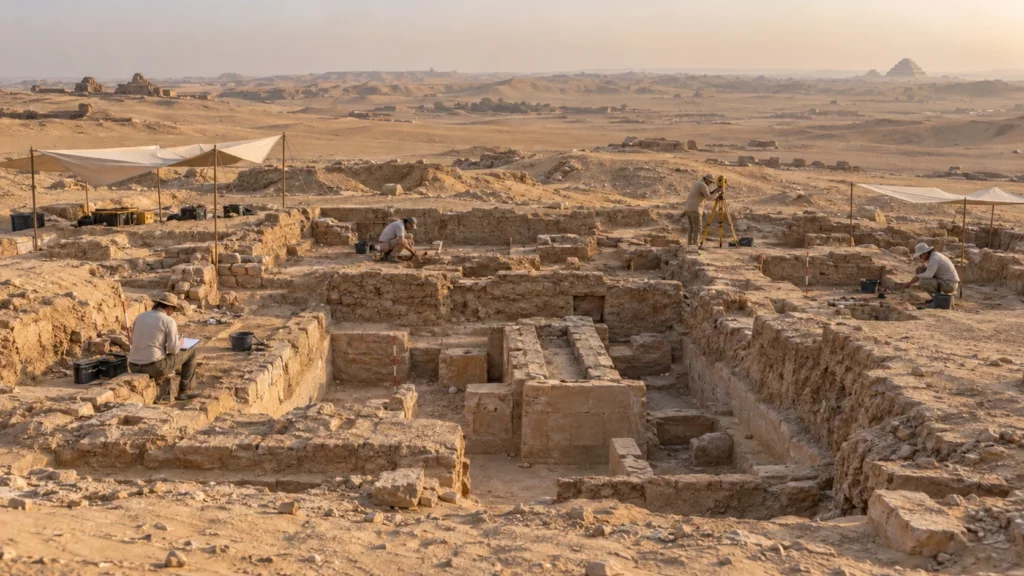
South of the Step Pyramid of Djoser, Tabbet al-Guesh is not an isolated tomb, what the Egyptians called a ‘house of eternity’, but a vast stretch of the Saqqara necropolis. The ground extends between the unfinished complex of Sekhemkhet, to the north, and the pyramid of Pepi I, to the south. Since 2000, the mission of the Institut français d’archéologie orientale (IFAO, French Institute of Oriental Archaeology) directed by Vassil Dobrev has been following the traces of several periods there: the end of the Old Kingdom, the First Intermediate Period and the Late Period. Every mudbrick wall must therefore be read before it is attached to a story.
What you discover
In the north-western area, archaeologists have uncovered mudbrick superstructures, chapels, burial shafts and chambers cut or built underground. Some burials belonged to priests of the 6th Dynasty; others are much later. The IFAO’s publications insist on one essential point: the excavated area remains tiny compared with the plateau. This disproportion explains why the successive discoveries look less like a finished inventory than like the first pages of a book still buried.
Its history
Five trial trenches opened in October 2000 preceded the start of regular excavation. From 2001, an area of about 60 by 50 metres was explored on the north-western plateau, nearly 2% of its fifteen hectares. The remains show that the funerary space was built, used, robbed, reoccupied and then transformed. The tomb of Pepior, the chambers of Sabi and Ankhti and the chapel of Haunefer belong to this long history, but they do not on their own sum up the site.
Why this place matters
Tabbet al-Guesh makes it possible to observe the society that surrounded the royal pyramids: priests, cult officials and families placed their tombs near the monuments of the kings. This organisation also feeds a more ambitious investigation. Several kings of the 6th Dynasty are known from king lists or annals, while their funerary complexes have not been located. The site therefore offers serious ground for seeking clues, provided that a topographical hypothesis is never confused with a pyramid actually discovered.
To go further
The series follows three complementary lines: the filmed excavation of the tomb of the priest Pepior; the cautious search for the lost complex of Userkare; and the well-published tombs of the lector priests Sabi and Ankhti. The tomb of the vizier Mehu appears in the general Saqqara section, but it is deliberately left out of this series: discovered in 1940 by Zaki Saad, it does not belong to Dobrev’s excavations.