In brief
Userkare reigned at the beginning of the 6th Dynasty, between Teti and Pepi I. His name survived in the king lists and in the annals of South Saqqara, but his funerary complex has not been located. At Tabbet al-Guesh, Vassil Dobrev is investigating whether a necropolis of priests might indicate the proximity of a vanished royal monument. The idea is coherent; it remains a hypothesis.
The historical evidence
The Abydos King List places Userkare among the rulers of the 6th Dynasty. The annals studied by Michel Baud and Vassil Dobrev confirm that this is not simply a name added at a late date. His reign seems to have been short, which might explain an unfinished, modest or quickly abandoned complex. But the brevity of a reign is not enough to point to a location.
Why search at Tabbet al-Guesh
The great royal complexes drew around them the tombs of courtiers and of cult staff. The sector has yielded burials of priests of the late Old Kingdom. Its position between the pyramids of Sekhemkhet and Pepi I also leaves a gap in the monumental map of South Saqqara. These clues justify the search; they do not constitute proof of a sanctuary of Userkare.
What the geophysics says
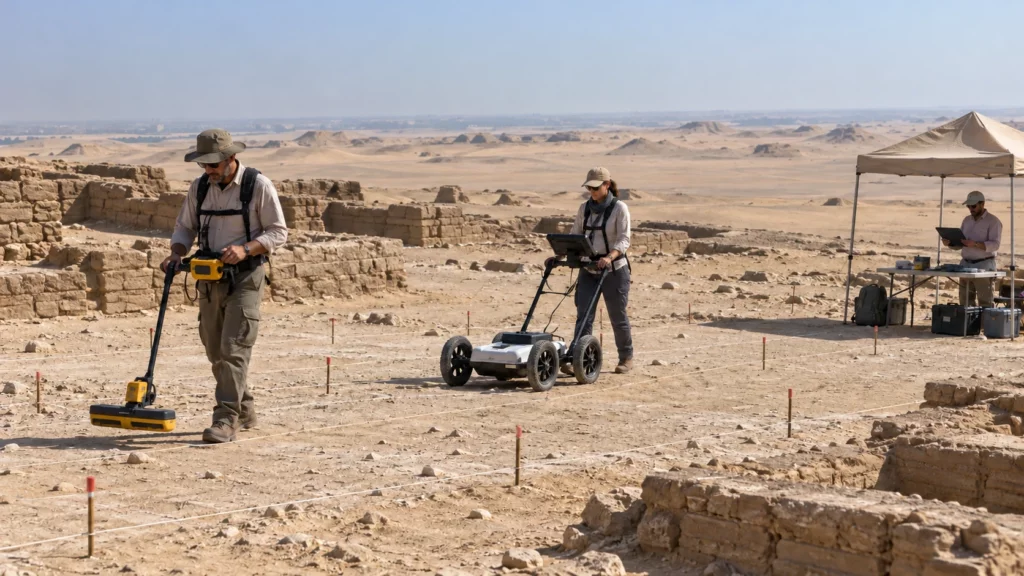
In 2013, electromagnetic, radar and magnetic measurements were carried out to locate possible foundations. A later publication states that no solid evidence of a pyramid was found at the time. In 2015, a finer electromagnetic survey revealed several shallow rectangular anomalies, probably man-made and comparable in size to the tombs already excavated. They may guide future trial trenches, but they do not outline an identified royal complex.
To go further
The investigation into Userkare is exemplary because it requires holding three levels together: a historically attested king, a monument expected by comparison and ground that yields nameless anomalies. The in-depth article follows this reasoning step by step and explains why the best present conclusion is neither ‘the pyramid has been found’ nor ‘it does not exist’, but ‘the search remains open’.