In brief
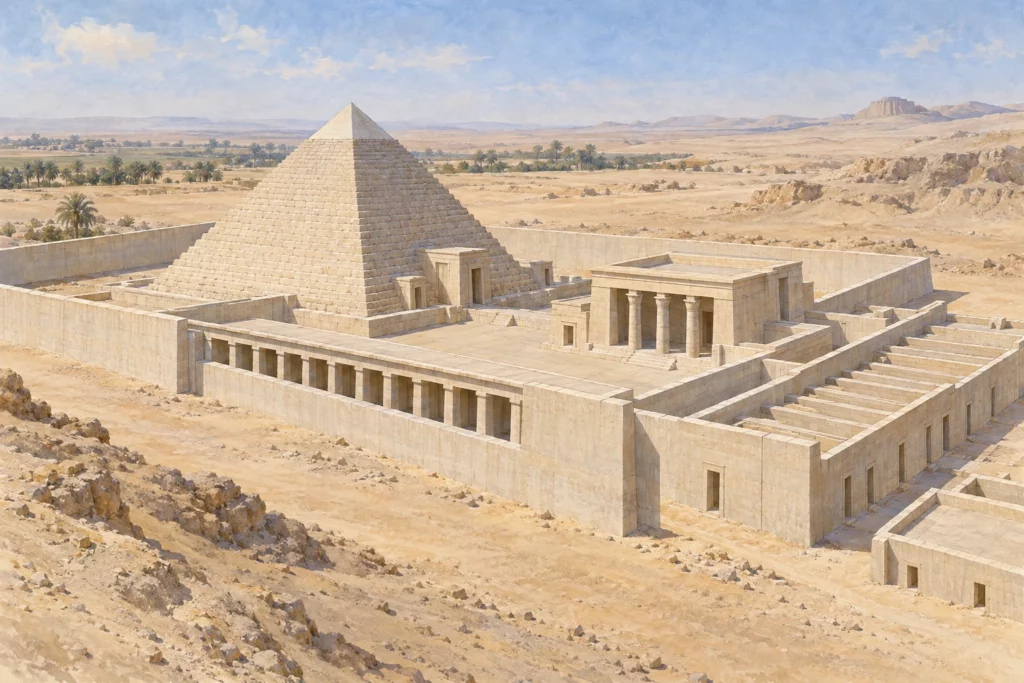
The pyramid of Ankhesenpepi II lies in the queens’ necropolis south-west of that of Pepi I, at South Saqqara. This queen was the wife of Pepi I and then of Merenre I, and the mother of Pepi II. The French-Swiss Archaeological Mission states that she acted as regent during the first years of her son’s reign. Her monument is the largest in the necropolis after that of King Pepi I.
What you discover
The pyramid had a base of about 31.40 metres. It was surrounded by a complex with a large porticoed court, offering rooms, a series of about twenty storerooms and a small satellite pyramid. These spaces served to organise the queen’s cult and to keep the objects it required. In the funerary apartments, Pyramid Texts were carved on the walls. The mission has recovered nearly 1,400 inscribed blocks over several seasons; their study makes it possible to reconstruct part of the lost programme.
Its history
The queen had a sarcophagus whose inscription gives her the title ‘king’s mother’. Her family and political status explains the scale of her monument, but the details of her regency must be drawn from the sources, not deduced from the plan alone. The funerary texts were intended to secure her posthumous survival. A scholarly edition of these inscriptions appeared in 2024. It distinguishes the spells known from elsewhere, their variants and those not found anywhere else.
Why this place matters
The monument shows that some queens of the late Old Kingdom had access to a highly developed architectural and textual programme. The elements visible today and the thousands of fragments do not, however, make up an intact room: the work of reconstruction brings together scattered pieces.