Identification and location
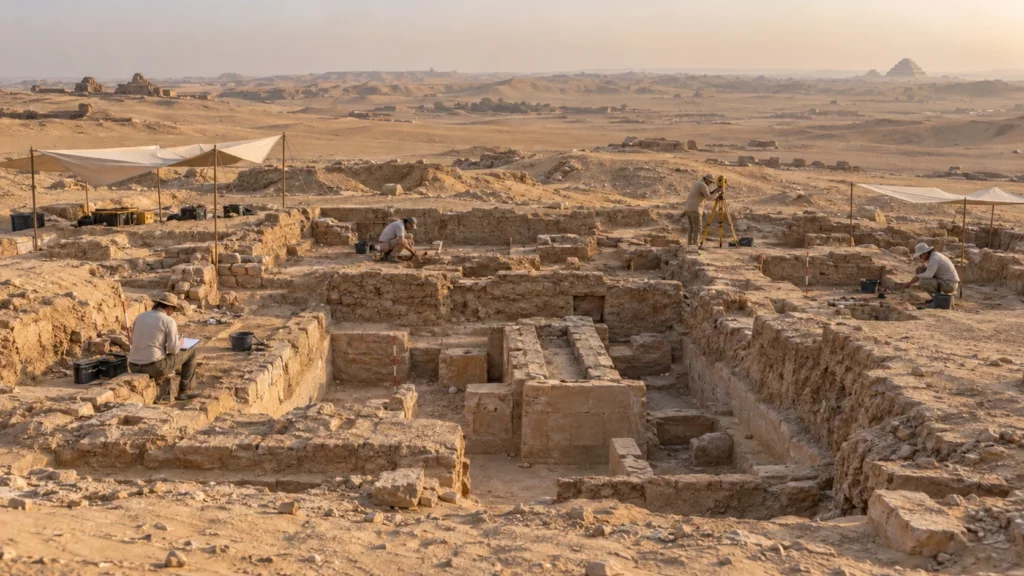
Tabbet al-Guesh covers about one square kilometre at the northern end of South Saqqara, some 800 metres south of the Step Pyramid of Djoser. The Wadi Gamal naturally divides the ground into eastern and western sectors, themselves divided into four entities: Tb NE, Tb SE, Tb SW and the Tb NW plateau. The excavation directed by Vassil Dobrev concentrated on this last sector. To the north lie the complex of Sekhemkhet and the former monastery of Apa Jeremias; to the south, the complex of Pepi I and its necropolis of private individuals.
A stratified funerary landscape
The site does not belong to a single period. Structures of the end of the Old Kingdom stand alongside mastaba-houses of the First Intermediate Period and tombs of the Late Period. This superimposition calls for reasoning based on stratigraphy, architecture, pottery and epigraphy. A wall that has appeared beneath the sand cannot be dated from its appearance alone. Ancient reuse further complicates the reading: a shaft may have been reopened, a chamber emptied, a funerary space adapted to new burials.
The architecture of the ‘houses of eternity’
The tombs of the elite, what the Egyptians called ‘houses of eternity’, most often combine a visible part, a superstructure or chapel in which the living performed the rites, and an underground part reached by a shaft. Mudbrick dominates in the elevations, while limestone could receive painted scenes or inscriptions. At Tabbet al-Guesh, the scientific interest lies as much in the plans as in the decoration: the relative placing of the tombs can reveal family groups, phases of construction and the attraction exerted by a cult centre that has now disappeared.
Pepior: an excavation made visible
In the extract broadcast by the programme Des Racines et des Ailes – France Télévisions, Vassil Dobrev presents the façade of the tomb of Pepior, his offices linked to the great palace, his title of lector priest and several figures of his circle. The film also shows the preparations for clearing the shaft and the protection of the chapel. The articles devoted to Pepior now take up these readings, attributing them to the archaeologist; the exact nature of his relationship with Henib and the complete study of the chamber are kept distinct from the facts shown. Watch the extract from the presentation of Pepior (in French).
Sabi and Ankhti: two published complexes
In 2015, two mudbrick structures yielded the chambers of Sabi and Ankhti, lector priests of the reign of Pepi II. The painted limestone walls, the offering scenes, the pottery and alabaster vessels and the tablet of the seven oils found beside one of the deceased provide a much better documented record. These tombs show that the necropolis sometimes preserves not only a name and an office, but also part of the ritual programme intended to secure the survival of the deceased.
Userkare: a question, not a discovery
Userkare appears between Teti and Pepi I in the Abydos King List and in the annals of the 6th Dynasty. His funerary complex remains unknown. The concentration of priests’ tombs and the position of Tabbet al-Guesh led Dobrev to look here for the centre of a vanished royal necropolis. The geophysical surveys carried out in 2013 did not, however, convincingly reveal the foundations of a pyramid. A finer campaign in 2015 located several rectangular anomalies, probably man-made, of dimensions comparable to neighbouring tombs. These results guide the excavation; they do not demonstrate the existence of a pyramid.
Excavating, conserving, publishing
At Saqqara, discovery is immediately followed by conservation work. Mudbrick erodes, painted plaster reacts to changes in humidity and underground spaces can become unstable. The excavation therefore brings together archaeologists, conservators, surveyors, pottery specialists, geologists and epigraphers. The publication of the tombs of Sabi and Ankhti illustrates the indispensable step that turns a field discovery into verifiable knowledge. Tabbet al-Guesh thus remains an open file: rich in clues, but still very far from fully excavated. The IFAO now lists this operation as completed. The publications preserve the results of the excavation and the questions it has raised.