In brief
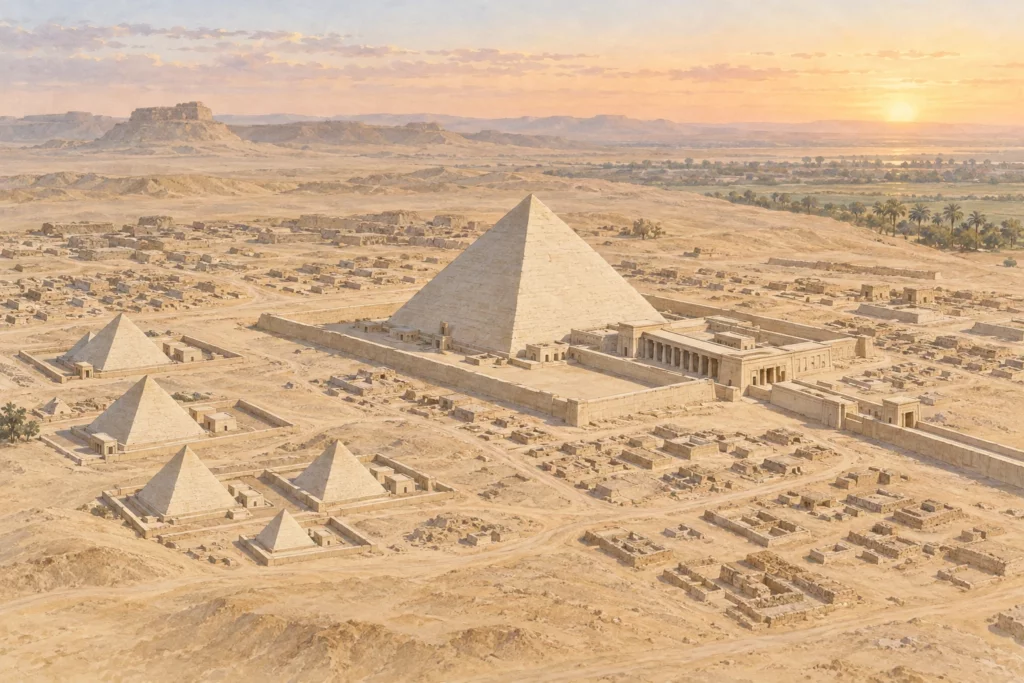
At South Saqqara, King Pepi I had his pyramid built in the 6th Dynasty, around the middle of the 3rd millennium BC. His throne name was Meryra. The king’s complex became the centre of a vast necropolis in which monuments of queens and dignitaries were also established. This group should be seen as a funerary landscape that developed over time, rather than as a single, instantaneous construction.
What you discover
The royal pyramid is now very ruined, but its substructure preserves a major testimony: the Pyramid Texts carved in the funerary apartments. The temple of the royal cult lay to the east. Excavations by the French, then French-Swiss, Archaeological Mission have made it possible to clear, study and restore parts of the pyramid and the temple. The inscribed fragments have been recorded and, where their position could be determined, put back to reconstruct the walls. The neighbouring queens’ pyramids occupy mainly the southern and western sectors of the necropolis.
Its history
The name of the pyramid, Men-nefer, played a part in the history of the name of Memphis. This linguistic legacy does not mean that the whole ancient city was reduced to the tomb. The carved spells were intended to secure the king’s transformation and survival after death. The presence of queens’ burials around the royal monument reveals a family and dynastic topography; their owners, dates and inscriptions must nevertheless be studied separately. The tomb of an official linked to the cult of Pepi I has also been identified near the complex.
Why this place matters
The pyramid of Pepi I shows how a monument badly degraded on the surface can preserve essential data in its chambers and its scattered blocks. Research on the inscriptions and on the neighbouring monuments is changing our understanding of the whole.