In brief
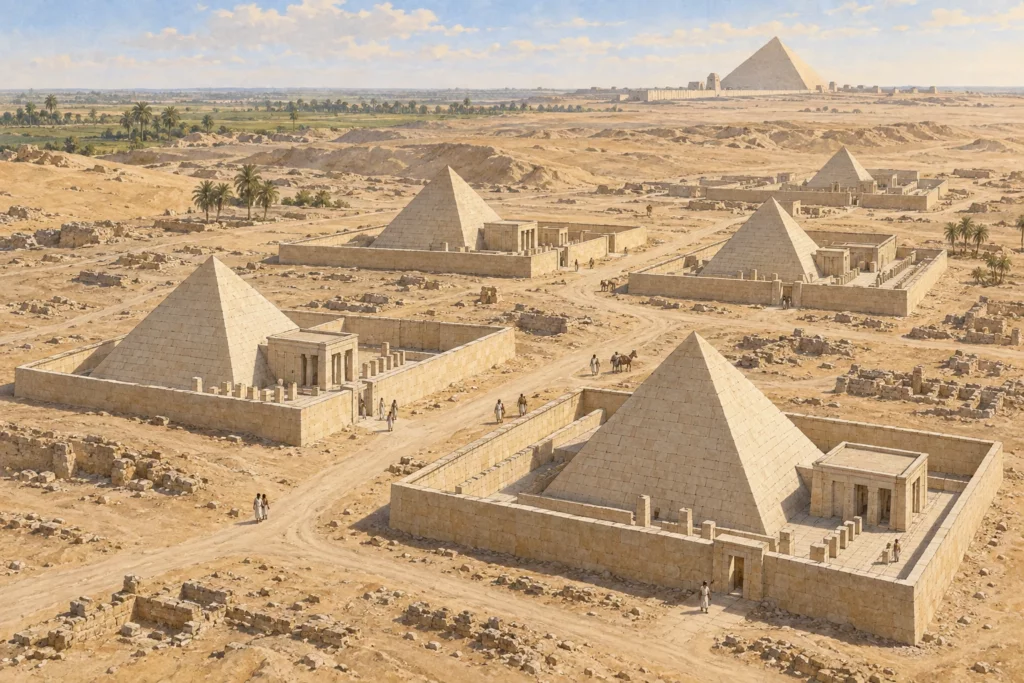
Around the pyramid of Pepi I, at South Saqqara, several queens and women of the royal family had their own monuments. The excavations of the French-Swiss Archaeological Mission have revealed a dense necropolis, organised over several generations. The title ‘queens of Pepi I’ refers here to a research sector; not all the owners of the pyramids discovered were his wives.
What you discover
The complexes of Nubunet and Inenek-Inti, two wives of Pepi I, had small pyramids, courts and offering rooms. Inenek-Inti also bore the title of vizier. The complex of Mehaa, associated with her son Hornetjerykhet, belonged to the same neighbourhood. Further west, Behenu had a monument with Pyramid Texts in its chambers; her exact link with Pepi I or Pepi II is still debated. Ankhesenpepi II, wife of Pepi I and then of Merenre and mother of Pepi II, received a much larger complex, dealt with separately in the next article. Other monuments, such as those of Ankhesenpepi III and Meretites II, belong to later generations.
Its history
Each pyramid belonged to a cult complex with an entrance, offering spaces and sometimes a small satellite pyramid. The plans differ according to the space available and the status of the owner. The chambers of Nubunet and Inenek-Inti bear no carved texts, while those of Behenu and Ankhesenpepi II preserve them. This variation rules out representing all the queens’ pyramids as identical copies. The ‘western complex’, for its part, still has no identified owner and went through several building phases.
Why this place matters
This necropolis reveals the distinct role of royal women in the funerary landscape and the way the space was reused. Research has shed light on their titles, their cults and the transformations of the site, while leaving questions open. The accompanying visuals are interpretive compositions: they show types of layout and decoration without reconstructing the exact plan, identity or date of each monument depicted.