In brief
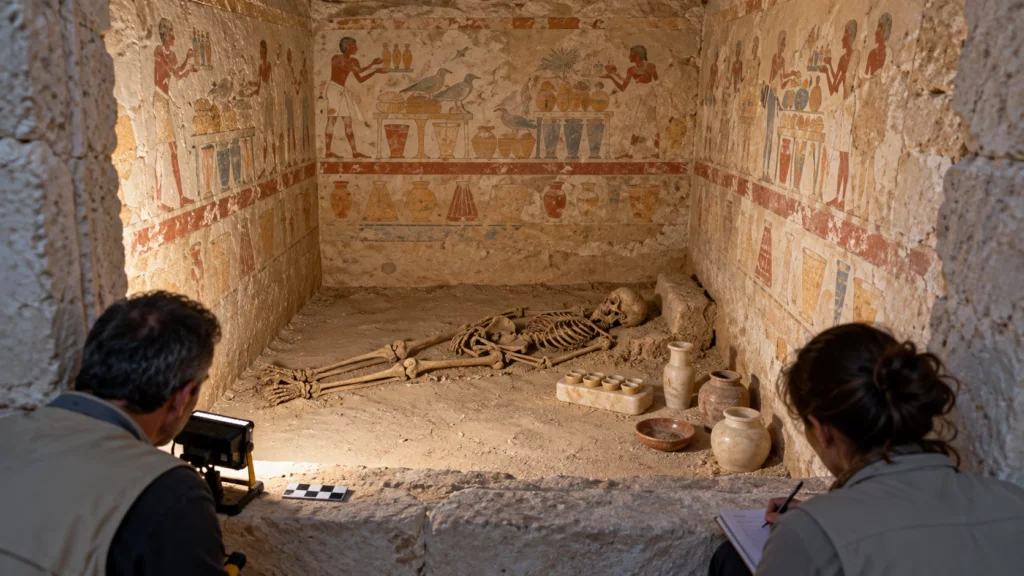
In February and March 2015, Vassil Dobrev’s mission opened two burial chambers at Tabbet al-Guesh in the names of Sabi and Ankhti. Both were lector priests under the reign of Pepi II. Their tombs, what the Egyptians called ‘houses of eternity’, had suffered ancient damage, but the chambers preserved painted limestone walls, offering scenes and part of the ritual equipment. Here, the discovery has been the subject of a detailed scholarly publication.
What you discover
Mudbrick superstructures gave access to several shafts. At the bottom of two of them, the archaeologists found the chambers of the two priests. The decoration shows the goods needed by the deceased: food, vessels and objects arranged according to the funerary conventions of the Old Kingdom. The colours are not mere decoration; through the image, they make lasting what the living were supposed to provide through ritual.
Objects for rebirth
Beside the deceased lay pottery and alabaster vessels. One of the groups included an alabaster tablet for the seven ritual oils. These substances played a part in the washing and regeneration of the body. Miniature objects and equipment linked to the Opening of the Mouth ritual are a reminder that the burial aimed to give the dead their faculties back: to breathe, see, speak and receive offerings.
The role of the lector priest
The lector priest, recognisable in the sources by his function as reciter, read the ritual spells. His knowledge gave efficacy to the gestures performed during ceremonies. The fact that Sabi and Ankhti held this office sheds light on the quality of their chambers and their equipment: they belonged to the world of the cult and knew the words meant to cross death. Their tombs transpose this professional knowledge into their own funerary future.
To go further
The tombs of Sabi and Ankhti allow us to go beyond the moment of their opening. Their architecture, decoration, objects and the burials added in the shafts show a monument used over a long period. The in-depth article follows this biography of the tomb and places the two priests within the necropolis of the late 6th Dynasty.