In brief
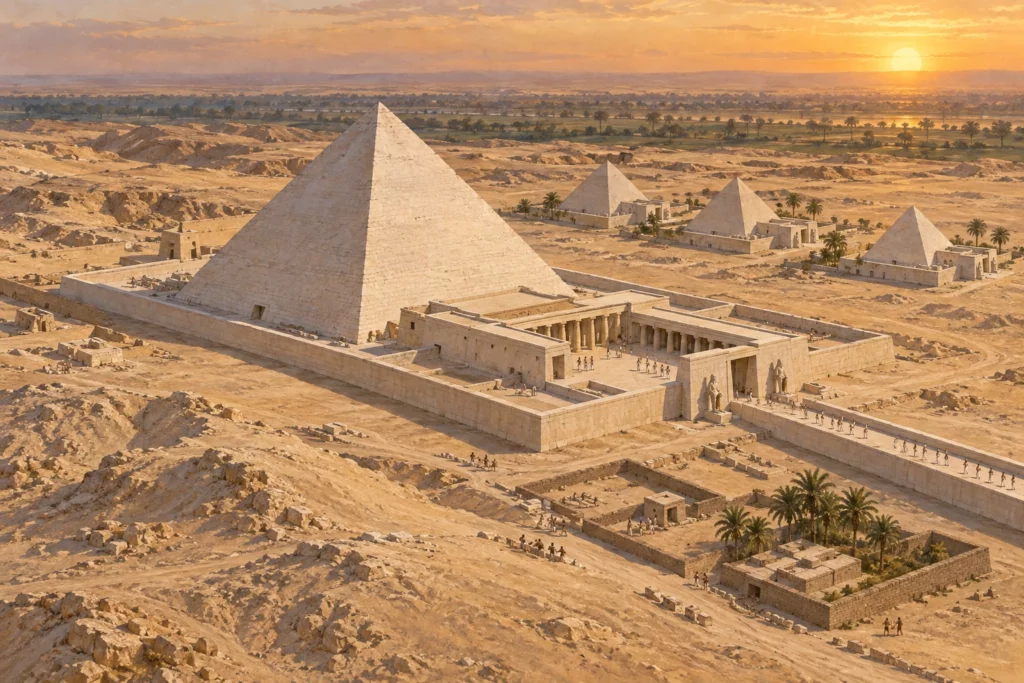
The pyramid of Pepi II stands at South Saqqara, at the heart of the funerary complex of King Neferkare, a ruler of the late 6th Dynasty. His reign was exceptionally long, but its exact length is debated. The pyramid is accompanied by a temple and by monuments of queens. It belongs to the last great phase of the royal pyramids of the Old Kingdom, whose chambers received the Pyramid Texts.
What you discover
A passage led beneath the pyramid to the king’s funerary spaces. The walls bore religious spells intended for his survival after death. Outside, the temple provided for the offering rites; the complex also included an approach from the valley. Queens’ pyramids such as those of Neith, Iput and Wedjebten have been studied in its vicinity. Each queen had her own monument and her own inscriptions: their tombs must not be reduced to annexes without identity.
Its history
Gaston Maspero opened the pyramid in 1881 and published the first known inscriptions. Gustave Jéquier resumed excavations in the 1930s, gathered dispersed blocks and proposed new readings. Since 2018, the French-Swiss Archaeological Mission has resumed the study of the texts of Pepi II. It stresses that not all the passages have yet been given a photographic record and a facsimile edition comparable to those of other royal pyramids. The state of research should therefore not be presented as definitively closed.
Why this place matters
The long history of the excavations shows how much the monument also depends on the work of conserving and documenting the stones. The pyramid illustrates the continuity of royal rites at the end of the Old Kingdom, without proving on its own the causes of the political changes that followed.