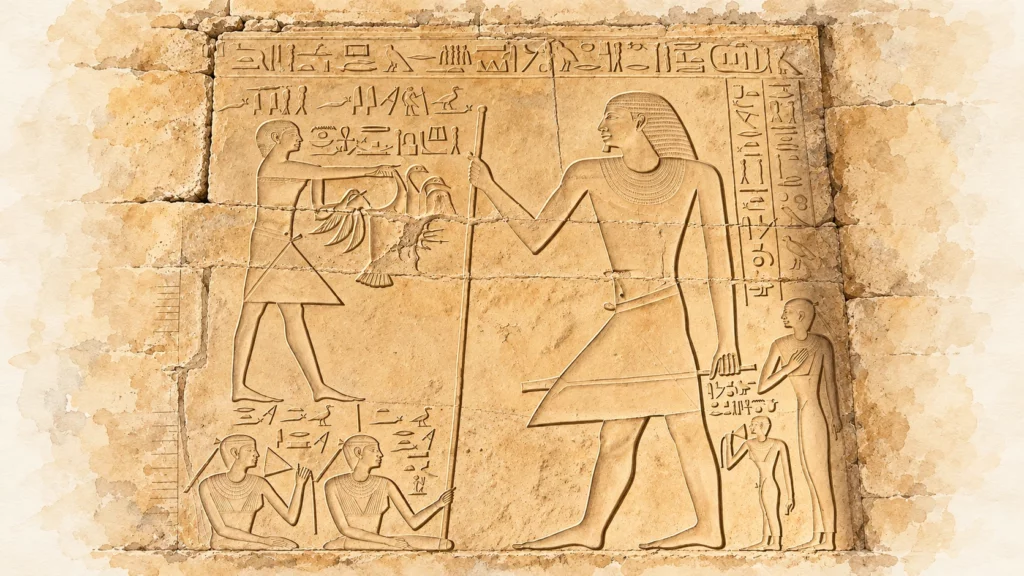
A face at the entrance to the chapel
At the entrance to the funerary chapel, a profile carved in stone makes Pepior immediately present. The information provided by Vassil Dobrev names him and shows this representation, before following the preparations for clearing his shaft. At Tabbet al-Guesh, in the necropolis of South Saqqara, Vassil Dobrev’s team thus recovers not only an architecture: it can also read part of the identity of its owner.
A priest linked to the royal service
In front of the façade, Dobrev explains that Pepior led a group of priests of the great palace and held the office of lector priest. The former looked after the statues of the pharaoh in the temple: they removed their clothes and ornaments, cleaned the statue, then dressed it again. The archaeologist describes a service renewed every fifteen days. The title of lector priest refers to the words recited to accompany the gestures of the ritual. These responsibilities place Pepior among the trusted men of the royal service, without making him a vizier.
A family set in stone
The façade gives a place to Pepior’s circle. His eldest son brings the offerings intended to maintain his cult after his death. At the bottom left, two daughters kneel; the elder holds a staff, which Vassil Dobrev interprets as a mark of authority.
Then the eye moves to the wife. Between her and her husband stands another woman. Smaller in the composition, she nevertheless occupies a place that the documentary’s commentary presents as more intimate. She is not a daughter of Pepior, Dobrev explains, and no family tie is indicated. The scene is surprising: beside the man whose tomb is to preserve his memory, the wife is not alone.
This woman is called Henib. The archaeologist presents her as a ‘pensioner of Ptah’ and translates her name as ‘she who brings my heart to life’ (translated from the French). On this wall devoted to titles, offerings and the survival of the deceased, these few words suddenly strike a more personal note. The dialogue that follows suggests what we would now call a mistress. Dobrev nevertheless points out that this relationship is not named in the inscription: it is the closeness of the figure and the reading of her name that feed his interpretation. Henib has her place in the monument; the stone leaves part of their story open.
Clearing the shaft
At the moment filmed, the workmen are building a wooden platform to empty the burial shaft. Dobrev estimates that it might descend eight or ten metres. The sand must be removed gradually, while monitoring the soundness of the rock and keeping the fragments that might complete the façade, which was found partly collapsed. The documentary places these tombs about 4,200 years before the filming; it does not show that the shaft remained untouched throughout that time.
Reading and protecting a tomb
The chapel received the offerings and kept alive the memory of the deceased; the shaft led to the burial space. The name, the titles and the figures of the circle give meaning to this arrangement. After it was cleared, the chapel was given a metal roof. The film also shows the daily closing of the entrances and the seal of the antiquities inspector. Opening a tomb immediately makes it necessary to protect what has just reappeared.
To go further
The in-depth article takes up Vassil Dobrev’s readings and explanations, distinguishing the elements shown in the documentary from the interpretations he proposes. It places Pepior’s titles and circle within the functioning of an Old Kingdom tomb.
Sources and references
- Des Racines et des Ailes – France Télévisions: ‘Les archéologues ouvrent une maison d’éternité oubliée depuis des millénaires !’ (in French), the audiovisual source of Vassil Dobrev’s readings.
- IFAO, presentation and bibliography of Tabbet al-Guesh (in French)
- IFAO, the Tabbet al-Guesh operation (in French)
- Illustration ‘The carved wall of Pepior’: drawn from the work of Vassil Dobrev.