In brief
Merenre I, whose birth name was Nemtyemsaf, reigned in the 6th Dynasty, between Pepi I and Pepi II. His pyramid stands at South Saqqara, in the group of royal tombs of the late Old Kingdom. Seen from outside, it is no more than a devastated monument; its interest lies elsewhere, beneath the mass of stone, in funerary apartments whose walls were covered with the Pyramid Texts. Only eleven pyramids inscribed with these spells are known today, all at Saqqara: that of Merenre is one of the richest.
What you discover
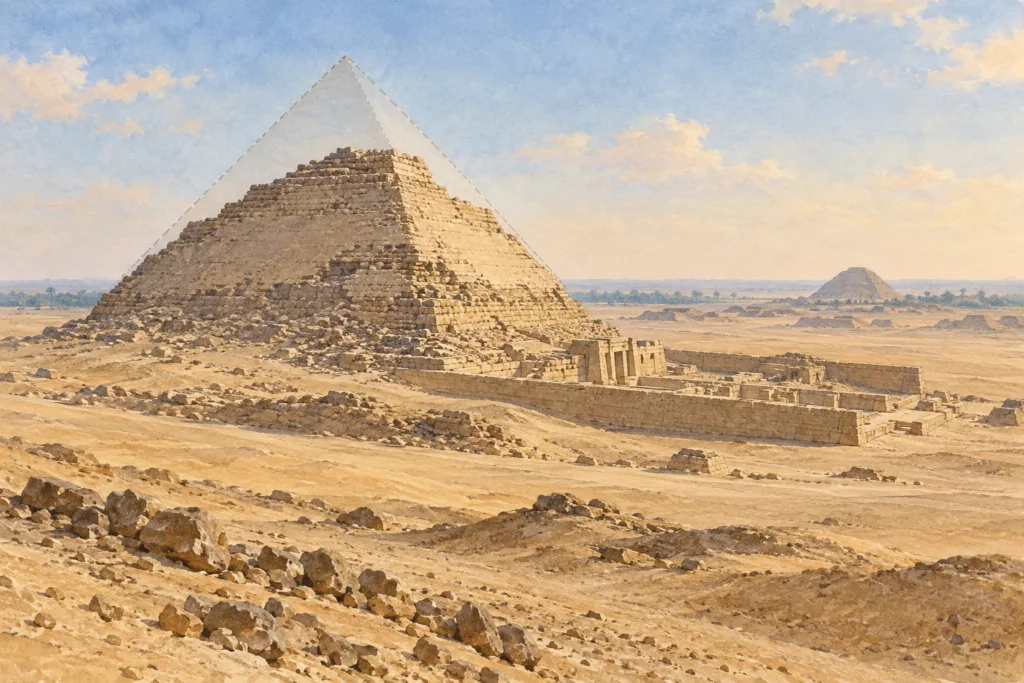
On the ground, the devastated monument offers no more than a mound of rubble, far removed from the image of a smooth pyramid with sharp edges. What matters lies beneath. A corridor, a vestibule and passages led to the antechamber and the burial chamber. It was in these underground spaces that the spells had been carved, to secure the king’s survival after death.
The state of the monument made its excavation a work of patience. Inside, many of the wall stones had been broken or moved. The archaeologists had to consolidate the structures as clearance progressed, to prevent collapses.
What to look at
What sets this place apart is the quantity of text it has yielded despite its ruin. More than two thousand inscribed fragments were collected from the rubble, then all drawn and studied. Fitting them together made it possible to identify about 627 spells, more than in the neighbouring pyramid of Pepi I, where some 569 are counted. Above all, 51 spells appeared in no other known pyramid: they were given the numbers 1101 to 1151 in the numbering of the Pyramid Texts. Each inscribed wall has been reproduced in facsimile at one fifth of its actual size, in 34 plates. One spell of the corpus (PT 422) sums up its spirit: ‘Your name will live on earth, your name will grow on earth, you will never perish, you will never disappear, for all eternity’ (translated from the French).
This monument should therefore be looked at as much through its fragments as through its walls: a published wall often combines stones that remained in place with pieces collected from the ground, whose position was recovered by studying the joins.
Its history
The pyramid was opened at the end of 1880, at the request of Auguste Mariette. Heinrich Brugsch entered it at the beginning of January 1881 and wrote a first report, while Gaston Maspero recorded the inscriptions and had squeezes made. Merenre is thus among the first kings whose Pyramid Texts were read, together with Unas, Teti, Pepi I and Pepi II. Nearly a century later, at the end of the 1970–1971 season, Jean Leclant and Jean-Philippe Lauer reopened the monument; work continued until 1974, then from 1976 to 1980. The complete edition of the texts, by Isabelle Pierre-Croisiau, appeared in 2019 from the Institut français d’archéologie orientale (IFAO, French Institute of Oriental Archaeology).
The reign itself left other traces, far from Saqqara: rock inscriptions near Aswan, mentions in the biographies of senior officials such as Weni at Abydos or Harkhuf near Elephantine. His pyramid nevertheless remains the place where his memory is densest, and the study of the fragments may yet clarify the position of some passages.
Sources
Consulted on 30 September 2026: Textes des pyramides, French-Swiss Archaeological Mission at Saqqara, University of Geneva (in French); Isabelle Pierre-Croisiau, Les textes de la pyramide de Mérenrê (MIFAO 140), Institut français d’archéologie orientale, 2019 (in French); King Merenre, Digital Egypt for Universities, University College London.