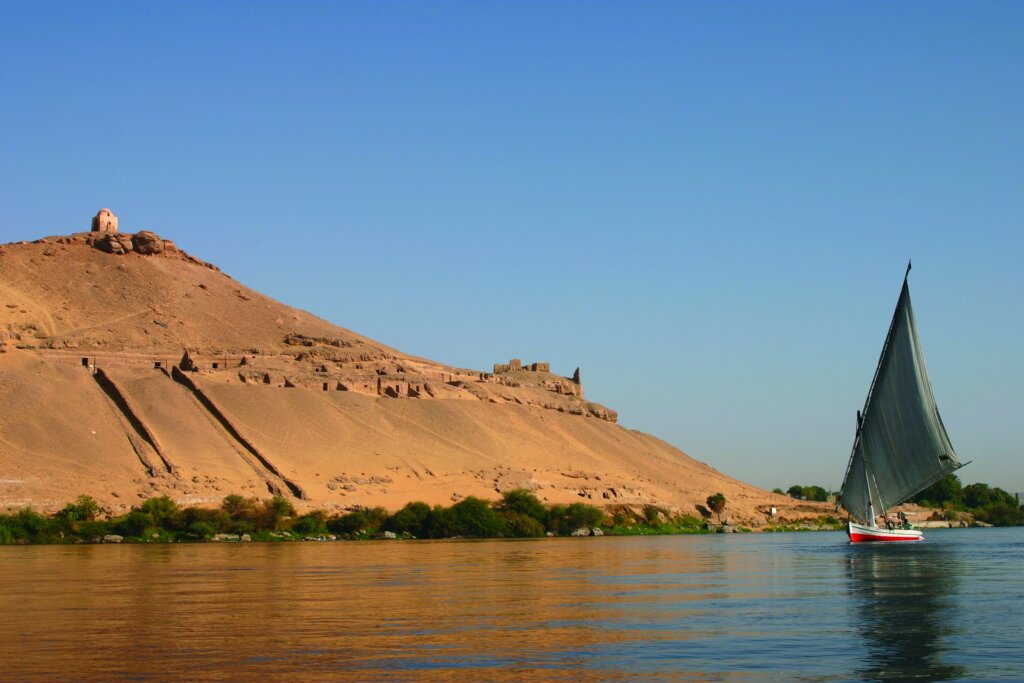
A whole day has been lost in the souk. At four o’clock, I finally remember my guide’s advice: the viewpoint, before sunset. I must hurry.
A day in the souk
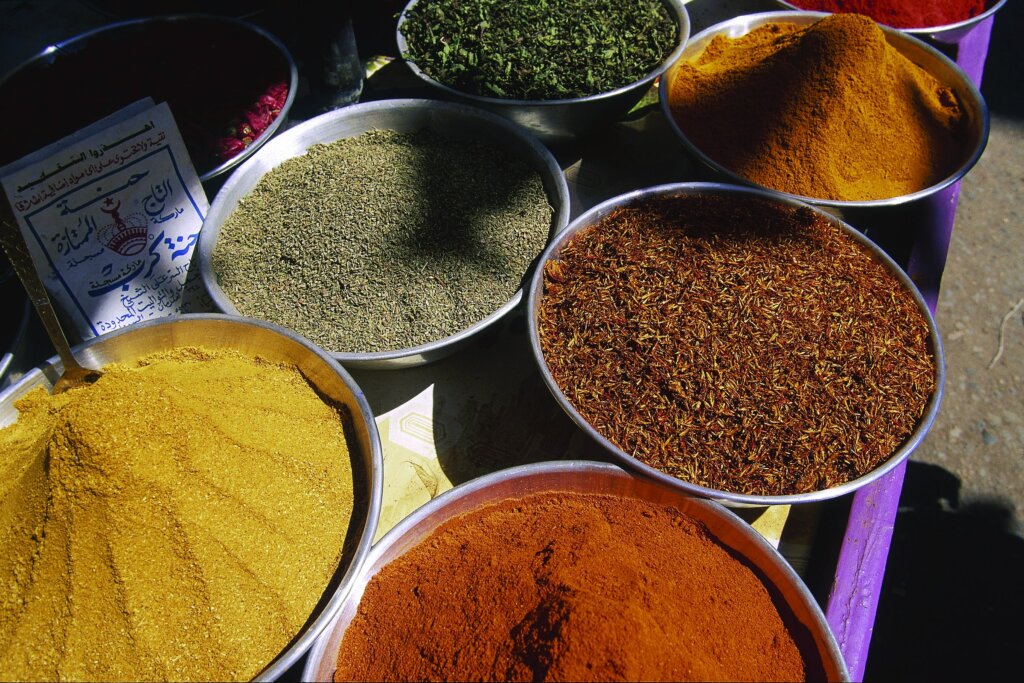
Having arrived from Paris in the middle of the night, I did not resist the call of the souk for long. In the morning I made my way to this street running parallel to the Corniche to take my first plunge into Egypt. Spices are heaped into pyramids, fabrics sit next to baskets, the traders call out. I go from one stall to the next. Modern gadgets have found their place in the jumble; they hardly change its rhythm.
Four o’clock already
Four o’clock. How could I have let the whole day slip by? My guide’s advice comes back to me: ‘This afternoon, don’t be late climbing up to the viewpoint, at the end of the Corniche. You like photography and fine colours. Up there, you will be well served.’ I leave the souk, a little reluctantly. There would still be so much to look at.
Swenet, the ancient name of Aswan, was linked to trade. After a few hours in this street, I remember it without effort. The ivory, gold, incense and skins that came from the South have given way to other goods, but people still come here to buy, to sell, to pass through. I lingered here like so many travellers before me. The sun, for its part, did not stop.
On the Corniche, the feluccas are moored in clusters. The boatmen call out to me. One of them, in a turban and tougher than the others, finally gets a promise out of me: tomorrow, I shall go out with him. For now, I have to climb.
The race against the sun
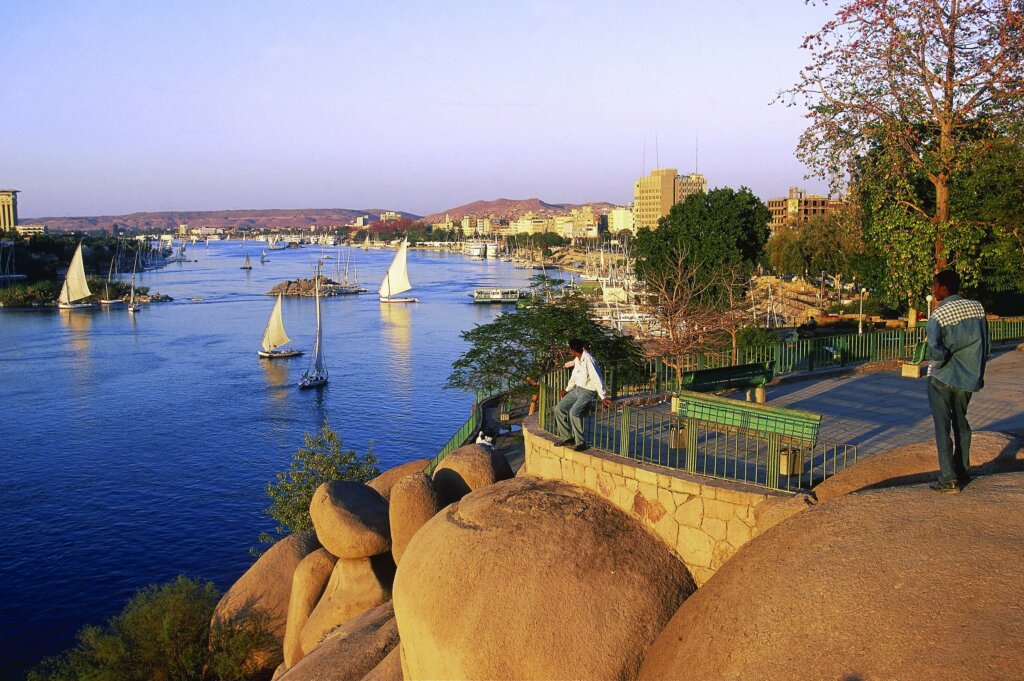
The shadows lengthen, the mud walls turn to gold. I quicken my step. The boats, the calls, the possible departures will have to wait: the setting sun barely leaves me time to reach the little square of the viewpoint.
At last, the Nile is at my feet. I stop hurrying. Between the islands and the clumps of papyrus, the feluccas glide, their sails holding the last rays. The cliffs of sandstone and sand change colour. In the distance, the town already seems to be dozing. Laughter rises from the gardens of the Old Cataract; its ochre façade and the azure of its swimming pool stand out against the dark water. I am alone in this spot, and all the bustle of the souk suddenly seems very far away.
Tomorrow on the river
Looking at the water, I think back to what made Aswan a frontier: the First Cataract, the granite rocks that barred the way to boats and, beyond, Nubia. Yet the river in front of me seems so peaceful. The High Dam has tamed its waters and changed the face of this ancient boundary.
It is hard to give a measure of this change. The Sadd al-Ali is nearly four kilometres long, more than a hundred metres high and rests on a base almost a kilometre wide. It took some ten years of work, in the 1960s, and tens of thousands of men to build it. Behind it now stretches Lake Nasser, for more than five hundred kilometres, as far as Sudan. From this viewpoint, nothing suggests such an inland sea.
The sails keep passing. Aswan now welcomes cruises, excursions, travellers arriving and those leaving again. Today, I let myself be caught by its souk; tomorrow, it will be the river. I have given my word to a boatman. I shall just have to manage to leave on time.
To go further (in French): Aswan, the last frontier · Aswan (Archaeological sites) · Qubbet el-Hawa · Granite quarries and the unfinished obelisk · The Aswan High Dam · The Nubian campaign · Elephantine, the frontier island