A richly attested reign
Pepi I, whose throne name is Meryre, is one of the best-documented rulers of the 6th Dynasty. His pyramid at South Saqqara, his decrees, the expedition inscriptions and the autobiographies of dignitaries make it possible to study several aspects of his power. The lengths of reign proposed are not the same in every chronology, and some episodes known only from private testimony call for a critical reading. The sources nevertheless show a government able to carry out building works, protect religious institutions and send teams to regions of resources. The reign therefore cannot be reduced either to his tomb or to a series of isolated campaigns. In the chronology of Ian Shaw (Oxford, 2000), his reign falls c. 2321–2287 BC.
The pyramid and the funerary texts
The complex of Pepi I lies in the necropolis of South Saqqara. Its inner chambers bore Pyramid Texts, continuing the practice begun under Unas. Fragments of these inscriptions are kept in modern collections and are used to compare the versions of the spells. The pyramid was surrounded by places of worship and by monuments associated with the royal family. Their study shows how the ruler’s memory depended on a lasting institution, provided with priests and offerings. The surviving architecture does not on its own tell all the phases of the building work. It does, however, bear witness to an ambitious funerary programme, in which the carved words had a protective function as important as the stone walls.
Missions in the deserts
Inscriptions bearing the name of Pepi I have been found in the Wadi Hammamat, at Hatnub and at Wadi Maghara. They record expeditions to quarries or to regions rich in raw materials. Some mention the ruler’s first Sed festival, which links the work and transport to the celebration of royal power. An inscription at Hatnub includes a date in year 25; it helps to fix a minimum for the length of the reign, subject to the ancient dating conventions. These texts do not provide a complete picture of the resources exploited or of the number of workers involved. They do, however, make visible operations organised outside the valley, with material and symbolic aims.
Weni and the king’s missions
The autobiography of Weni, carved in his tomb at Abydos, is an essential source on careers in the service of the 6th Dynasty. It refers in particular to judicial and military missions carried out under Pepi I. The text allows us to follow the trust placed in an official and the way he presented his successes. It should not be read as an impartial record of royal decisions: Weni was writing to celebrate his own position. It nevertheless provides rare information on the mobilisation of men and on relations between the ruler and his agents. The episodes it reports broaden the portrait of Pepi beyond the official inscriptions left in the quarries.
Decrees and presence in the temples
Decrees of the king have been found at Dahshur and Coptos, while a chapel bearing his name is known at Bubastis. These documents show that the court intervened in religious establishments in several regions. Each decree responded to a specific situation; it does not prove a general reform of all the temples. The inscriptions are nevertheless important for understanding the power to set exemptions, resources or statuses. Faience objects and vessels bearing the titulary of Pepi complete this network of attestations. Their variety shows that royal authority was expressed on monumental stone, but also in portable goods associated with festivals and foundations.
Sculptures and the image of the monarchy
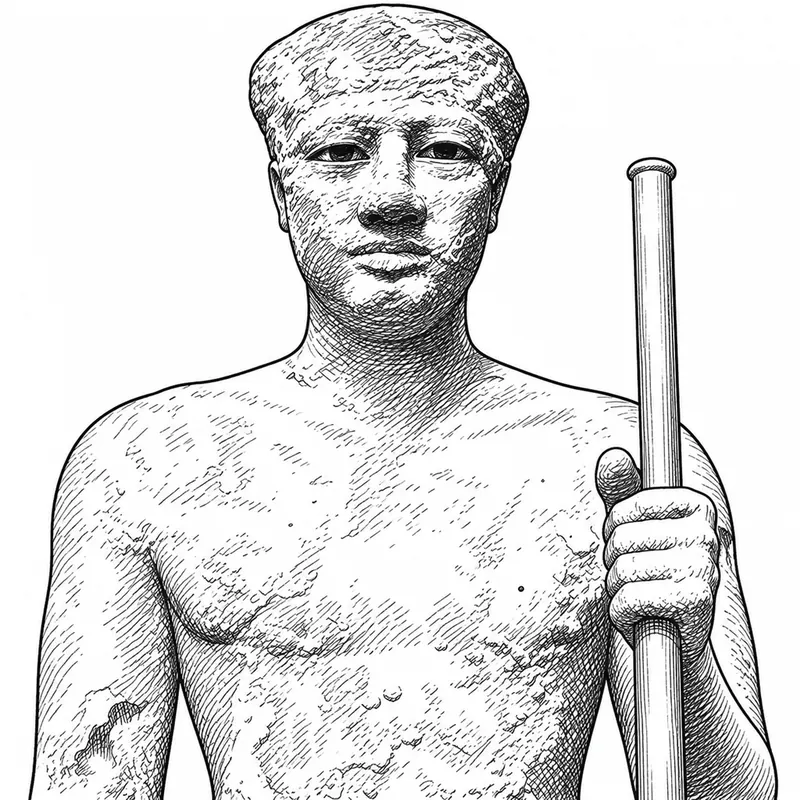
Copper statues discovered at Hierakonpolis are associated with Pepi I and the royal family. They bear witness to another form of the ruler’s visibility, distinct from the reliefs of his pyramid. The material and technique recall the variety of workshops able to represent the king. Smaller objects, including vessels and faience plaques, also spread his name. These representations do not offer a psychological portrait; they construct an image of power and dynastic continuity. Their discovery in sanctuaries and at distant sites allows us to study the places where kingship displayed itself, without assuming that each object corresponds to a personal visit by the ruler.
Authority exercised through several networks
Pepi I appears in the biographies of officials buried at Abydos, Giza, Edfu and elsewhere. The spread of this evidence shows that his government relied on officials with varied careers and regional roots. The documentary record makes it possible to cross-check the pyramid, the decrees, the quarry missions and the private accounts. It does not, however, justify an entirely certain history of court conflicts or of the king’s daily decisions. The significance of the reign lies in this exceptional documentation: it gives access to a monarchy that used writing to commemorate, organise and intervene, while depending on agents able to carry its projects beyond the capital.
Main sources
- UCL Digital Egypt, Pepi I
- UCL Digital Egypt, Pyramid Texts
- Metropolitan Museum of Art, Egypt in the Old Kingdom
- Model for the line portrait: copper statues of Pepi I, Hierakonpolis archaeological project.
Reference works
- Ian Shaw (ed.), The Oxford History of Ancient Egypt, Oxford, Oxford University Press, 2000, chronology pp. 479–483
- Aidan Dodson and Dyan Hilton, The Complete Royal Families of Ancient Egypt, London, Thames & Hudson, 2004