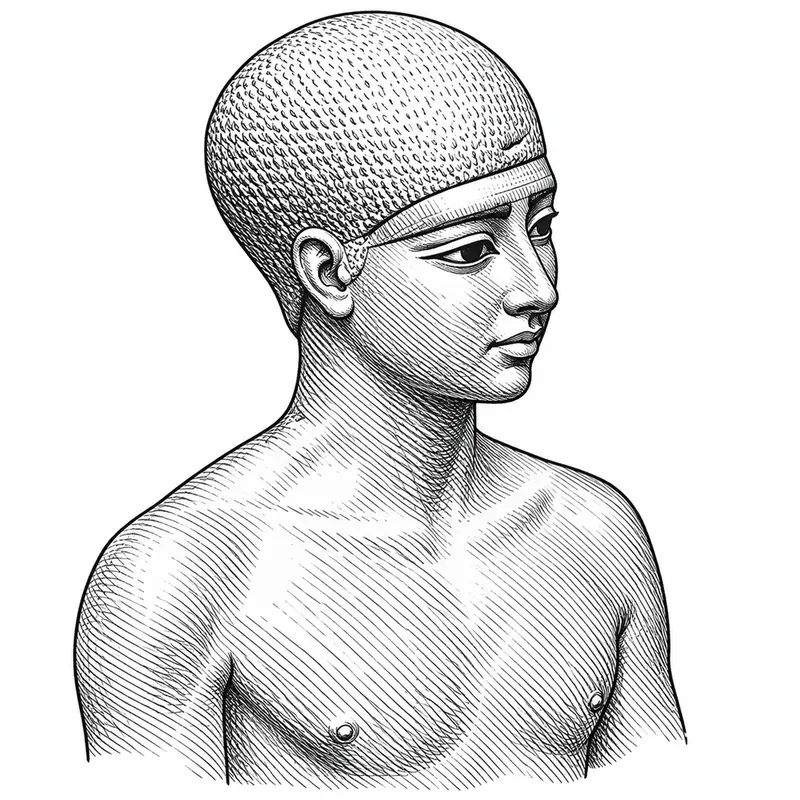
A successor of Pepi I
Merenre I, named Nemtyemsaf in his personal titulary, reigned after Pepi I and before Pepi II in the 6th Dynasty. His time in power was probably shorter than that of his neighbours in the succession, but the precise figures vary between reconstructions. His pyramid complex lies at South Saqqara. Quarry inscriptions, decrees and above all the autobiographies of senior officials make it possible to go beyond the monument. The reign is particularly instructive for the history of relations with Nubia and for the growing place of officials from Elephantine. The texts do not provide a complete chronicle; they do show, however, how distant missions were organised in the ruler’s name. In the chronology of Ian Shaw (Oxford, 2000), his reign falls c. 2287–2278 BC.
The pyramid and the royal cult
Merenre had his pyramid built in the necropolis of South Saqqara, in a landscape already occupied by the complexes of the 6th Dynasty. The funerary texts carved in the chambers continue the practices inaugurated under Unas. The monument was intended to protect the dead king, but also to house a cult served by people and supplied with offerings. The present state of the ruins does not allow its original appearance to be measured directly. Study of the plan, the fragments of decoration and the inscriptions is needed to restore the complex’s place in the sequence of royal monuments. The tomb reveals the continuity of the funerary tradition even when the documents of the reign mostly shed light on external activities.
Weni and the quarry mission
The autobiographical inscription of Weni reports missions under Merenre after a career already under way under the previous rulers. It refers in particular to operations linked to the extraction and transport of stone. The account shows an experienced agent to whom the court entrusted large-scale tasks. It is also a monument of personal prestige: Weni chose the facts that best illustrated his success. The source must therefore be compared with the inscriptions at the work sites and with the material remains. It remains valuable for understanding that royal building depended on officials able to mobilise men, negotiate routes and bring materials to the monumental centres.
The expeditions to Nubia
Harkhuf, a senior official of Elephantine, recounts in his tomb journeys to the south made under Merenre. His inscriptions are fundamental to the history of the Nubian routes and of contacts with regions that the Egyptians called Yam and other names. These accounts combine the circulation of goods, diplomacy and royal authority. They should not be turned into proof of permanent administrative rule over all the territories crossed. The exact routes are still debated, and the author emphasised the difficulties overcome. The texts nevertheless show that the court sought to obtain products and maintain relations beyond the First Cataract, relying on agents familiar with the south.
Rock inscriptions and decrees
Rock inscriptions near Aswan and at Hatnub bear the name of Merenre. They attest official actions in areas of passage and resources. Decrees found in the temple of the pyramid of Mycerinus also show that the authorities continued to intervene in very old foundations. This last fact is a reminder that a king of the 6th Dynasty had to manage several generations of royal cults, not only build his own. The texts are fragmentary and answer different needs; set side by side, however, they allow us to grasp a monarchy present at once in the quarries, in the temples and in the biographies of its servants.
Objects and the royal image
A copper statue discovered at Hierakonpolis, a small sphinx, an ivory box and vessels bearing the king’s titulary complete the record. They bear witness to the spread of his image and name on a variety of media. Each object has its own history of manufacture, deposition and sometimes modern displacement. The presence of a piece in a museum does not always give its full ancient context. Their comparison nevertheless shows that Merenre was not only the patron of a pyramid; he took part in the practices of royal representation in sanctuaries and court circles. The sculptures do not tell of his political decisions, but they make tangible the visual construction of his authority.
The significance of a short reign
The documentation of Merenre highlights the role of southern agents in the politics of the late Old Kingdom. Weni and Harkhuf provide exceptional testimony, while pursuing their own funerary celebration. The quarry inscriptions and the decrees provide points of reference external to these accounts. The king thus appears at the centre of networks linking Saqqara, Aswan, Nubia and regions of resources. Most of his personal decisions remain unknown, but the body of sources allows logistics, contacts and royal memory to be studied concretely. His reign shows that the length of a rule does not on its own determine its documentary value.
Main sources
- UCL Digital Egypt, Merenre
- UCL Digital Egypt, Pyramid Texts
- Metropolitan Museum of Art, Egypt in the Old Kingdom
- Model for the line portrait: small copper statue found with Pepi I, UCL Digital Egypt.
- Reference photograph: Holger Uwe Schmitt, CC BY-SA 4.0.
Reference works
- Ian Shaw (ed.), The Oxford History of Ancient Egypt, Oxford, Oxford University Press, 2000, chronology pp. 479–483
- Aidan Dodson and Dyan Hilton, The Complete Royal Families of Ancient Egypt, London, Thames & Hudson, 2004