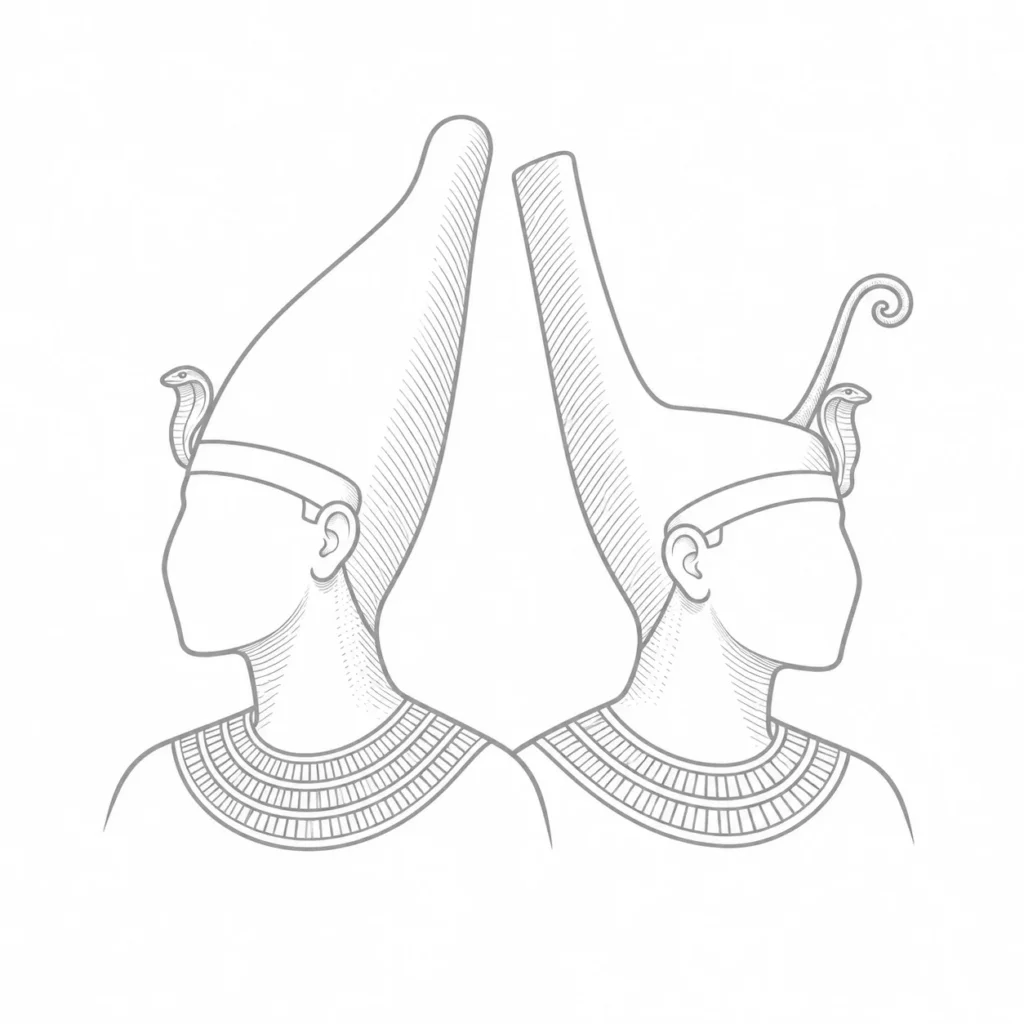
The last king of the 5th Dynasty
Unas is generally regarded as the last ruler of the 5th Dynasty. His pyramid, built at Saqqara near the complex of Djoser, is famous for the spells carved on its inner walls: it offers the oldest known group of Pyramid Texts. This documentary innovation often dominates the portrait of the reign, but the king is also attested by inscriptions, objects and the tombs of members of his circle. Absolute dates remain approximate, and the boundary between the 5th and 6th Dynasties comes from later historical reconstructions. The interest of Unas lies at once in his funerary foundation, in the spread of his name and in a decisive transformation of royal religious writing. In the chronology of Ian Shaw (Oxford, 2000), his reign falls c. 2375–2345 BC.
A pyramid of modest size
The pyramid of Unas does not have the scale of the great monuments of Giza. It belongs, however, to a complete complex combining a mortuary temple, a causeway, a valley temple and spaces for the cult. Its size should not hide the care given to the organisation of the buildings and to the decoration. Studies of the causeway and the temples show that the ancient visitor’s experience passed through a sequence of spaces carrying images and rites. The monument has suffered destruction and reuse; reading it depends on the excavations and publications that place the blocks back in their context. It would be reductive to contrast a ‘small’ pyramid with a reign supposedly lacking ambition, since the investment also went into the texts and the places of ceremony.
The spells carved in the chambers
Inside the pyramid, the walls bear religious texts that Egyptologists call the Pyramid Texts. These spells were meant to help the dead king join the divine powers, to be protected and to continue his existence. They were not all composed for Unas: their inscription is the first surviving monumental witness of a repertoire of which some elements may be older. This distinction is essential. The appearance of the texts on the walls does not allow us to date the invention of each of the beliefs they express. Their arrangement in the chambers and passages nevertheless shows that writing now played a visible part in the ruler’s funerary protection.
A tradition continued after him
The successors of Unas, notably Teti and the kings of the 6th Dynasty, also had Pyramid Texts inscribed in their tombs. Some queens would later receive comparable spells. In the Middle Kingdom, part of this repertoire was taken up on coffins and in other contexts. Unas therefore holds an important place in the history of religious transmission, without his being personally credited with composing all the texts. The study of variants makes it possible to follow the transformations of the spells over the centuries. Their long afterlife is a reminder that choices made in a royal monument could influence practices far beyond the length of a reign.
Attestations outside Saqqara
The name of Unas appears in a rock inscription near Aswan and on objects found on Elephantine and at Byblos. Biographies of private individuals at Saqqara also mention him. These sources give a wider geography than that of his pyramid. They are not enough to recount a complete foreign policy: a displaced vessel may have circulated through exchange or been reused long after it was made. The Aswan inscription documents an official presence in the south more directly, but it must be read according to its formula and context. The tombs of dignitaries, for their part, place the king within a court milieu whose careers sometimes continued from one reign to the next.
The end of a dynasty without an automatic break
Classifying Unas as the last king of the 5th Dynasty is convenient for organising the chronology. It does not mean that the Egyptians experienced his death as a clear institutional break. Teti, placed at the beginning of the 6th Dynasty, took up the practice of funerary texts and also built at Saqqara. The transition must therefore be studied from titularies, tombs and the careers of officials, rather than from a numbered boundary alone. The exact family ties and the circumstances of the succession remain debated. The monument of Unas illustrates both an architectural continuity with the kingship of the Old Kingdom and the emergence of a new monumental use of writing.
An influence beyond his reign
The record of Unas shows how a ruler can have major historical importance without his campaigns or political decisions being recounted in detail. The pyramid makes visible texts that would become a fundamental reference for the study of Egyptian funerary religion. The objects and inscriptions found elsewhere show that his name circulated beyond Saqqara, while the private tombs reveal links with the court. The influence of the reign lies above all in the preservation of a programme of written protection for the dead king, taken up and transformed by other generations. Caution means describing what the monument attests, without confusing the first surviving inscription with the first creation of the tradition.
Main sources
- UCL Digital Egypt, Unas
- UCL Digital Egypt, Pyramid Texts
- UCL Digital Egypt, evolution of pyramids
- Metropolitan Museum of Art, Egypt in the Old Kingdom
- Crowns drawn from the statue of Senusret I and the relief of Ahmose, Metropolitan Museum of Art.
Reference works
- Ian Shaw (ed.), The Oxford History of Ancient Egypt, Oxford, Oxford University Press, 2000, chronology pp. 479–483
- Aidan Dodson and Dyan Hilton, The Complete Royal Families of Ancient Egypt, London, Thames & Hudson, 2004