A reign of exceptional length
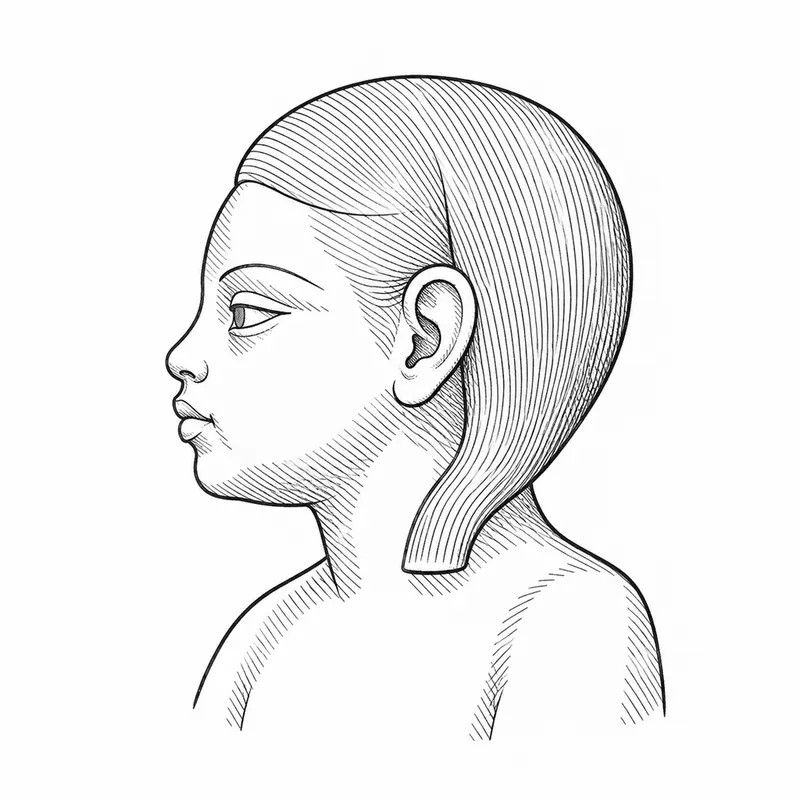
Pepi II came to the throne while still a child, as several representations suggest, including a statuette showing him with his mother. Estimates of the length of his reign vary widely, often between about sixty and ninety years depending on how the chronology is read. It is better to retain its exceptional character than to repeat a precise figure as a certainty. Pepi II is the last ruler of the Old Kingdom whose reign is abundantly attested. This position gives him a special place in narratives of decline, but the later political changes cannot be explained by his longevity alone. Inscriptions, decrees and monuments reveal an active government over several generations. In the chronology of Ian Shaw (Oxford, 2000), his reign falls c. 2278–2184 BC.
The funerary complex at South Saqqara
The pyramid of Pepi II lies at South Saqqara and belongs to the tradition of royal tombs bearing Pyramid Texts. His complex included the spaces needed for the rites, the offerings and the lasting memory of the ruler. Excavations have also documented monuments of queens associated with his circle. The whole shows that the court continued to mobilise substantial resources for funerary architecture. The present ruin should not be confused with the state of the site under the king. The study of building phases, reliefs and inscriptions makes it possible to place the pyramid in the continuity of the programmes of the 6th Dynasty, despite the political transformations that followed his death.
The letter to Harkhuf
In the tomb of Harkhuf, on Elephantine, a letter attributed to the young Pepi II is preserved. In it the king shows keen interest in a person of small stature brought back from an expedition to the south and asks for him to be brought to the court with care. The text is famous because it gives a rare impression of the royal voice, but it was copied into an inscription intended to celebrate its recipient. This staging must therefore be taken into account. The letter nevertheless sheds light on exchanges between the palace and the agents responsible for distant missions. It also shows that the power of a child king was exercised through a circle able to draft, transmit and carry out orders.
Decrees and the management of institutions
Decrees of Pepi II have been found at Abydos, at Coptos and in the complex of Mycerinus at Giza. They concern particular institutions and bear witness to the administrative activity of the reign. Their geographical spread shows that the court continued to take decisions affecting several regions and ancient cults. The texts do not prove that the centre exercised control everywhere with the same effectiveness, especially over such a long period. They do, on the other hand, allow us to study relations between the king, the sanctuaries and local officials. The continuation of the funerary services of Mycerinus, several centuries after his death, illustrates the time depth of the obligations the monarchy had to maintain.
The provinces and the careers of officials
The biographies of figures such as Harkhuf, Ibi and Djau document responsibilities exercised far from the royal residence. They show the importance of provincial families and circles in the administration of the late Old Kingdom. These texts have often fed the idea of a mechanical weakening of the king to the benefit of the governors. The reality is more complex: the rise of provincial tombs may also make more visible actors who were still serving the monarchy. Dates, offices and contexts must be compared before concluding that there was a uniform loss of power. Pepi II reigned for decades during which relations between the centre and the regions evolved, but the sources do not describe a single, simple trajectory.
Festivals and representations of the king
Objects and inscriptions mention Sed festivals of Pepi II, ceremonies especially relevant to a long reign. The titulary appears on vessels, faience plaques and other media. A statuette of a child with his mother highlights the early age of his accession, while other objects refer to the longevity of his rule. These images belong to different contexts; they do not make up a continuous visual biography. The throne name Neferkare was borne by several rulers, which means that the dating of objects must be checked before attributing them to him. This precaution is essential so as not to inflate artificially a record that is already abundant.
The end of an era, to be explained without a single cause
After Pepi II, the succession becomes harder to reconstruct and Egypt gradually entered the First Intermediate Period. The factors behind this transformation are debated: regional dynamics, the workings of institutions, resources and environmental change have all been examined. No decree and no tomb shows that the length of the reign alone brought about the end of the Old Kingdom. Pepi II deserves study for the exceptional length of his rule, but also for the precise documents he left: a royal letter, decrees, private inscriptions and a funerary complex. They show a monarchy that was still active, whose history cannot be summed up in a formula of decadence.
Main sources
- UCL Digital Egypt, Pepi II
- Metropolitan Museum of Art, Egypt in the Old Kingdom
- UCL Digital Egypt, Pyramid Texts
- Model for the line portrait: statuette of Pepi II as a child with his mother, Brooklyn Museum, inventory 39.119.
- Reference photograph: griannan, CC BY 2.5.
Reference works
- Ian Shaw (ed.), The Oxford History of Ancient Egypt, Oxford, Oxford University Press, 2000, chronology pp. 479–483
- Aidan Dodson and Dyan Hilton, The Complete Royal Families of Ancient Egypt, London, Thames & Hudson, 2004