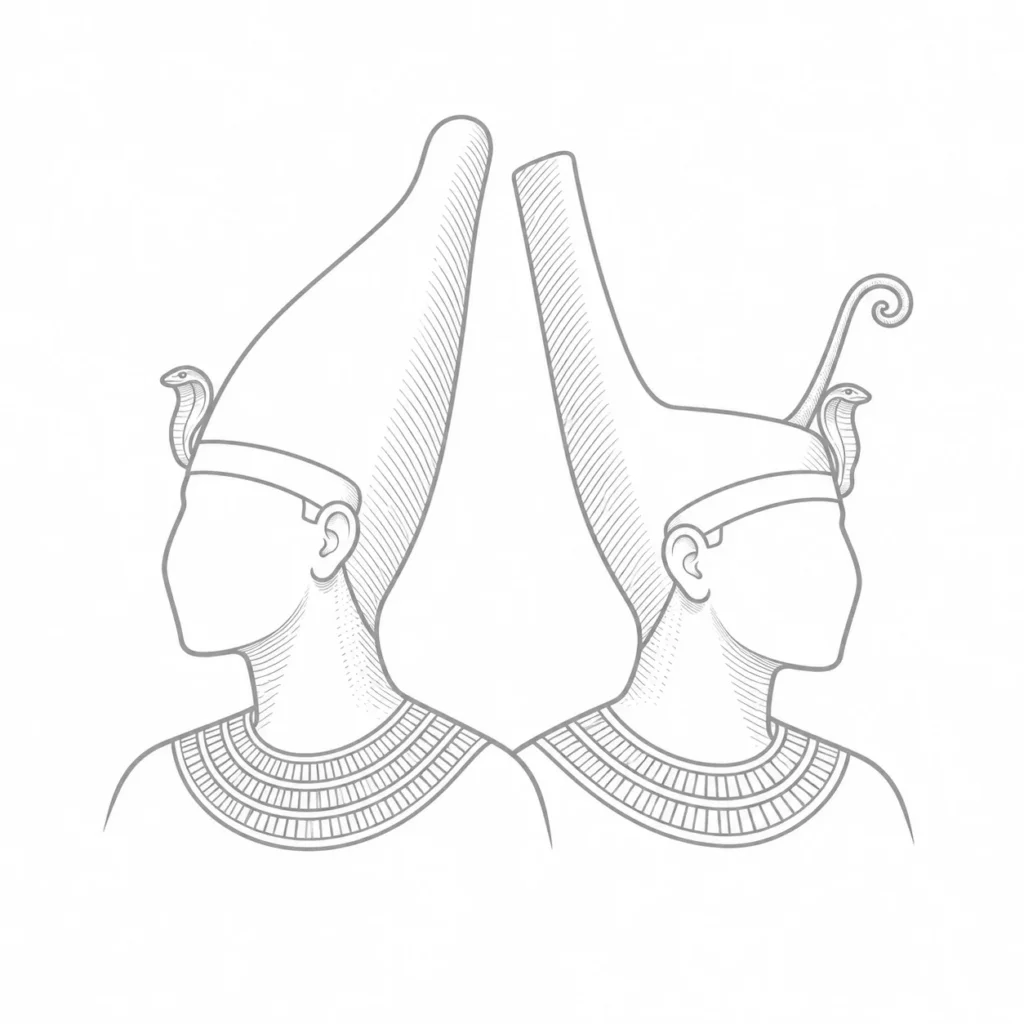
A ruler on the threshold of a new dynasty
Teti is generally placed at the beginning of the 6th Dynasty, after Unas. The dynastic division helps to organise the reigns, but it does not show that a clear break was felt by contemporaries. Teti’s pyramid lies at Saqqara, like that of his predecessor, and it too bears Pyramid Texts. His name appears on decrees, on objects and in the autobiographies of several dignitaries. This evidence gives a more varied picture than a simple king list. Absolute dates remain debated; the monuments and inscriptions above all allow us to study religious continuities, the activity of temples and the networks of officials at the beginning of the 6th Dynasty. In the chronology of Ian Shaw (Oxford, 2000), his reign falls c. 2345–2323 BC.
An inscribed pyramid at Saqqara
Teti’s funerary complex continues the practice inaugurated in the pyramid of Unas: religious spells cover the walls of the inner chambers. They were intended to protect the dead ruler and to accompany his transformation in the afterlife. The presence of these texts does not mean that each spell was composed under Teti. Comparison of the versions shows, on the contrary, a repertoire handed down and adapted. The monument combined the pyramid with the temples and the spaces needed for offerings. Its present ruined state does not allow the original quality of the work to be judged directly. The surveys and surviving fragments make visible a kingship that was still investing in architecture and funerary writing.
The women and great dignitaries of the court
The cemeteries around the pyramid include monuments of queens and of high-ranking individuals. Their proximity expresses the king’s place at the centre of a social and ritual landscape. The private titularies reveal a range of functions linked to the court, the temples and the administration. They are also documents of personal memory: their owners highlighted their careers and their privileged relationships. The whole government cannot be reconstructed from a single tomb. On the other hand, the repetition of names and offices sheds light on the formation of a ruling circle able to serve the ruler and to maintain institutions after his death.
Decrees and religious foundations
A decree of Teti discovered at Abydos attests a royal intervention in a religious establishment. Other objects or monuments mention him at Bubastis and elsewhere. These traces show that his power made itself felt beyond the Memphite necropolis. A surviving decree does not prove that the king personally visited the place or reorganised all the temples of the country. It tells us more precisely about a decision or protection granted to an institution. Religious foundations required resources, staff and rules; their management was an important part of the monarchy. Scattered attestations must be brought together without being merged into a uniform narrative.
Autobiographies as sources for the reign
The inscriptions of Sabu, Gemni, Qar and other officials mention Teti or belong to the time of his rule. The biography of Weni is particularly useful for following a career that spans several reigns of the 6th Dynasty. These texts show how officials presented their closeness to the king and the tasks carried out in his name. Their language of loyalty and success calls for a critical reading. They are not neutral royal annals, but they complement the inscriptions of the official monuments. Comparing them makes it possible to understand how local elites and the court were bound together by appointments, favours and services.
Objects that travelled far
Teti’s name is found on a calcite vessel discovered at Abydos, on objects linked to Byblos and on a calcite sistrum kept in New York. These pieces show the variety of media on which the royal titulary could appear. Their presence outside Saqqara tells us about exchanges, deposits or the journeys of objects, but it does not always provide the precise date of transport or its cause. An object bearing a king’s name may have been kept or moved long after it was made. Each provenance must therefore be read with care. The circulation of these goods nevertheless helps to reconstruct a kingship whose material influence extended beyond its great stone monuments.
The significance of Teti’s reign
Teti stands at a moment when the tradition of inscribed pyramids was consolidating and when the careers of senior officials are better documented. His burial shows the continuity of the royal rites after Unas; the decrees and biographies reveal authority exercised through institutions and people. The sources do not recount in detail the circumstances of his accession or all his possible campaigns. The succession of documents nevertheless helps to avoid an image reduced to that of a mere ‘founder’ of a dynasty. Teti belongs fully to the history of an active monarchy, whose funerary practices, religious decisions and administrative networks are visible in complementary fragments.
Main sources
- UCL Digital Egypt, Teti
- UCL Digital Egypt, Pyramid Texts
- Metropolitan Museum of Art, Egypt in the Old Kingdom
- Crowns drawn from the statue of Senusret I and the relief of Ahmose, Metropolitan Museum of Art.
Reference works
- Ian Shaw (ed.), The Oxford History of Ancient Egypt, Oxford, Oxford University Press, 2000, chronology pp. 479–483
- Aidan Dodson and Dyan Hilton, The Complete Royal Families of Ancient Egypt, London, Thames & Hudson, 2004