A reign after Djoser
Sekhemkhet is one of the first rulers of the 3rd Dynasty and usually succeeds Netjerikhet-Djoser in the chronologies. The precise dates and length of his reign are uncertain. His documentary record is far thinner than that of his predecessor: the architecture of an unfinished funerary complex therefore holds a central place in his history. It would, on the other hand, be rash to credit him with campaigns or reforms that the sources do not mention. His reign sheds light above all on the continuity of the architectural experiment begun at Saqqara and on the limits of what archaeology can reconstruct. In the chronology of Ian Shaw (Oxford, 2000), his reign falls c. 2648–2640 BC.
A building site next to the Step Pyramid
The monument attributed to Sekhemkhet lies on the Saqqara plateau, south of that of Djoser. Its present appearance earned it the modern name of the ‘Buried Pyramid’. The low visible elevation does not mean that the king wanted a small tomb: the foundations and the enclosure point to a far more ambitious project, very probably a new step pyramid. The underground structures were more advanced than the superstructure. This difference makes it possible to study a building site interrupted at several points in its development. Graphic reconstructions of a completed pyramid show the supposed project, not a building that actually existed.
The underground spaces
An entrance descends to galleries and to the burial chamber prepared beneath the future monument. Creating these spaces required excavation, stonecutting and the organisation of spoil, even though the pyramid above ground remained unfinished. The remains therefore show a real royal investment, not a mere intention without work. Associated structures have sometimes been compared with the South Tomb of Djoser’s complex. Their exact function is debated. Continuities of plan and technique between the two reigns can be observed without regarding the second monument as a fully explained copy of the first.
The empty sarcophagus
The excavations uncovered in the chamber a monolithic sarcophagus of calcite, often called Egyptian alabaster. It appeared to be sealed when it was opened in modern times, but it was empty inside. This spectacular discovery prompted numerous hypotheses: abandonment of the work before the burial, interment elsewhere or a more complex history of the funerary spaces. None of these explanations follows automatically from the observation that it was empty. The state of the closures, the stratigraphy and the disturbances to the monument must be examined together. To say that we do not know where Sekhemkhet was finally buried is more accurate than to propose a romantic solution.
Why did the work stop?
A short reign is often invoked to explain why the complex was left unfinished. The idea is plausible: royal building depended on the length of a reign and the will of successors. It is not, however, recorded in any inscription describing the halt of the work. Other factors linked to resources, dynastic choices or the development of the building site are difficult to rule out. Comparison with the unfinished buildings of other rulers shows that the phenomenon was not isolated. Architecture tells us what was undertaken and abandoned; it does not, on its own, give the personal or political reasons for that abandonment.
The discovery in the twentieth century
The Egyptian archaeologist Zakaria Goneim identified and excavated the complex in the early 1950s. His 1957 publication remains fundamental for the objects, the plans and the observations made during the clearance. Jean-Philippe Lauer then studied several aspects of the record. The early descriptions remain indispensable, because the condition of the monument has changed with excavation, consolidation and exposure to the weather. They also call for a critical examination of the methods and interpretations of the time. The modern history of the discovery is particularly important here: it explains why the empty sarcophagus became famous and why some images of the site give the misleading impression of an almost non-existent monument.
What Sekhemkhet reveals
The reign is poor in known events but rich for the history of royal building. It shows that the monumental model inaugurated under Djoser was immediately taken up again, with adaptations that are still difficult to define. The respective places of the galleries, the enclosure and the planned pyramid allow us to think about the order of work and the priorities of the court. These data shed light on the attribution of the complex, the building choices and the historical questions that remain open. Caution takes nothing away from the interest of the ruler: on the contrary, it allows us to measure the share of the project and that of the monument actually built.
Main sources
- Zakaria Goneim, Horus Sekhem-khet, IFAO, 1957
- Jean-Philippe Lauer, review of Goneim, BIFAO 59
- UCL Digital Egypt, Evolution of Pyramids
- UCL Digital Egypt, Old Kingdom kings
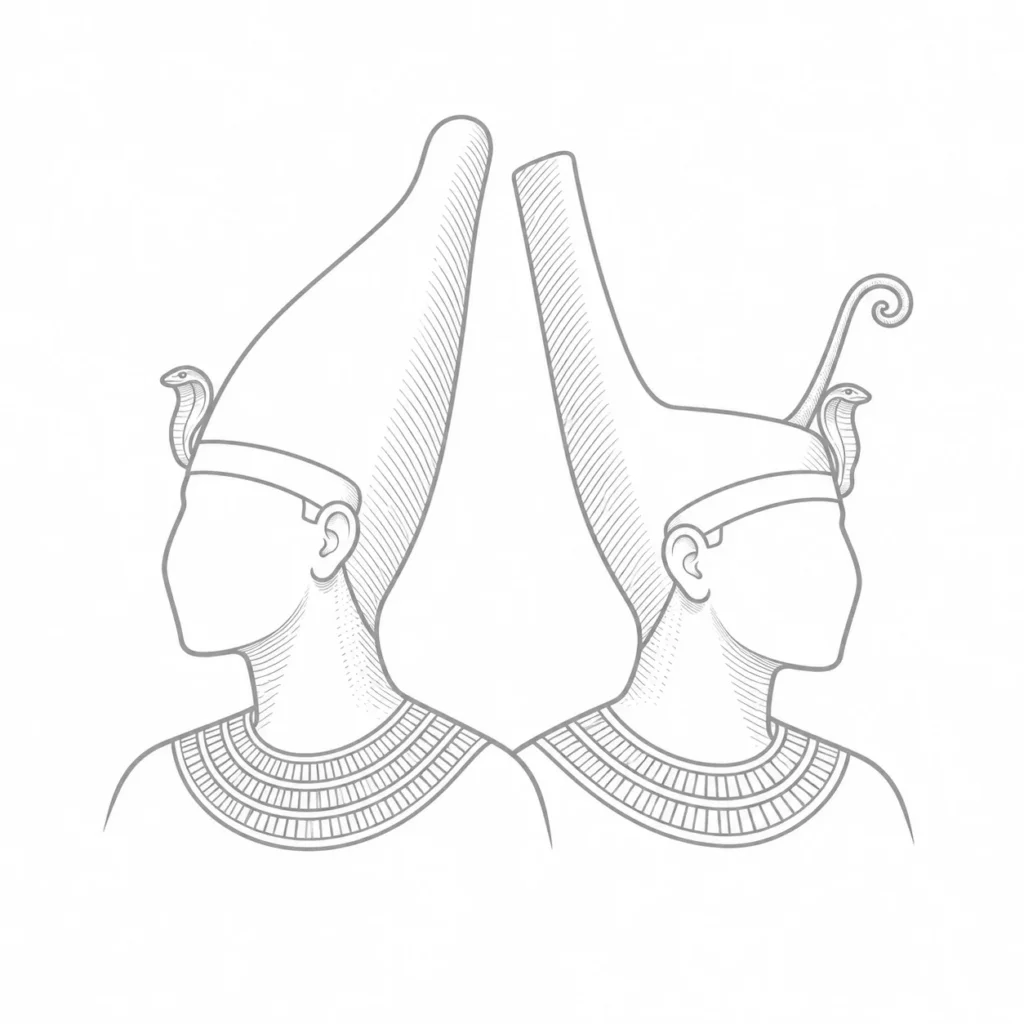
- Crowns drawn from the statue of Senusret I and the relief of Ahmose, Metropolitan Museum of Art.
Reference works
- Ian Shaw (ed.), The Oxford History of Ancient Egypt, Oxford, Oxford University Press, 2000, chronology pp. 479–483
- Aidan Dodson and Dyan Hilton, The Complete Royal Families of Ancient Egypt, London, Thames & Hudson, 2004