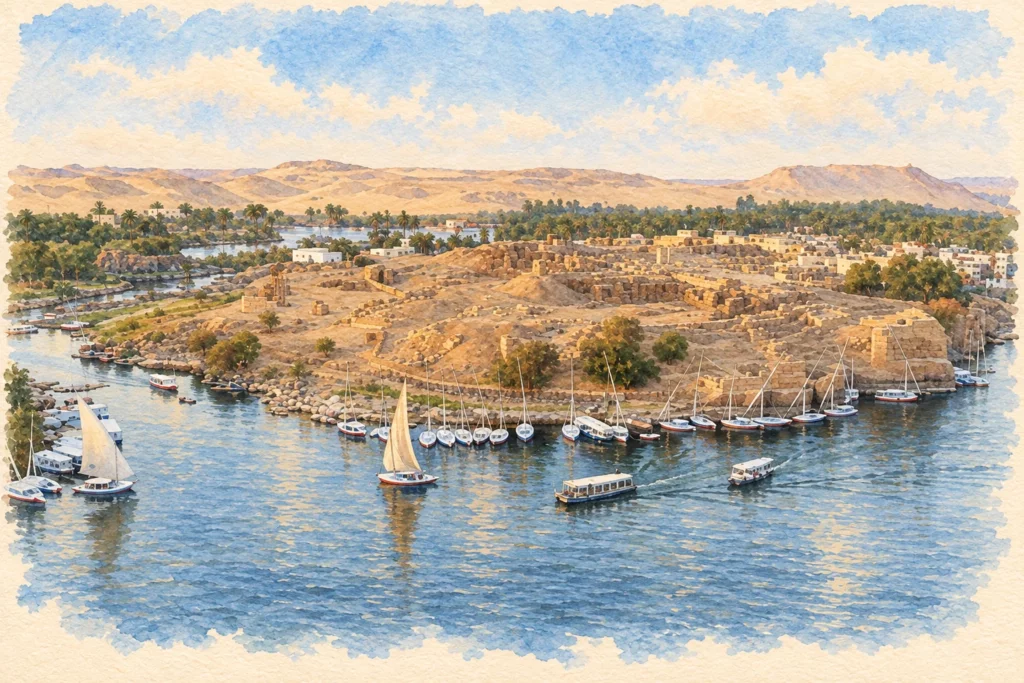
From the Corniche at Aswan, Elephantine first looks like an island of greenery and rocks polished by the river. Two Nubian villages, Siou and Koti, keep their colourful houses there. At the southern tip, however, stretches a vast field of ruins: mud-brick walls, temple foundations, stairways going down to the water. This is where the ancient town stood, capital of the first province of Upper Egypt and the country’s forward post facing Nubia.
A name from ivory
The Egyptians called the island and its town Abu, a word that designates the elephant. The Greeks translated it as Elephantine. The origin of the name is still debated. It is often explained by the trade in ivory from the south that passed through this point, or by the shape of the large grey granite boulders that rise from the river and recall the backs of elephants. The two explanations are not mutually exclusive.
The site owes its importance to its position. Just north of the First Cataract, where the Nile breaks over the granite bars, it marks the natural limit of Egyptian navigation. The goods of Nubia, gold, ivory, ebony, skins and incense, were unloaded here, checked and sent on northwards. Military and trading expeditions set out from here towards the south.
A town rebuilt again and again
The excavations carried out since 1969 by the German Archaeological Institute and the Swiss Institute for Architectural and Archaeological Research in Egypt have revealed continuous occupation from the end of prehistory to the Middle Ages. As early as the 1st Dynasty, around 3000 BC, a fortress was built on the island. The town then grew around it, layer upon layer, until it formed an artificial mound.
The governors of Elephantine, responsible for the frontier and for distant expeditions, were buried on the west bank, in the rock-cut tombs of Qubbet el-Hawa. One of them, Heqaib, who lived in the 6th Dynasty, was venerated after his death as a local saint. His sanctuary, on the island, received statues and stelae offered by his successors for generations.
The temple of Satet and the temple of Khnum
The oldest monument on the island is the sanctuary of Satet, the protective goddess of the frontier. It began around 3000 BC as a modest niche set up between granite boulders. It was then rebuilt many times, in the Middle Kingdom, under Hatshepsut and Thutmose III, then in the Ptolemaic Period. In it archaeologists read nearly three millennia of religious architecture, one layer above another.
Beside it stood the great temple of Khnum, the ram-headed god associated with the flood. It was rebuilt under Nectanebo II, then enlarged by the Ptolemies and the Roman emperors. Today only its foundations and a few elements of a gateway remain. Khnum formed with Satet and Anuket the triad of the cataract.
Two nilometers, one of them at the temple of Satet, made it possible to measure the height of the flood. The Greek geographer Strabo described one in the 1st century BC. Their readings were used to forecast the harvest and to set taxes.
A cosmopolitan island
In the 5th century BC, under Persian rule, Elephantine housed a garrison of Jewish and Aramaean soldiers. The Aramaic papyri found on the island, contracts, letters and accounts, give a rare picture of the daily life of this community. They mention a temple dedicated to their god, Yahu, next to that of Khnum; it was destroyed around 410 BC during a conflict with the Egyptian priests.
The history of the island also includes recent losses. The scholars of the French expedition to Egypt had drawn, for the Description de l’Égypte, an elegant temple of Amenhotep III that was still standing. It was demolished around 1822 to provide building material; the plates of the Description are now its main record.
Visiting Elephantine
A shuttle boat or a felucca links the island to the Corniche. The archaeological site, restored by the German and Swiss missions, is marked out with information panels. The Aswan Museum, housed in a villa built around 1900, and its annexe display objects from the excavations. You can then cross the Nubian villages to the west side of the island, facing the tombs of the governors, to grasp what this threshold between two worlds was, the same threshold found at Aswan.