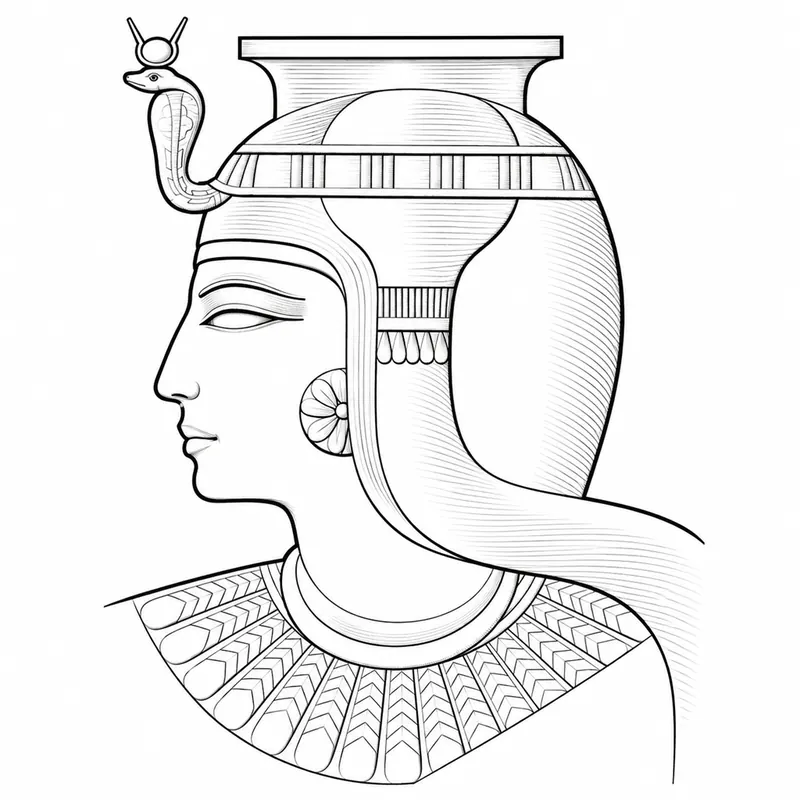
A queen who became pharaoh
Tawosret, or Tausret, is one of the few women to have exercised pharaonic kingship with a full titulary. She appears at the end of the 19th Dynasty, in the troubled sequence that follows Merenptah and Seti II. UCL Digital Egypt places her period of power c. 1194 or 1193 to 1186 or 1185 BC, but the exact order of events with Siptah remains debated. She was first a central figure at court, then took the throne name Satre Meryamun. The monuments and tomb KV14 prove the reality of her status. The story of her accession must nevertheless be told without filling the gaps with an over-simple narrative of regency followed by independent reign.
Siptah and the government
The young king Siptah and Tawosret are linked by inscriptions that show the political role of the latter. Researchers debate the precise nature of their association and the date at which she adopted full kingship. The regnal years inscribed on objects are not always easy to attribute to a single person, since the same monument may have gone through several phases. A distinction must be drawn between power exercised in the name of Siptah, the titles of queen and Tawosret’s own titulary. This passage lies at the heart of her historical interest. It reveals how the pharaonic institution could be taken on by a woman in a context of fragile succession, with adapted choices of names and images.
Monuments in several regions
UCL records a statue of Tawosret found at Heliopolis and a door jamb discovered at Memphis. A scarab from Gurob bears her name, and objects are linked to her mortuary temple. These attestations show that her official presence was not confined to the Theban necropolis. Their interpretation nevertheless requires following the provenance of each piece. A statue can be moved; a scarab travels; a block can be reused. Together, however, they confirm that the ruler used the normal means of spreading the royal name. Comparison with Hatshepsut is instructive as regards the means of representation, without assuming identical political situations three centuries apart.
KV14 and the changes of decoration
Tomb KV14, in the Valley of the Kings, is closely linked to Tawosret. Its architecture and decoration went through several phases, then alterations under the following dynasty. Examination of the cartouches, plaster and scenes makes it possible to distinguish the successive projects. An altered tomb is not immediate proof that the whole reign was rejected as soon as the ruler died; each intervention must be dated. KV14 nevertheless shows that her memory was contested. It also bears witness to the funerary ambition of a woman who fully held the office of king. The burial complements the scattered objects and provides a major material framework for studying the last years of the 19th Dynasty.
The mortuary temple and memory
Tawosret began a mortuary temple on the west bank of Thebes. The remains and objects collected on the site allow her cult programme to be studied, even though the building no longer stands as an intact monument. After her death, names and images were altered or erased. UCL points out that this erasure aimed to remove the presence of a reigning queen from the inscribed memory. The precise intentions of the successors must nevertheless be inferred with caution. The same stones may also have served practical building projects. The history of the temple combines Tawosret’s wish to endure with the later efforts to reorganise the official succession.
The transition to the 20th Dynasty
After Tawosret, Sethnakht opened the 20th Dynasty. The texts of this transition present a return to order, a common language at a new seizure of power. They do not provide a neutral chronicle of all the last years of the previous dynasty. To understand the transition, the dates of the monuments, the royal tombs and the inscriptions of the craftsmen of Deir el-Medina must be compared. Tawosret thus stands at the point where one line died out and another built its legitimacy. Her reign was important enough to be recognised in the material traces and contested enough to leave marks of alteration. Both aspects must appear in a balanced portrait.
A major subject for the history of power
The career of Tawosret sheds light both on the capacity of a woman to bear the names of pharaoh and on the tensions at the end of the 19th Dynasty. Her record brings together titles, inscribed objects, a temple, KV14 and the later alterations. We must show how each source situates a different phase of her power, rather than look for a continuous biography that the documents do not provide. Comparison with Sobekneferu and Hatshepsut helps to understand the diversity of female reigns. Tawosret is not merely a spectacular exception: she is a ruler whose monuments allow succession, memory and the royal function to be studied.
Main sources
- UCL Digital Egypt, Tawosret and her attestations
- UCL Digital Egypt, Seti II and the end of the 19th Dynasty
- UCL Digital Egypt, kings of the New Kingdom
- Model for the line portrait: copy of the portrait of Tawosret in her tomb, Émile Prisse d’Avennes.
Reference works
- Ian Shaw (ed.), The Oxford History of Ancient Egypt, Oxford, Oxford University Press, 2000, chronology pp. 479–483
- Aidan Dodson and Dyan Hilton, The Complete Royal Families of Ancient Egypt, London, Thames & Hudson, 2004