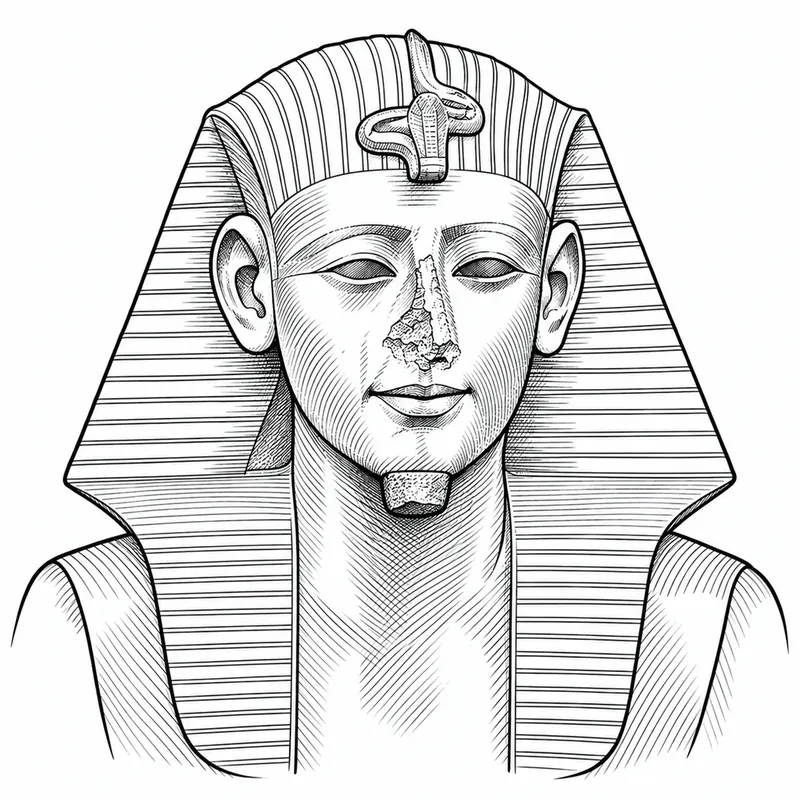
The second king of the 19th Dynasty
Seti I, Menmaatre, succeeded Ramses I and reigned approximately from 1290 to 1279 BC according to UCL Digital Egypt. He was the father of Ramses II, whose long afterlife has sometimes overshadowed his own achievements. Yet his military reliefs, his sanctuaries and his tomb make him one of the best-documented rulers of the 19th Dynasty. His reign consolidated the new line that emerged from Horemheb and sought to reassert Egypt’s place in the Levant. The official inscriptions present a restoration of order; archaeology and the geography of the monuments allow its concrete expressions to be measured. The relatively short length of his rule did not prevent ambitious programmes.
The campaigns in Western Asia
The walls of Karnak bear long scenes and inscriptions devoted to the campaigns of Seti I in Western Asia. They show routes, cities, enemies and triumphal returns. These reliefs are not neutral military maps. They select episodes to assert the king’s ability to protect the frontiers and impose Egyptian authority. Their topographical richness nevertheless helps to follow the movements towards Sinai, Palestine and Syria. Comparison with Near Eastern sources and regional chronology is needed to estimate how long the conquests lasted. The reign of Seti shows that Egyptian positions in the Levant required repeated interventions, before the battle of Qadesh under Ramses II.
Abydos, an exceptional sanctuary
The temple of Seti I at Abydos is one of the major surviving cult complexes of ancient Egypt. Its chapels, its reliefs and the famous king list link the king, the gods and the succession of rulers deemed legitimate. This list is valuable for chronology, but it selects names according to a religious and political programme; absences do not prove that a king was fictitious. The temple combines remarkable sculptural quality with an architecture designed for several cults. Nearby, a large underground monument often called the Osireion or cenotaph belongs to the landscape of Abydos. Its building history and precise function have prompted debate, which should be set out without forcing certainty.
Karnak and the other building projects
Seti I worked at Karnak, notably in the Great Hypostyle Hall, where the work continued under Ramses II. He also had a mortuary temple built on the west bank of Thebes and left attestations on Elephantine (in French), at El-Kab and near Aswan. The distribution of these monuments shows a policy of display in the main religious centres and on the routes of the kingdom. Reused blocks and inscriptions altered by successors call for an analysis of each phase. A building project begun under one king may receive its decoration under another. The architectural history of Seti I must therefore be written with plans, techniques and texts, and not only with the cartouches visible today.
KV17, a richly decorated tomb
The tomb of Seti I, KV17, is among the longest and most abundantly decorated in the Valley of the Kings. Its walls present texts and images of the afterlife, notably books describing the night journey of the sun. These compositions show the religious choices of the court and the mastery of the craftsmen. Their present beauty should not make us forget that the colours, surfaces and funerary objects have suffered losses. The tomb does not recount the king’s campaigns; it places his person within the cosmic renewal expected after death. Comparison with the temple at Abydos and the reliefs of Karnak thus reveals three different forms of royal representation: cult, war and funerary destiny.
The relationship with Ramses II
Ramses II succeeded Seti I and continued or completed several of his projects. This continuity sometimes makes it difficult to separate the building works. The two reigns were also linked by a political transmission prepared within the royal family. The question of a precise co-regency has been discussed; we should avoid turning scenes associating father and son into automatic proof of a formal joint reign. What is certain is that Ramses inherited a monarchy that was solidly staged, active in Asia and very present in the sanctuaries. Reading Seti only as the father of a more famous king would lose sight of the scale of his programme and of his contribution to the legitimacy of the dynasty.
A reign on several scales
The sources for the reign of Seti I allow us to link the frontiers of the Levant, the sanctuaries of the valley and the Theban tomb. The Karnak reliefs show the military claim; Abydos places the king within a sacred history of kingship; KV17 sets out funerary theology. These groups are contemporary with or close to the reign, but each has its own function and language. Read together, they give a fairer portrait than a simple inventory of battles and temples. Seti gave the 19th Dynasty political and visual forms that his son would develop. His importance rests on this concrete foundation, documented in stone.
Main sources
- UCL Digital Egypt, Seti I and his attestations
- UCL Digital Egypt, the site of Abydos and its temples
- UCL Digital Egypt, kings of the New Kingdom
- Model for the line portrait: statue of Seti I, Metropolitan Museum of Art.
Reference works
- Ian Shaw (ed.), The Oxford History of Ancient Egypt, Oxford, Oxford University Press, 2000, chronology pp. 479–483
- Aidan Dodson and Dyan Hilton, The Complete Royal Families of Ancient Egypt, London, Thames & Hudson, 2004