In brief
Deir el-Medina was the village of the craftsmen who cut and decorated the royal tombs on the west bank at Thebes. According to the Metropolitan Museum of Art, it housed about sixty workmen: stonecutters, sculptors, painters and carpenters, employed in the Valleys of the Kings and Queens. The site brings together their houses, family tombs and places of worship. It was not just a place where people came to work: families lived there for several generations of the New Kingdom.
What you discover
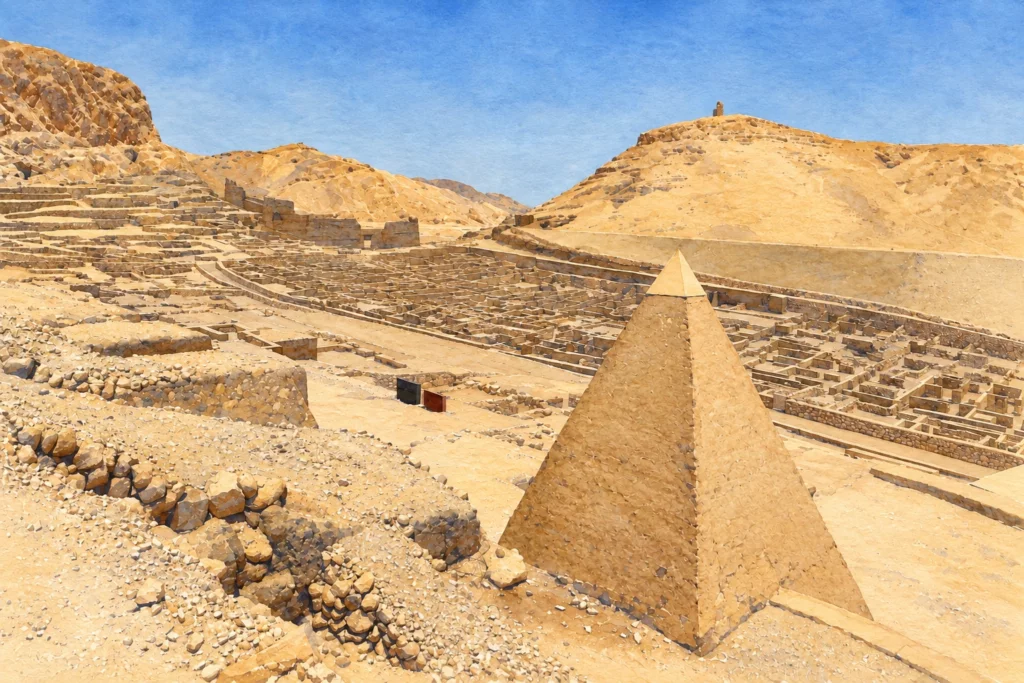
The foundations of the mudbrick houses trace the streets of the village. In the neighbouring hills lie private tombs, some of which preserve paintings. Texts and drawings on potsherds or limestone flakes, known as ostraca, provide information on the work, the exchanges and the concerns of the inhabitants. The houses, burials and objects are not all of the same date: each must be placed in its own history.
What to look at
A specific case shows the link between the village and its necropolis. The Metropolitan Museum presents the family of Sennedjem and his son Khonsu, ‘servants in the Place of Truth’, that is, craftsmen of the royal tombs. Khonsu had anthropoid wooden coffins, a painted mask, a canopic box and shabtis made. Their tomb, built near Khonsu’s house in the hillside cemetery, remained sealed for nearly two thousand years, until its discovery on 1 February 1886 by agents of the Egyptian Antiquities Service. The craftsmen thus used for themselves the skills they applied for the kings.
Its history
The teams worked in the Valleys of the Kings and Queens, and the village also housed their relatives. Since 1917, the Institut français d’archéologie orientale (IFAO, French Institute of Oriental Archaeology) has been studying Deir el-Medina. Bernard Bruyère carried out methodical excavations there from 1922 to 1951. He uncovered thousands of objects, including ostraca and papyri, the village, the necropolis, confraternity chapels and the Great Shaft north of the temple. In February 1928, he discovered the intact tomb of Sennefer, whose contents his drawings recorded in place, down to the fragile funerary garlands that rarely survive. His four excavation diaries, kept by the IFAO, provide information missing from the preliminary reports.
Why this place matters
Deir el-Medina makes it possible to approach the people who built the royal monuments, their living conditions and their own funerary traditions. The writings offer rare details, but they do not speak for all the inhabitants of ancient Egypt. The low walls and the excavation archives must be read together to avoid turning an attractive reconstruction into a certainty.
Sources
Consulted on 30 September 2026: An Artisan’s Tomb in New Kingdom Egypt, Metropolitan Museum of Art; Archives of Bernard Bruyère, Institut français d’archéologie orientale.