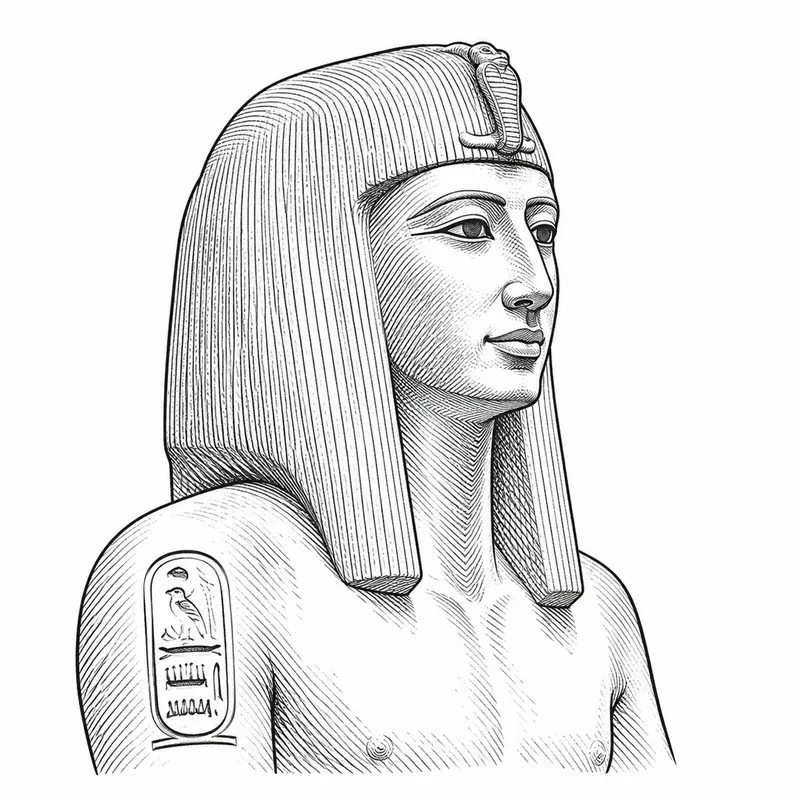
A king whose place calls for caution
Seti II, Userkheperure Setepenre, belongs to the end of the 19th Dynasty. UCL Digital Egypt places his reign approximately between 1200 or 1199 and 1194 or 1193 BC. The exact chronology of the period after Merenptah remains debated, in particular the relationship between Seti II and Amenmesse. The inscriptions of the two rulers and their regional distribution have given rise to several models. We should avoid turning any one of them into a confident story of usurpation or civil war. Seti II was nevertheless a very real king, attested by sanctuaries, objects and a tomb in the Valley of the Kings. His record reveals the capacity of institutions to carry on despite dynastic competition.
Cartouches from Pi-Ramesse to Sinai
Inscriptions of Seti II were found at Tanis, but they originally came from Pi-Ramesse. Others are known at Athribis, Heliopolis and in Sinai, notably at Serabit el-Khadim. These places show that the king’s name circulated in the Delta and on supply routes. Displaced blocks nevertheless require us to distinguish the present location from the original site of a monument. The map of cartouches must be built from provenances, not from the display cases in which the objects are kept. Mining or sanctuary inscriptions bear witness to official activity, without giving a full account of the resources extracted. They are reference points for measuring where the power of Seti was recognised.
Karnak and Luxor
Seti II left several inscriptions and a small sanctuary at Karnak. Traces are also known in the temple of Luxor. These interventions in the great Theban places of worship had particular political weight if the succession was contested. Displaying his cartouche there meant placing himself before Amun (in French) and before the religious elites of Thebes. The buildings themselves must be dated by their styles, their texts and their relationship with neighbouring structures. Some parts have been moved or reused. The monuments show a visible royal presence, but they are not enough to reveal the balance of power between the palace, the clergy and the regional administrations. Reading them gains from comparison with the documents from Deir el-Medina.
The community of Deir el-Medina
The craftsmen of Deir el-Medina worked on the royal tombs and left written traces of their collective life. For the end of the 19th Dynasty, the dates on their ostraca and journals are particularly useful. They help to follow the years recognised under different rulers and the works undertaken in the necropolis. These documents do not give a national map of authority, but they offer a local point of view less monumental than the victory stelae. Comparison with the names of Seti II and Amenmesse is therefore valuable. It allows changes in political recognition to be measured without assuming that all the inhabitants of the country experienced them at the same time or in the same way.
Tomb KV15
Seti II is associated with KV15 in the Valley of the Kings. His tomb belongs to a funerary landscape in which projects were sometimes interrupted, resumed or altered with the rhythm of the successions. The scenes of the afterlife there assert the full royal function of the deceased, whatever the political difficulty of his reign. The tomb must be studied for itself and compared with KV10 of Amenmesse and KV14 of Tawosret. Similarities or erasures may shed light on the relationships between rulers, but they require the phases of decoration to be dated. The burial proves the preparation of a funerary cult; it does not provide an exhaustive chronology of the rivalries during the king’s lifetime.
Tawosret and Siptah after Seti II
After the death of Seti II, the young Siptah became king and Tawosret played a growing role before exercising kingship herself. The precise family ties and the order of certain decisions remain debated. Modern lists must combine royal inscriptions, regnal years and the documents of the necropolis. The transition shows that a court could maintain the forms of the monarchy while rapidly reorganising who held it. Seti II stands at the centre of this sequence. Reducing him to a victim or a victor over Amenmesse would forget the effective government attested by his own monuments. His reign also prepared the problems of legitimacy at the end of the dynasty.
A history through compared traces
Seti II highlights the gap between an attested reign and a political history that is still incomplete. His inscriptions cover several regions, his sanctuary at Karnak asserts his legitimacy and KV15 documents his funerary memory. The documents from Deir el-Medina help to date local life under his name. No single source fully resolves his relationship with Amenmesse or the transition to Tawosret. The best approach is to present the solid points, then the hypotheses with their degree of confidence. This method makes visible a complex end of dynasty without imposing on it a plot more certain than the available evidence.
Main sources
- UCL Digital Egypt, Seti II and his attestations
- UCL Digital Egypt, Amenmesse and the succession
- UCL Digital Egypt, ostraca from Deir el-Medina
- Model for the line portrait: seated statue of Seti II, British Museum, EA26.
- Reference photograph: Ángel M. Felicísimo, CC BY 2.0.
Reference works
- Ian Shaw (ed.), The Oxford History of Ancient Egypt, Oxford, Oxford University Press, 2000, chronology pp. 479–483
- Aidan Dodson and Dyan Hilton, The Complete Royal Families of Ancient Egypt, London, Thames & Hudson, 2004