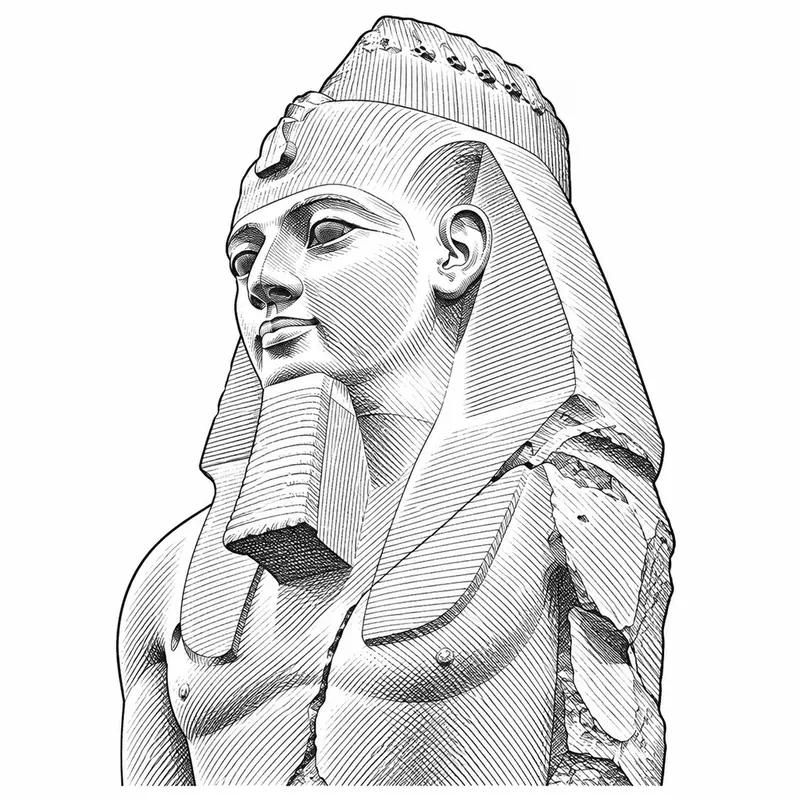
A reign of sixty-six years
Ramses II (Ramesses II), Usermaatre Setepenre, reigned from 1279 to 1213 BC according to the chronology of UCL Digital Egypt. The son of Seti I, he had one of the longest and best-documented reigns in pharaonic history. His name appears on monuments in almost every region of Egypt and Nubia. This omnipresence results at once from new building projects, from the completion of works begun under his predecessors and from reinscriptions on older works. A distinction must therefore be drawn between the monuments he actually had built and those whose decoration he appropriated. The reign offers an exceptional record for studying war, diplomacy, sanctuaries, the royal family and the making of a political memory.
Qadesh, battle and official account
The battle of Qadesh against the Hittite empire was recounted on several temples in long texts and sculpted scenes. The Egyptian account places Ramses at the centre of a dangerous situation, then of a heroic recovery. This composition is a first-rate source on strategy, chariots and royal communication, but its triumphal tone calls for a critical reading. The battle did not give Egypt lasting control of Qadesh. Historians compare the Egyptian version with the Hittite documentation and with the later diplomatic situation. The interest of the episode lies as much in the military event as in its monumental repetition: Ramses wished to show throughout the country the power and divine protection of the king.
The treaty with Hattusili III
In year 21 of the reign, Ramses II concluded a treaty with the Hittite ruler Hattusili III. Egyptian and Hittite versions of the text have survived, allowing a rare comparison between two ancient chancelleries. The treaty organises a peace, commitments of assistance and the treatment of fugitives. It shows that rivalry in the Levant was also settled by diplomacy after the campaigns. Marriages between the royal houses then strengthened relations. The document is not simply a moral proclamation of eternal peace: it answered precise political interests in a shifting Near East. Its study makes Ramses a negotiator as much as a war leader shown on the pylons.
Pi-Ramesse, capital of the Delta
Ramses II developed Pi-Ramesse in the eastern Delta, near present-day Qantir, as a residence and centre of power. The location favoured communications with the Levant and the former regions of Avaris. The remains of the city are harder to see than the stone temples, because of changes in the course of the Nile and the removal of materials. Archaeology nevertheless reveals a capital of palaces, workshops and infrastructure. The decision to enlarge it shows that Ramesside power was not concentrated solely at Thebes. It links military logistics, the management of resources and the presence of the court. Reading the monuments moved to Tanis requires relating them to this first context.
Abu Simbel and Nubia
The rock-cut temples of Abu Simbel are among the best-known creations of Ramses II. The great temple asserts the presence of the deified king and the gods in a strategic Nubian landscape; the smaller one honours Nefertari and Hathor (in French). Other sanctuaries, at Beit el-Wali, Wadi es-Sebua, Derr or Gerf Hussein, show the extent of the southern programme. These monuments bear witness to the investment of the state and to its wish to make Egyptian authority visible. They do not on their own tell the story of daily relations with the Nubian populations. The modern relocation of Abu Simbel during the construction of the Aswan High Dam adds another story: that of the international conservation of a fragile heritage.
Thebes, Abydos and the family
At Thebes, the Ramesseum was the main temple of the royal cult. Ramses also completed or decorated parts of the Great Hypostyle Hall at Karnak and built at Abydos. The Valley of the Kings preserves his tomb, KV7, while the tombs of members of his family show the scale of the dynasty. Nefertari and Isetnofret are among the known wives; several sons held high office. The length of the reign brought about a succession of generations of crown princes. The family images supported the stability of the throne, but they do not give a complete intimate history. They must be read with the titles and dates, distinguishing ceremonial representations from individual lives.
A legacy more complex than greatness
Ramses II has become the archetype of the builder pharaoh. This reputation rests on an exceptional volume of monuments and inscriptions, but it can hide the work of craftsmen, soldiers, diplomats and administrators. It can also encourage the automatic attribution of every work bearing his cartouche to a new construction. The architecture, the Qadesh inscriptions, the texts of the treaty and the archaeology of Pi-Ramesse complement one another. Cross-checking them shows a long reign, able to sustain projects and change external strategy. His influence was considerable, while remaining part of a dynasty and of human networks that went beyond the royal figure alone.
Main sources
- UCL Digital Egypt, Ramses II and his monuments
- UCL Digital Egypt, relations with Asia in the New Kingdom
- UCL Digital Egypt, Seti I and the inherited building projects
- Model for the line portrait: colossal bust of Ramses II, British Museum, EA19.
- Reference photograph: JRennocks, CC BY 4.0.
Reference works
- Ian Shaw (ed.), The Oxford History of Ancient Egypt, Oxford, Oxford University Press, 2000, chronology pp. 479–483
- Aidan Dodson and Dyan Hilton, The Complete Royal Families of Ancient Egypt, London, Thames & Hudson, 2004