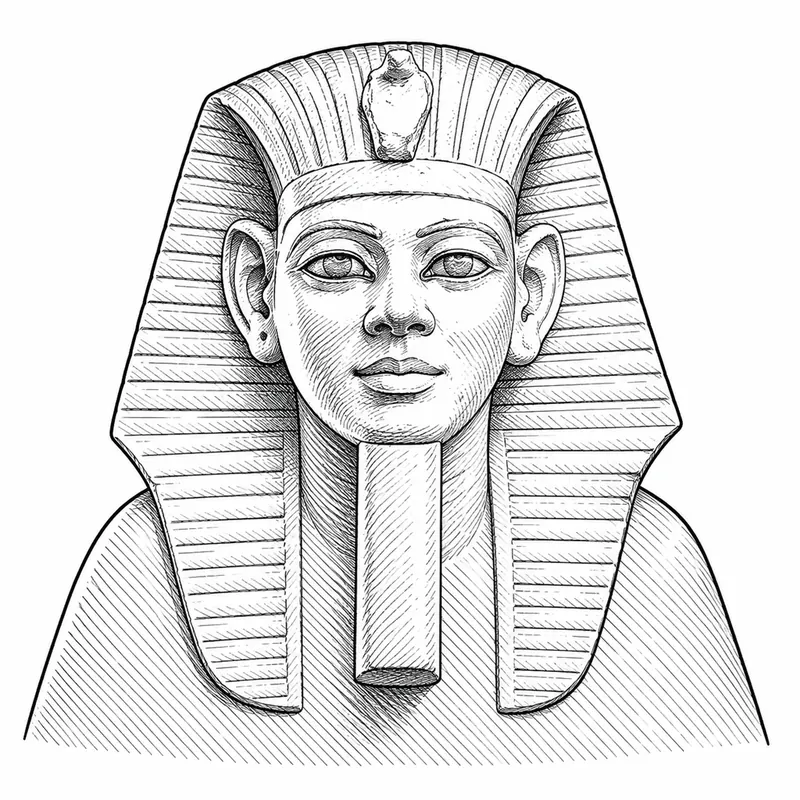
An accession after a very long reign
Merenptah, Baenre, was a son of Ramses II. He came to the throne after his father’s sixty-six years of rule and reigned approximately from 1213 to 1203 BC. The probable advanced age of the new king and the large number of Ramses II’s descendants make the succession interesting, although not all its stages are known. Merenptah inherited a vast administrative apparatus, sanctuaries and external relations that were already established. His reign is documented by military inscriptions, stelae in Egypt and Nubia, a palace at Memphis and his Theban tomb. These sources show a ruler faced with new conflicts, but one who also sought to set his action within the continuity of the dynasty.
The war against the Libyans
A great inscription at Karnak recounts Merenptah’s confrontation with a coalition led from the west, often called the Libyan war. The text describes the enemy, the battle, the prisoners and the rewards. It allows us to study the court’s concerns in the face of population movements and conflicts on the western frontier. The figures and victory scenes must be read as royal proclamations: they are not independent statistics. The conflict nevertheless shows that power could not live solely on the successes inherited from Ramses II. Merenptah had to mobilise troops and assert his ability to protect the country. The Nubian inscriptions also take up this message of security and authority.
The so-called Israel Stela
A victory stela attributed to Merenptah mentions, among other peoples or regions of the Levant, a group named Israel. It is the oldest generally recognised Egyptian attestation of this name. The formula appears in a triumphal text, not in a detailed chronicle of Levantine society. It proves neither the existence of an organised state in the form known later nor the truth of other narratives without independent examination. Its value is to place a name in a geographical and political context of the late 13th century BC. The determinative used by the scribe is an important element of the interpretation. The stela is thus of interest for Egyptian history and for that of the Levant, within precise limits.
Memphis and the sanctuaries
UCL Digital Egypt records a palace of Merenptah at Memphis, building works at Abydos and monuments at Pi-Ramesse. These traces are a reminder that the king’s action was not limited to his wars. A palace indicates a place of residence or administration; the temples express relations between the court and the cults; Pi-Ramesse remained a centre linked to the dynasty. The remains must be distinguished from the blocks moved to Tanis or reused elsewhere. The history of a building project is reconstructed from its provenance, technique and inscriptions. The whole shows a state able to maintain several centres, even if the exact scale of Merenptah’s works is smaller than that of the previous reign.
The texts from Nubia
Four stelae with closely similar texts are known at Amada, Amara West, Wadi es-Sebua and Aksha. Their spread in Nubia shows the will to make the royal message known in a strategic region. The repetition of a text does not prove that each place experienced the same military events; rather, it shows a programme of communication. The inscriptions serve to inscribe Merenptah’s name in temples and territories inherited from earlier conquests. They also give an insight into how the court shared a single official version on several media. Comparing them allows the variants to be noted and the workings of the engraving workshops to be better understood.
Tomb KV8 and the end of the reign
Merenptah was buried in tomb KV8 in the Valley of the Kings. His burial continues Ramesside funerary practice and allows the representation of the king after death to be distinguished from his victory inscriptions. After his reign, the 19th Dynasty entered a complex succession involving Amenmesse, Seti II, Siptah and Tawosret. The exact place of some rulers remains debated. We should therefore avoid presenting this transition as a simple, unanimously dated sequence. The monuments of Merenptah provide a relatively solid anchor before this phase. They make it possible to compare the names, building projects and places of power that his successors would seek to control.
A reign of defence and transmission
The reign of Merenptah reveals what it meant to succeed a very famous king. He kept the centres of the dynasty, responded to a western threat, claimed a victory in the Levant and spread his texts as far as Nubia. The stela mentioning Israel must be explained for its exact value, without turning the reign into a mere footnote to another history. The Karnak inscriptions and the palaces show a ruler engaged in choices of his own. His legacy also lies in the succession crisis that followed: his monuments became landmarks for understanding the order of the kings. The quality of the account depends on a critical reading of the victory proclamations.
Main sources
- UCL Digital Egypt, Merenptah and his monuments
- UCL Digital Egypt, the kings of the New Kingdom
- UCL Digital Egypt, index of sites and the so-called Israel Stela
- Model for the line portrait: inscribed shabti of Merenptah, Metropolitan Museum of Art, 26.7.1451.
Reference works
- Ian Shaw (ed.), The Oxford History of Ancient Egypt, Oxford, Oxford University Press, 2000, chronology pp. 479–483
- Aidan Dodson and Dyan Hilton, The Complete Royal Families of Ancient Egypt, London, Thames & Hudson, 2004