In brief
Heliopolis, called Iunu by the ancient Egyptians, gave its Arabic name, Ain Shams, ‘the eye of the sun’, to a district of Cairo. The ancient city now lies buried beneath the districts of Ain Shams, Matariya and Tell el-Hisn. Its great temple was dedicated to the sun god, and Ra-Atum was associated there with one of the Egyptian theories of creation. The sanctuary received the attention of kings for more than two thousand four hundred years, from the pharaonic era to the Ptolemaic and Roman periods.
What you discover
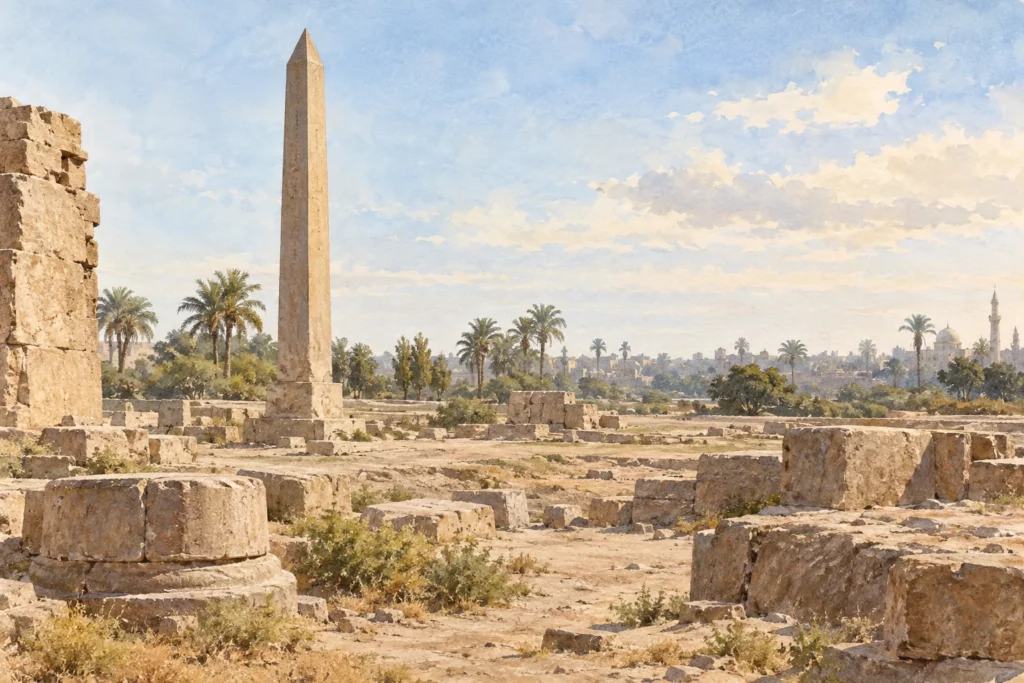
The first landmark is the obelisk of Senusret I, a king of the 12th Dynasty, still standing in the middle of an open-air museum. It is 20.41 metres high and was erected for the king’s sed festival, probably with a second obelisk and at the same time as a temple of Ra-Horakhty. Around it, the landscape is that of a dense city: recent houses and the open trenches of the Egyptian-German mission, which works among dwellings built more and more on the very footprint of the temple. Of the ancient city and its sanctuaries, few elements remain in place.
What to look at
The most telling detail is the ground level. The present ground surface lies about 3.3 metres above the surviving base of the obelisk: the monument seems to stand at the bottom of a hollow, because the deposits of the Nile and the layers left by human occupation have raised the whole area. This difference in level sums up the difficulty of the site, where the ancient remains are buried under metres of sediment and beneath a high water table.
The colour of the stone also deserves attention. Among the blocks uncovered are pieces of quartzite, quarried at Gebel el-Ahmar, about 8.4 kilometres to the south-east. This stone, whose shades range from gold to red and brown, recalls the colours of the sky at sunrise; that is what explains its association with the solar cult.
Its history
Heliopolis was one of the great religious centres of Egypt, but its material history is above all one of dismantling. For about a thousand years the temple served as a quarry for neighbouring Cairo, and from the Ptolemaic and Roman periods onwards monuments were taken to Alexandria and Rome. A column of Merenptah, found dismantled, is now on display in the Grand Egyptian Museum. Since 2012 the Egyptian-German mission has found, among other things, sphinxes of Amenemhat III and elements dating from the Middle Kingdom to the Ptolemaic period, some of which are to be shown in local museums.
Much remains uncertain. The exact location of the sun temple has not been demonstrated: the position of the obelisk inside the great mudbrick enclosure suggests it, without proving it. The date of this enclosure is debated, with proposals ranging from the first dynasties to the 30th Dynasty. Even the original god is discussed: during the Old Kingdom, the site seems more closely linked to Atum and the Ennead than to Ra, whose explicit link with Heliopolis appears only at the turn of the 5th and 6th Dynasties.
Sources
Consulted on 30 September 2026: Ayn Shams City, Egyptian Ministry of Tourism and Antiquities; Massimiliano Nuzzolo and Jaromír Krejčí, ‘Heliopolis and the Solar Cult in the Third Millennium BC’, Ägypten und Levante 27, 2017; Heliopolis, German Archaeological Institute (DAI).