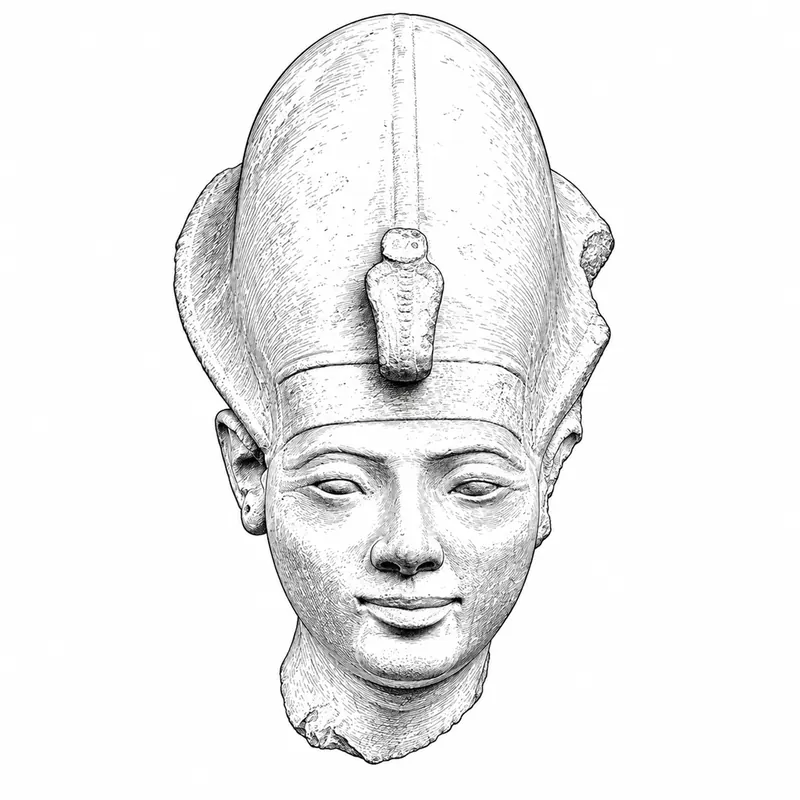
A chronological position still debated
Amenmesse, Menmire Setepenre, reigned at the end of the 19th Dynasty, after Merenptah according to several reconstructions. UCL Digital Egypt stresses that his exact place in the succession remains an open question. The dates proposed, around 1203–1200 BC, are landmarks and not a certain calendar. The relationship with Seti II, Tawosret and Siptah has produced varied hypotheses: overlapping dates, regional powers or a clash between claimants. The surviving inscriptions do not allow all these scenarios to be settled. The history of Amenmesse must therefore be built from his attested monuments and later alterations, without turning an appealing interpretation into a fixed narrative.
The monuments bearing his name
The name of Amenmesse appears at Karnak, in the small temple at Medinet Habu, in a chapel at Deir el-Medina and on a stela found at Buhen in Nubia. A faience vessel discovered at Riqqeh also bears his titulary. This map of attestations shows that his kingship was proclaimed on several types of media, from the sanctuary to the portable object. It does not automatically give the boundaries of his power: objects can travel and buildings can be reused. The context of each find is therefore decisive. Their convergence is nevertheless enough to establish that Amenmesse was not a name invented by a later list. He exercised a visible kingship in the usual forms.
Thebes and the question of a regional power
Several important attestations lie at Thebes and in its region. This concentration has led to the proposal that Amenmesse controlled mainly the south, while another ruler was recognised elsewhere. The hypothesis deserves examination, but it cannot be turned into a certainty solely on the basis of the number of surviving objects. Archaeological losses and the movement of materials alter our map. At Karnak, each cartouche must be studied in its phase of carving; at Deir el-Medina, the inscriptions of the craftsmen may tell us which regnal years were recognised locally. The geography of power at the end of the 19th Dynasty is reconstructed by cross-checking, not from a single find.
Buhen and the Nubian horizon
The stela of Amenmesse found at Buhen shows that his name was inscribed in a Nubian centre long linked to the Egyptian administration. It raises an important question: did the official network of the south recognise his authority, and for how long? The presence of a monument allows us to affirm a recognition or an act of commemoration at a given moment; it does not tell the whole story of local organisation. The structures inherited from earlier reigns could go on functioning during contested successions. The stela is therefore a political witness, but also a clue to institutional continuity. Its text, date and context must be examined before inferring stable rule over Nubia.
Tomb KV10
Amenmesse is associated with tomb KV10 in the Valley of the Kings. Like other burials of the late 19th Dynasty, it underwent alterations and reuse. The tomb attests a royal funerary ambition, even if not all the planned work was perhaps completed under him. The alterations to the decoration and the names of other people who may have appeared there require the phases to be separated. A tomb does not on its own resolve the question of the order of the reigns; rather, it provides clues to projects of legitimation and to the later history of the monument. Comparison with KV15 of Seti II and KV14 of Tawosret helps to understand a funerary landscape marked by reuse.
A contested memory
The changes of names on the monuments of this period reveal a competition for official remembrance. When a cartouche is erased or replaced, the intervention must be dated and it must be checked whether it concerns the whole building. The relative disappearance of Amenmesse from some royal sequences does not prove that he never reigned. It may reflect the choices of successors, the fragmentary state of the lists or the limited authority of certain reigns. The work of Kitchen, Krauss and other specialists has proposed different readings of these clues. The sources yield points of agreement and open questions, without guaranteeing a genealogy.
Why uncertainty is part of the subject
The case of Amenmesse helps us understand how Egyptologists study a contested succession. The monuments of Karnak, Medinet Habu, Buhen and KV10 prove his existence and his royal claims. Their distribution feeds hypotheses about the extent of his power, but does not close them. Absolute dates depend on a wider reconstruction of the end of the 19th Dynasty. Setting out these levels of evidence clearly makes the reign more intelligible than a romantic story of civil war without sources. Amenmesse becomes a concrete case for examining the relationship between inscriptions, geography and official memory, at a time when the Ramesside state was changing hands.
Main sources
- UCL Digital Egypt, Amenmesse and his attestations
- UCL Digital Egypt, Seti II and the succession debates
- UCL Digital Egypt, Tawosret and the end of the 19th Dynasty
- Model for the line portrait: royal head 34.2.2, Metropolitan Museum.
Reference works
- Ian Shaw (ed.), The Oxford History of Ancient Egypt, Oxford, Oxford University Press, 2000, chronology pp. 479–483
- Aidan Dodson and Dyan Hilton, The Complete Royal Families of Ancient Egypt, London, Thames & Hudson, 2004