In brief
Tanis, ancient Djanet, is today called Tell San el-Hagar. The site lies in the north-east of the Delta, about 120 kilometres north-east of Cairo, on the former course of the Pelusiac branch of the Nile. Founded around the 11th century BC, the town became the capital of the kings of the 21st Dynasty and the burial place of sovereigns of the 21st and 22nd Dynasties. It was conceived as a ‘Thebes of the North’, with its sanctuaries of Amun, Mut and Khonsu.
What you discover
The landscape surprises first by its look of an overturned building site. In the northern part of the tell, inside a vast mud-brick enclosure, lie sections of obelisks, colossi, columns, stelae and blocks, almost all of granite or quartzite. This impression of a town made entirely of hard stone is misleading: since late Antiquity, the limestone of the temples has been carried off and burnt in lime kilns, so that only the most resistant materials have stayed in place. The ancient settlement covered more than 200 hectares, and the organisation of its urban fabric is still being researched.
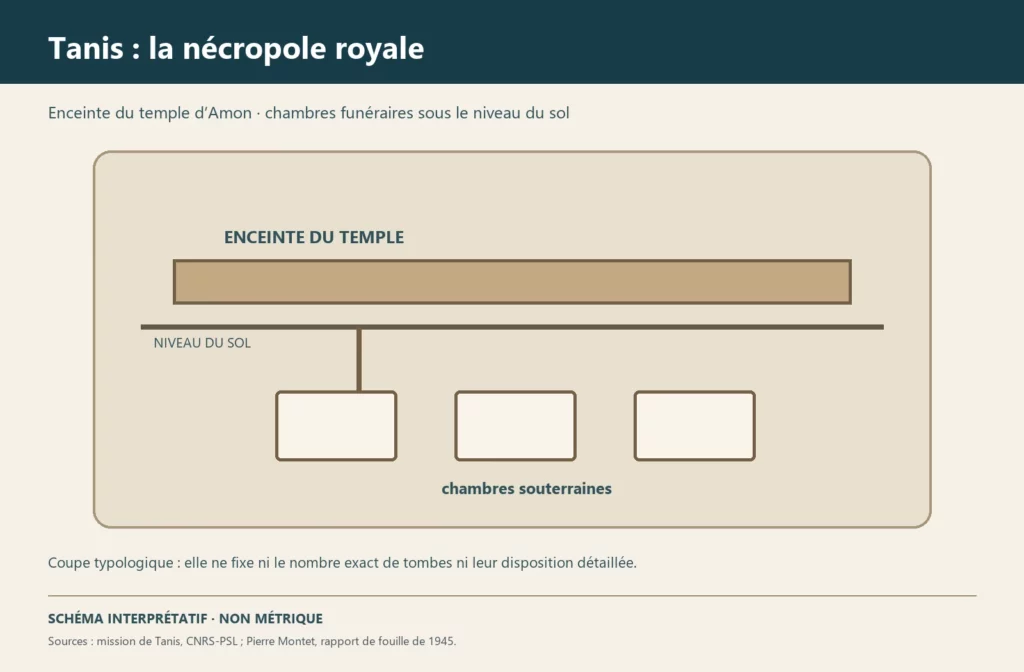
South-west of the first pylon of the great temple, within the enclosure itself, open the vaults of the royal necropolis. The kings of Tanis thus had themselves buried at the heart of the sacred domain of their town, not in a desert necropolis like the Valley of the Kings at Thebes.
What to look at
Two details sum up the site. The first concerns the inscriptions: many blocks and statues bear the name of Ramses II (Ramesses II), although this king did not build at Tanis. These pieces come from Pi-Ramses, the former Ramesside residence some twenty kilometres away, abandoned when the Pelusiac branch shifted and then exploited as a quarry. A carved name therefore tells us who had the piece sculpted, not who set it up here.
The second detail is more discreet: some bricks of the great enclosure wall bear, stamped, the cartouche of Psusennes I. These marks make it possible to link the enclosure to the 21st Dynasty, at the very moment when the new capital was taking shape. The Great Sphinx of pink granite kept in the Louvre, found at Tanis and acquired in 1826, illustrates the same phenomenon on the scale of a single work: carved much earlier, it was reinscribed by several kings, including Merneptah and Shoshenq I.
Its history
The town had several lives. After the temples of the Third Intermediate Period, the sanctuaries were remodelled in the Late Period, when a sacred lake was built with many reused blocks, then a temple of Horus of Mesen was raised under the first Ptolemies. Visited by the French expedition to Egypt in 1798, Tanis was cleared by Auguste Mariette in 1860–1864, then explored by William Flinders Petrie in 1884. It was the French mission of Pierre Montet, active from 1929, that uncovered between 1939 and 1946 the royal and princely tombs, including that of Psusennes I, found intact. Because these discoveries coincided with the beginning of the Second World War, they long remained less well known than that of Tutankhamun.
Much remains uncertain. The attribution of some burials is still debated, and the date of a wall cannot be deduced from the name carved on one of its blocks. The French Mission for the Excavation of Tanis is continuing the study of the town, its temples and its tombs.
Sources
Consulted on 30 September 2026: Tanis (Tell San el-Hagar), Institut français d’archéologie orientale (IFAO, French Institute for Oriental Archaeology) (in French); Tanis, a major city in the history of Egypt, École pratique des hautes études (in French); Sphinx of Tanis (A 23), Musée du Louvre.