In brief
The temple of el-Derr, or Derr, is a rock-cut temple of Ramses II. Its ancient name, according to the Egyptian Ministry of Tourism and Antiquities, was ‘the temple of Ramses beloved of Amun in the domain of Ra’. Dismantled in 1964, it now stands at New Amada, about 160 km south of Aswan, near the temple of Amada.
What you discover
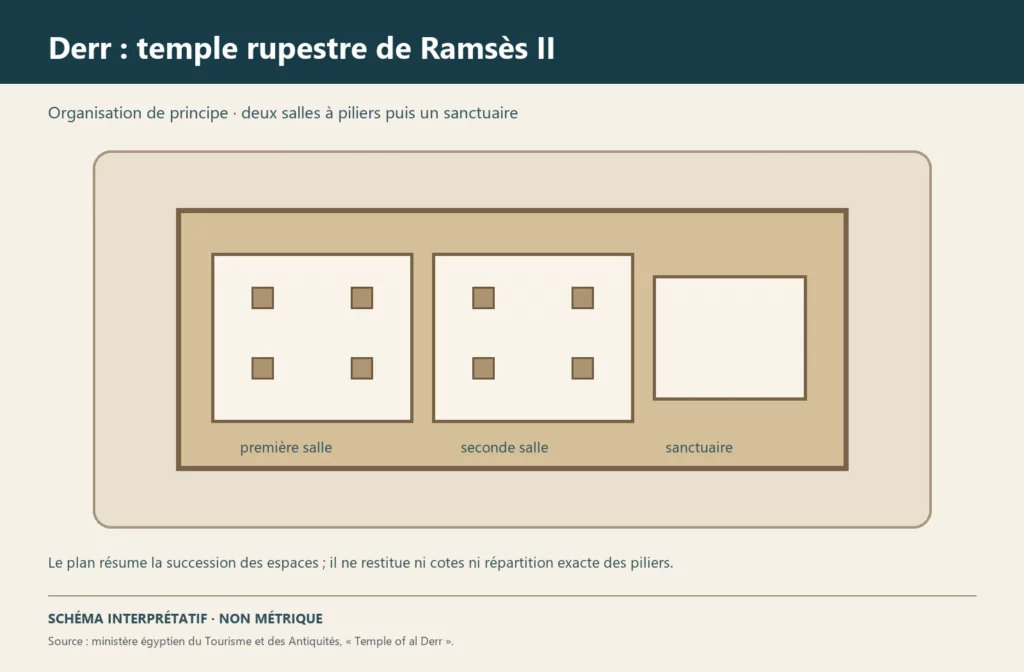
The plan comprises two successive pillared halls leading to a sanctuary. At the back, four figures cut from the rock represent Ptah, Ra-Horakhty, the deified Ramses II and Amun-Ra. This arrangement recalls that of the great temple of Abu Simbel, on a more modest scale.
The site of New Amada groups three rescued monuments: the temple of Amada, the temple of Derr and the tomb of Pennut. Amada, built by Thutmose III and Amenhotep II in the 15th century BC, belongs to the 18th Dynasty; Derr dates from Ramses II, in the 13th century BC. Their present proximity is the result of the modern rescue: the monuments were dismantled and rebuilt a few kilometres from their original locations.
What to look at
The clearest detail is colour. According to the Egyptian ministry, the reliefs of the second pillared hall have kept remarkably vivid colours. They deserve a close look: they give an idea of what the polychromy of Ramesside temples might have been, most of whose monuments now keep only bare stone.
Note also the distribution of themes. The first hall shows scenes of the king’s military campaigns; most of the other reliefs show Ramses II performing rites before the gods. This good preservation concerns the surfaces of that hall, not necessarily the whole temple.
Its history
The temple was later turned into a church, like several sanctuaries in Nubia. This reuse is a useful reminder: the present state of a monument is the product of centuries of use, and not only of its builders’ project.
The move of 1964 saved the decoration, but it broke the link with the original cliff, on the right bank of the river. The temple was carried to the other side of the Nile to escape submersion caused by the Aswan High Dam. The four figures of the sanctuary express the deified status of the king without making the temple a tomb. A war scene or a royal name is not enough to fix each phase of decoration, and the sources consulted do not specify the internal chronology of the work.
Sources
Consulted on 30 September 2026: Temple of al-Derr, Egyptian Ministry of Tourism and Antiquities; Amada temples, Egyptian Ministry of Tourism and Antiquities; Nubian Monuments from Abu Simbel to Philae, UNESCO.