In brief
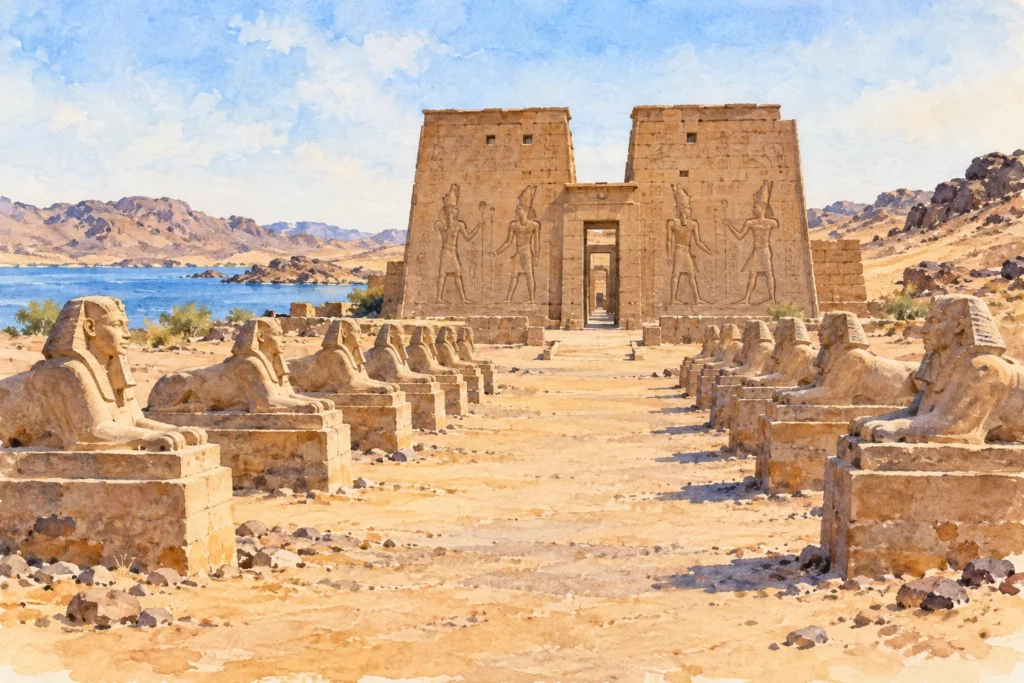
At Wadi es-Sebua, Ramses II had a temple built dedicated to Amun-Ra and Ra-Horakhty. It now stands at New Wadi es-Sebua, 4 km north-west of its original location, on the west bank of the Nile in Lower Nubia. Its move resulted from the building of the Aswan High Dam, in the 1960s, which threatened to cover it with water.
What you discover
The temple was preceded by an avenue of sphinxes, hence the Arabic name of the place, and combined a built front part with rooms cut into the rock. This combination of a façade in blocks and a rock-cut sanctuary characterises several Nubian temples of the reign. The sphinxes are not mere decoration: they organise the approach to the sanctuary, in stages, from the open space to the inner rooms.
The present site brings together three monuments of different periods, as UNESCO recalls when describing the grouping of the temple of Ramses II with those of Dakka and Maharraqa. According to the Egyptian ministry, the temple of Dakka, of the Graeco-Roman period, is dedicated to Thoth, and that of Maharraqa, of the Roman period, to the couple formed by Isis and Serapis. Within a few dozen metres, the visitor thus passes from the New Kingdom to the Roman period.
What to look at
The most telling detail is the position of the three temples in relation to one another. In Antiquity they were not neighbours in this way: their present proximity is the result of the rescue, which gathered on the same height monuments scattered along the river. The visitor should therefore look at the setting of the temple of Ramses II as that of a relocated building, without trying to read in it the original cult geography.
Note also the transition between the built front part and the rear part cut into the cliff. The dismantled and rebuilt blocks, like the cut-out sections, belong to the same rescue work, but the surfaces are not read in the same way: some are courses of a wall, others walls of rock.
Its history
The temple is part of the network of sanctuaries that the king had established in Nubia to combine the cult of the gods of the state with that of the sovereign. Each nevertheless answered a local situation, and the idea of a single model of a Nubian temple of Ramses would erase these differences. As in other Nubian temples, the rock-cut part was turned into a church in the Christian period, evidence of the long reuse of the place.
The sources consulted do not allow us to say how ceremonies took place in the avenue or what river landscape surrounded the temple: the present site no longer preserves that environment. One must separate what is visible today, what photographs taken before the move show and what is supposed about the vanished surroundings.
Sources
Consulted on 30 September 2026: Temples of Wadi es-Sebua, Egyptian Ministry of Tourism and Antiquities; Nubian Monuments from Abu Simbel to Philae, UNESCO; Safeguarding the monuments of Nubia, UNESCO.