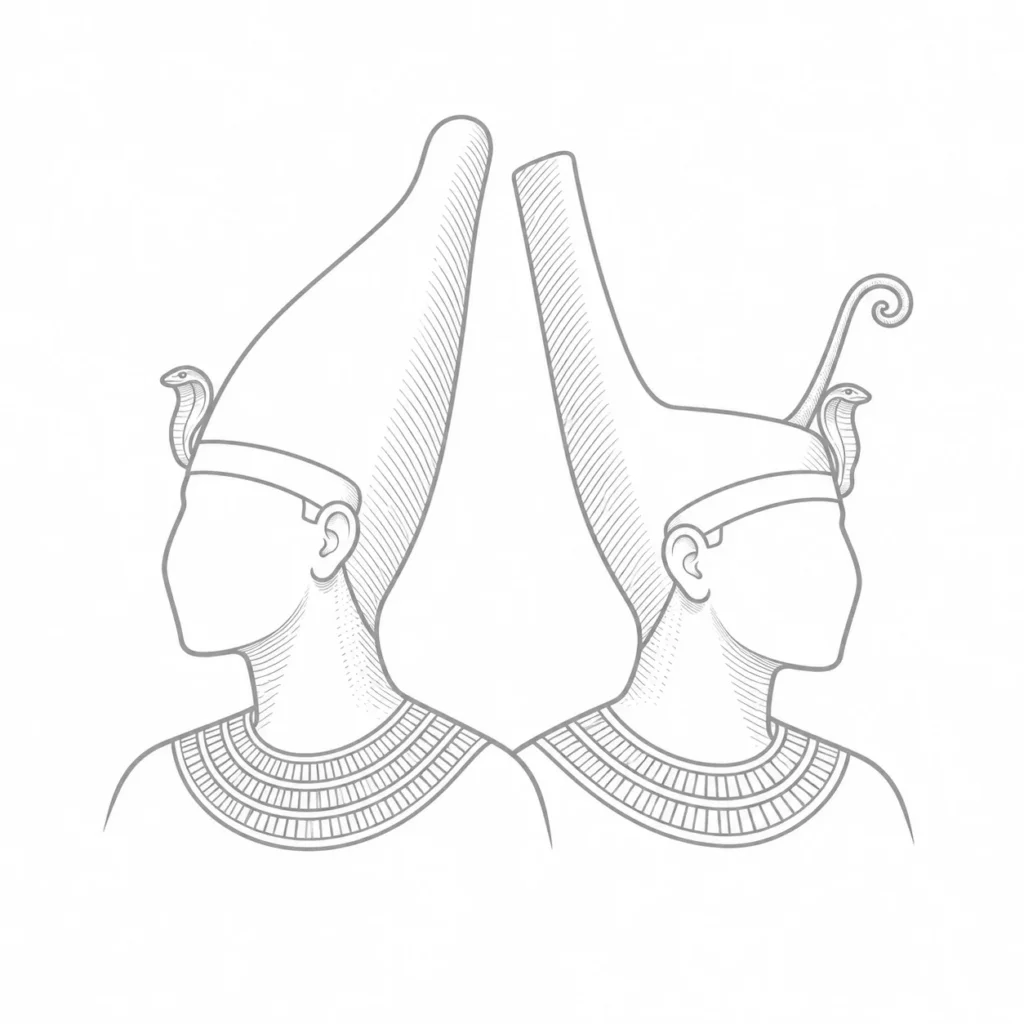
A king of Thebes in a divided Egypt
Neferhotep III reigned at Thebes during the Second Intermediate Period, at a time when Egypt was divided between several powers. In the north, the Hyksos of Avaris dominated the Delta and extended their influence. In the south, the Theban kings controlled only part of Upper Egypt. His full name, Sekhemre Seankhtawy Neferhotep Iykhernefert, takes up traditional royal formulas. His reign was short, perhaps a single year. He is nevertheless known from an exceptional document, which lets us hear what a Theban king wished to say about himself in a period of crisis. In the chronology of Ian Shaw (Oxford, 2000), his reign falls in the Theban 16th Dynasty, c. 1650–1580 BC (Shaw does not date its kings one by one).
A single major source: the Karnak stela
Most of what is known about Neferhotep III comes from a stela found at Karnak and kept in the Egyptian Museum in Cairo. The monument is badly damaged, and part of the text is missing. What survives is nevertheless remarkable. The king does not celebrate distant conquests there. He presents himself as the protector of a city. This unique source calls for caution: it expresses the king’s official discourse, not a neutral account of events. It remains, however, one of the most direct pieces of evidence for the situation of Thebes at this time.
‘My city’: Thebes at the centre
On his stela, Neferhotep III calls Thebes ‘my city’ and describes himself as ‘guide of victorious Thebes’. These formulas are unusual. Egyptian kings normally presented themselves as masters of the Two Lands, that is, of the whole of Egypt. Here the ruler puts forward a single city. Many Egyptologists see in this a sign that his authority hardly extended beyond the Theban region. The king remained pharaoh through his titles and rites, but his political horizon narrowed around the city that would become, a few generations later, the starting point for the reconquest of the country.
Famine and war
The stela also refers to concrete difficulties. The king describes himself as the one who feeds his city and saves it from famine. He claims to have raised it up when it had been laid low by struggles against foreigners. These foreigners are often identified with the Hyksos or their allies, but the text does not name them precisely. The famine may refer to poor Nile floods or to the consequences of the conflicts. These formulas belong to the royal vocabulary, which presents the king as a saviour, but they hint at a genuinely difficult period for the Theban region.
The 16th Dynasty, a debated construction
The place of Neferhotep III among the dynasties is not unanimously agreed. Kim Ryholt has proposed recognising a Theban 16th Dynasty, distinct from the 17th, on the basis of the Turin royal papyrus. Neferhotep III appears there among the first kings. Other researchers, such as Jürgen von Beckerath, placed him rather at the end of the 13th Dynasty. Several specialists also consider the evidence for a break between the 16th and 17th Dynasties insufficient. Visite Égypte follows Ryholt’s division here, while pointing out that the debate remains open.
A new crown
The stela of Neferhotep III also draws attention for an iconographic detail. It is among the oldest known mentions of the khepresh crown, often called the ‘blue crown’. This headdress would become very common in the New Kingdom, particularly in representations of kings at war or in majesty, such as those of Amenhotep III or Ramses II. Its presence on a Theban stela of this period shows that certain forms of New Kingdom kingship originated in the Theban milieu of the Second Intermediate Period.
What this reign reveals
Neferhotep III left only one important monument, and his place in the chronology is debated. His interest lies in what he says about Thebes. His stela shows a kingship reduced to a region, faced with hunger and war, but still asserting its legitimacy. It foreshadows the political identity that would later carry the kings of the 17th Dynasty, such as Seqenenre Tao and Kamose, in their struggle against the Hyksos. His reign is a reminder that the reconquest of Egypt was born in a city that first had to survive.
Main sources
- Alexander Ilin-Tomich, ‘Second Intermediate Period’, UCLA Encyclopedia of Egyptology, 2016
- UCL Digital Egypt, chronology of the Egyptian kings
- Crowns drawn from the statue of Senusret I and the relief of Ahmose, Metropolitan Museum of Art.
Reference works
- Ian Shaw (ed.), The Oxford History of Ancient Egypt, Oxford, Oxford University Press, 2000, chronology pp. 479–483
- Aidan Dodson and Dyan Hilton, The Complete Royal Families of Ancient Egypt, London, Thames & Hudson, 2004